
Safe online pokies Australia 2026: what offshore safety claims are actually worth
Online pokies cannot be lawfully offered to a person in Australia. Every offshore casino that markets itself as “safe” or “Australian-friendly” is offering a service the Interactive Gambling Act 2001 prohibits, and any licence it displays is a licence to operate somewhere else, not here. That single fact is the floor of every other check on this page, because the protections an Australian player is looking for — a local complaints body, a withdrawal that cannot be silently blocked, a self-exclusion register that actually fires — are not part of the product being sold.

Data current as of 7 November 2026, checked against the Australian Communications and Media Authority’s formal warning register and the regulator’s published blocking list.
Table of Contents
- How to read an offshore pokies site when the law already says no
- The ACMA record: what regulators actually do about offshore pokies
- Player protection that is Australian, and what offshore sites cannot offer
- Offshore brands the ACMA has acted against
- The mechanics behind the warnings: how the ACMA’s process works
- Pokies specifically: what makes the safety question different
- What the offshore sites’ marketing is actually selling
- How to think about a withdrawal that has gone quiet
- The 2026 reform picture
- Tax, winnings and the conversation the offshore site will not have
- What a sensible reader does with this page
- The shelf of marketing claims, and what each one is worth
- Where to read further, and where not to
- FAQ
How to read an offshore pokies site when the law already says no
A punter who lands on an offshore pokies page is being asked to trust a counterparty that operates outside Australian law, outside Australian dispute resolution and outside Australian payment rules. The site’s own marketing is the only assurance on offer, and that assurance is the thing to be tested, not taken at face value.

What an offshore safety claim is, mechanically, is a set of words on a webpage: “licensed”, “SSL”, “provably fair”, “responsible gambling tools”. Each of those words refers to something real somewhere, but here they refer to nothing an Australian can compel. The licence is held with a regulator that does not take calls from the Australian Competition and Consumer Commission. The SSL padlock means only that traffic is encrypted, not that the operator will pay out. “Provably fair” is a cryptographic check on a result the player has already seen. “Responsible gambling tools” describe a deposit limit the player can set themselves with the same operator that wants the deposit.
The site knows this. The site’s whole pitch is that the player does not.
What follows on this page is a way to read those claims — what each one is, what it costs the player to believe it, and where the line falls between a marketing word and a protection the player can actually use.
The licence the site shows you is not a licence from here
Offshore pokies sites almost always display a Curaçao, Anjouan or Kahnawake licence at the foot of the page. Those licences exist and they are issued by real regulators, but none of them covers an Australian player. A Curaçao licence permits the operator to take bets from countries that do not prohibit the activity; Australia prohibits it.
The Northern Territory Racing and Wagering Commission (NTRWC) is the body that licenses online bookmakers for Australian play — Sportsbet, Bet365, Ladbrokes among them, licensed in the Territory for tax reasons and meeting once a month in Darwin with no full-time staff of its own. The NTRWC’s wagering licences cover racing and sports wagering before the event. They do not cover online casino games, online pokies or in-play betting. No state or territory issues such a licence. Anyone claiming one is either confused or lying.
So when an offshore site answers the question “are you licensed?” it is telling the truth, and the truth is “yes, somewhere that does not include Australia”. The risk to the player is not that the licence is fake. It is that the licence is real, that it has no jurisdiction over the player’s complaint, and that the marketing word “licensed” is doing the job of a protection that does not exist.
What “provably fair” actually verifies
The phrase “provably fair” comes up on most offshore pokies sites. It refers to a scheme in which the player can, after a spin, run a hash check that confirms the result was not altered after the bet was placed. The scheme is sound cryptography. It is also not what the player is hoping it is.
A provably fair check confirms that the result you saw is the result the server produced at the time. It does not confirm that the underlying game returns what it claims to return over thousands of spins, that the operator will pay out a win that has been verified, or that the operator will still be in business next week. The maths protects the spin. It does not protect the bank.
The bet stays the same: the player trusts the operator with the payout, not the random number generator. A reader who is reassured by “provably fair” should weigh that reassurance against the absence of an Australian complaints body and the absence of a credit-card or PayID ban that the operator is subject to. A cryptographic proof on a spin does not reach either of those gaps.
Deposit limits on a site that has no Australian payment rules
A licensed Australian wagering provider takes debit cards, bank transfers, PayID, Osko and BPAY, and is forbidden from accepting credit cards, credit-related products or digital currency. A site taking a credit card or a crypto deposit from an Australian player is not bound by any of those rules.
That is not a minor point. The credit-card ban exists because evidence showed credit-funded gambling correlated with heavier losses and worse harm outcomes; the rule was put in place by the same parliament that wrote the Interactive Gambling Act. An offshore operator that happily takes a Visa or a Tether deposit is operating in deliberate disregard of that finding, and the deposit limit it offers inside the account is a setting on a product the operator could have refused to sell in the first place.
For a reader, the practical question is whether the deposit limit is a ceiling set by the regulator or a slider set by the player. The first caps losses; the second is a New Year’s resolution. On an Australian-licensed wagering site the ceiling is statutory. On an offshore pokies site the slider is a feature.
The ACMA record: what regulators actually do about offshore pokies
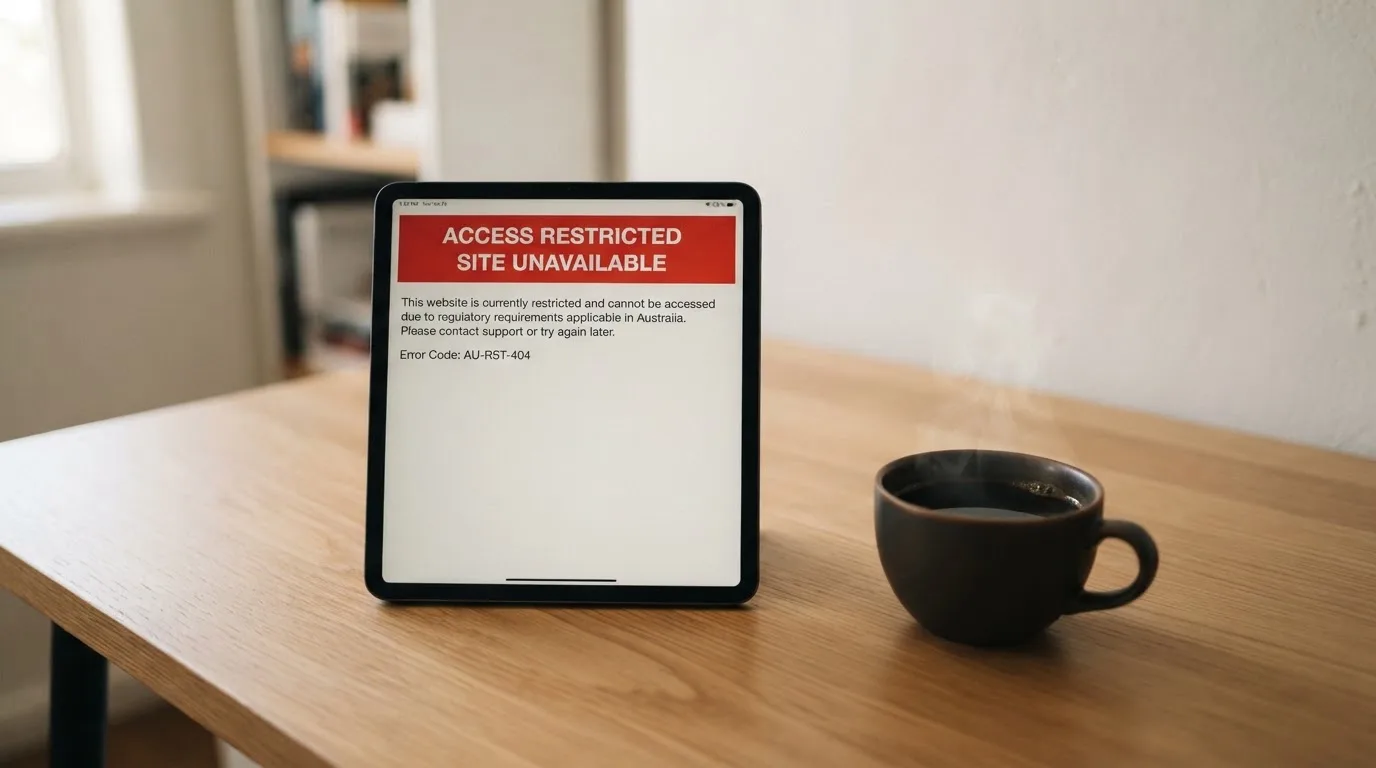
The Australian Communications and Media Authority enforces the Interactive Gambling Act 2001. It investigates complaints, issues formal warnings to operators, and directs Australian internet service providers to block sites that keep offering prohibited services.
The pattern is informative. A formal warning is not a one-line press release; it is a notice that names the operator behind the brand and the section of the Act the operator is breaching. Where the warning is ignored, the next step is a blocking instruction to ISPs, after which the site goes dark for Australian users. The sequence — warn, then block — is what the ACMA has used against every brand reviewed later on this page.
What the record tells a reader is not that the ACMA has a particular grudge against any one brand. The record shows a regulator working through a list of operators that have each, separately, decided to keep offering a service that is unlawful for Australians. The regulator’s response is mechanical and predictable. The operator’s decision to keep going, after a warning, is the actual story.
Blocking rate since the first request in November 2019
The ACMA’s first blocking instruction to Australian ISPs went out in November 2019. As of June 2026, the regulator had asked ISPs to block 1,751 illegal gambling and affiliate websites in total, and more than 230 unlicensed services had left the Australian market since enforcement was strengthened in 2017.
That is the rate at which the regulator’s machinery processes the industry’s output. Pick a window — a year, a quarter — and the numbers stack up the same way: a list of new domains the ACMA has identified, a list of warnings to named operators, a list of blocks. The June 2026 round alone added 12 sites: 7Signs, ChromaBet, Donbet, Duospin, Freshbet, Slots Gem, Jacks Club, Lucky Start, Pointsbetz, Spinrise, Vinyl Casino and Wildsino. Each one had been offering prohibited services to Australians. The pipeline does not empty; it refills.
Working the rate forward from the first blocking request in November 2019 to the 1,751 total reported in June 2026 gives a range of roughly 250 to 280 sites blocked per year on average, with the higher end in the years after the 2017 amendments landed and the regulator’s enforcement budget grew. The exact figure shifts round by round, and the ACMA’s own reporting is the place to look for an updated tally. What the rate tells the reader is that the operator pipeline is continuous and the regulator is responding to it continuously.
Why the legal channels share keeps shrinking
H2 Gambling Capital’s 2025 report estimates that Australians lose about A$3.9 billion a year to illegal gambling sites. The same report tracks the share of gambling going through legal channels falling from 74% in 2021 to 64%. The trend is the wrong way for the regulator and the right way for the offshore marketing budget.
The reason matters. A player does not migrate to an offshore site because the local TAB or Sportsbet rejected them. The migration happens because the offshore site is one click away, accepts a deposit method the Australian rules ban, and is advertised as “safe” with no Australian authority behind the word. The legal-channel decline is a marketing problem dressed as a consumer choice.
The IGA does not prosecute the player. It targets the provider. So the choice sits with the punter, and the punter’s choice costs the legal channels share of every dollar they redirect offshore. The A$3.9 billion is the price tag on the migration, and it is paid by Australian households.
Player protection that is Australian, and what offshore sites cannot offer
Player protection in this market means a set of tools that work whether the operator likes them or not: a self-exclusion register that all licensed Australian wagering services are connected to, a credit-card ban that closes off the worst funding channel, a complaints body that can compel a payout, and a helpline that is free and confidential.
Each of those exists for the licensed wagering side of the market. None of it reaches the offshore pokies side. The distinction is the point of the whole regulatory architecture, and it is the answer to the reader who asks why the Australian rules seem so heavy when “everyone just uses an offshore site anyway”.
BetStop covers licensed wagering, not offshore casinos
BetStop — the National Self-Exclusion Register — went live in August 2023. It binds every Australian-licensed online and phone wagering service, which is to say the racing and sports bookmakers the NTRWC licenses. A punter who registers with BetStop is excluded from placing a wager with any of those providers, for the period they nominate, and the providers are required to enforce it.
An offshore pokies site is not connected to BetStop. It does not have to check the register, and it does not have to honour an exclusion. The exclusion works against the licensed bookmakers the punter can no longer reach. It does not work against the offshore site the punter can still open. For a reader who is using BetStop as part of getting gambling under control, the offshore site is the obvious hole the exclusion leaves open.
The credit-card and crypto ban, and what it says about an offshore site that accepts either
Since 11 June 2024, Australian-licensed wagering services have been forbidden from accepting credit cards, credit-related products and digital currency as payment. The penalty for breaking the rule is up to $247,500 per operator. The rule was put in place because the evidence base tied credit-funded gambling to higher losses.
An offshore pokies site that accepts a credit card or a Tether deposit from an Australian player is breaking the spirit of the rule the operator is not bound by. The reader who sees a credit-card logo on the checkout page is seeing, in one image, the gap between the Australian consumer-protection framework and the offshore operator’s own standards. The logo is not a feature.
Where to get free, confidential support
The National Gambling Helpline is 1800 858 858, free, available 24/7. Web chat is available at Gambling Help Online. The line is for anyone whose gambling has started to cost more than they planned, and for the people around them. The conversation is confidential and the call does not appear on the player’s record.
For a reader who has already started down the offshore road, the helpline is the single piece of the Australian framework that does not depend on the operator’s cooperation. It does not need the site to be licensed, the site to honour a self-exclusion, or the site to pay out a withdrawal. It is the one channel that works on the player’s side regardless of what the offshore operator does.
Offshore brands the ACMA has acted against
Each operator below has been the subject of a formal warning from the ACMA for offering prohibited interactive gambling services to Australians. The warning is the regulator’s notice that the operator is breaching the Interactive Gambling Act 2001 by providing online casino games or online pokies to people in Australia. None of these sites is licensed in any Australian state or territory to offer the product they are offering.
The list is not a ranking. It is the record of operators who, despite a published warning, kept offering the service. Reading down the list, the same pattern repeats with different brand names attached.
Rocketplay
Pulsup Ltd, the operator behind Rocketplay, received a formal warning from the ACMA in March 2026 for offering prohibited interactive gambling services to Australians. The brand had earlier been the subject of a May 2022 warning to Dama N.V. when Dama was the operator behind it. The change of operator did not change the product; the product is what the regulator warned about.
Rocketplay’s marketing positions the brand as a fast, modern pokies site. The product on offer is the same online casino game the regulator told two separate operators to stop offering. For a reader, the conclusion is straightforward: the brand is the most recent label on a service the regulator has now warned twice.
Level Up Casino
Dama N.V. received a formal warning from the ACMA in May 2022 covering six casino brands, one of which was Level Up. The warning named Dama as the operator behind the brand at that date. Dama is one of the more prolific operator names on the regulator’s record; the same company has also been warned over Bambet, Dazard, Rocketplay, Wild Tornado and Cobra Casinos in that 2022 round, and over Woo Casino and Spirit Casino in subsequent rounds.
Level Up’s brand promise is the standard offshore one — a large game library, a tiered loyalty programme, fast withdrawals inside the operator’s own rules. The promise sits on top of a service the ACMA has formally notified the operator is unlawful for Australian players. The reader who lands on the site is being asked to take the operator’s word over the regulator’s notice.
Woo Casino
Dama N.V. received a fresh formal warning from the ACMA in March 2025 over Woo Casino. The 2022 round had already covered the brand under Dama’s umbrella. The 2025 warning is the second time the regulator has had to write to the operator about the same brand.
The reader’s takeaway is not that Dama is particularly bad. Dama is large enough to be on the regulator’s list more than once. The takeaway is that the regulator’s process is sequential — warn, follow up — and the same brand can be warned twice without changing what is being offered to Australians.
Spirit Casino
Dama N.V. received a further formal warning from the ACMA in May 2025 over Spirit Casino. Spirit is a newer label under the same operator; the brand has not been the subject of an earlier round of warnings. The 2025 warning is the regulator’s first formal notice on this particular brand.
The pattern across Spirit and Woo is that the operator offers multiple brands and the regulator’s enforcement addresses the brands one at a time. From the reader’s perspective, a new brand name is not a fresh start; it is the same operator with a different logo.
National Casino
Consolutetish S.R.L. received a formal warning from the ACMA in July 2025 over National Casino. The operator behind the brand is a different corporate entity from Dama N.V., which is the point: the regulator’s enforcement goes operator by operator, and the supply side of the offshore market is large enough that several operators can be in the warning pipeline at once.
National Casino’s marketing emphasises game variety and tournament play. The service the regulator has warned about is the offering of online casino games to Australians — the same product the marketing is selling.
Bizzo Casino
Consolutetish S.R.L. also received a formal warning in July 2025 over Bizzo Casino. Bizzo had already been the subject of a 2022 formal warning issued to TechSolutions (CY) Group Limited and TechSolutions Group N.V. Two different operators have now been told, at different times, that the brand’s offering to Australians is prohibited.
For a reader, Bizzo is the clearest case on this page of a brand that has outlived an operator. The brand kept its name, the operator changed, and the ACMA has had to write to both. The continuity is the brand; the warning has to be repeated because the underlying offering did not change.
Ignition Casino
Bamboo Media received a formal warning from the ACMA in July 2025 over Ignition Casino. Ignition is one of the longer-running offshore brands targeting Australian players, and the warning is the regulator’s first formal notice on this operator-brand pair.
What the reader should notice is the year. The brand has been operating long enough that it has earned its own entry in the regulator’s record. A reader who has used the brand and assumed it was simply part of the offshore landscape should treat the warning as the regulator’s answer to that assumption.
Instant Casino
EOD Code SRL received a formal warning from the ACMA in February 2025 over Instant Casino. The brand’s marketing leans on speed — the word “instant” is doing the work of promising fast payouts and quick account creation. The regulator’s concern is not the speed; it is that the product being sold quickly is a prohibited one.
For a reader, “instant” on an offshore site describes how fast the deposit clears. It does not describe how fast a contested withdrawal is resolved, because there is no Australian body to escalate it to.
Jackbit
Ryker B.V. received a formal warning from the ACMA in April 2026 over Jackbit. The same operator was also warned in the same round over CasinOK. Two brands, one operator, one round of warnings.
The reader’s reading is the same as for Dama and Consolutetish: a single operator carries several brand names, and the regulator’s enforcement addresses the brand names as they appear. From the player’s perspective, the brand names do not insulate the operator from the warning, and they do not give the player any extra recourse.
Casino Intense
Sterplay Holding Ltd received a formal warning from the ACMA in April 2025 over Casino Intense. The brand’s marketing plays on the word “intense” — the implication being that the games, the bonuses and the play are at a higher tempo than competitors. The regulator’s notice is on the offering, not the tempo.
Casino Intense is one of the brands that lists its games with a third-party provider, which is one of the few pieces of structural information an Australian reader can check. The brand’s operators change the marketing; the underlying game providers are slower to change, and the reader can verify which provider the brand is currently listing.
Sky Crown
Hollycorn N.V. received a formal warning from the ACMA over its Sky Crown and Blue Leo casino services, published in September 2022. Sky Crown is the older of the two brands on the warning, and Hollycorn is the operator named on it.
Sky Crown’s pitch to Australian players is a polished casino product with a wide game library and a tiered bonus structure. The product the regulator warned about is the same offering the marketing is selling. Hollycorn has continued to operate; the regulator’s record on Sky Crown is the published warning a reader should check before believing the polish.
The mechanics behind the warnings: how the ACMA’s process works
A formal warning under the Interactive Gambling Act is the first step. It is a published document that names the operator, the brand, the section of the Act being breached and the conduct giving rise to the breach. The warning is published on the ACMA’s website and is searchable by brand name.
Once a warning is issued, the operator has a chance to comply. If the operator keeps offering the prohibited service to Australians, the ACMA can move to the next step: a written instruction to Australian internet service providers to block the relevant domains. The ISP-level block is what actually takes the site offline for Australian users.
The reason the sequence matters to a reader is that a formal warning is not a one-off event. It is the regulator putting the operator on notice, in writing, with a date and an operator name attached. The next time the regulator acts against that operator — for the same brand under a different operator, or for a different brand under the same operator — the warning is on the record. A reader who does a five-minute check on the brand before depositing has access to the same record.
What an Australian can actually do with an ACMA warning
The warning is not a refund and not a payout guarantee. It is a record. A reader who has been told their withdrawal is delayed, or that their account has been closed and the balance forfeit, can take the warning to a complaint they file with the ACMA. The regulator cannot reverse the operator’s decision, but it can investigate, add to the case file and, where the operator keeps offering prohibited services to Australians, move toward a blocking instruction.
The practical effect is cumulative. A single complaint against an offshore site does not move the regulator much. A pattern of complaints, each one tied to the same brand and the same operator, is what builds the case for a block.
Where the offshore operator’s “responsible gambling” tools fail an Australian
Offshore pokies sites almost universally offer deposit limits, time-outs and self-exclusion inside the player’s account. The tools exist; they are real settings on the platform.
The failure is structural. A player who sets a deposit limit on an offshore site has set the limit on a product the operator is offering in breach of the Interactive Gambling Act. The operator has no Australian obligation to honour the limit, and the player’s recourse if the limit is overridden is the same recourse as for any other dispute: an offshore regulator that does not take calls from the ACCC. The deposit limit is a feature on the platform; it is not a protection an Australian can rely on in the way the same setting on a Sportsbet account would be relied on.
For a reader who is using deposit limits as a way to keep gambling in check, the offshore site is the wrong place to set them. The setting works as well as the operator wants it to. The Australian-licensed wagering side, with BetStop behind it, is where the setting is enforced regardless of what the operator wants.
Pokies specifically: what makes the safety question different
Pokies and table games are not the same product, and the safety considerations are not the same. Pokies are designed to be played quickly and continuously, with no decision points between spins. Table games like blackjack and baccarat require decisions, and a player can choose to play fewer hands per hour.
The mechanics matter because the harms are different. A pokies player in a session of an hour will see hundreds of spins, each one paid for and judged. A blackjack player in the same hour will see dozens of hands, with a decision on each. The pace of pokies is part of the product, and the pace is part of why the regulatory framework treats them as a higher-harm product.
The 2020-21 figures and what they actually mean
In 2020-21 Australians bet almost A$150 billion through gaming machines and lost A$12.18 billion on them. Australia has about 3% of the world’s pub and club poker machines and 0.3% of the global population. The figures are from the regulatory data on the legal, land-based machines, which are licensed state by state.
What the figures say is not that Australia is unusual in liking a flutter. The figures say that Australians engage with gaming machines at a rate well above the global average, and that the engagement is concentrated in a product that is, by design, fast. The harms the regulator is responding to — pre-commitment, mandatory card-based play, venue caps — are responses to a product whose design the regulator understands.
An online pokies product is the same product with no cap on the number of spins in an hour and no closing time. The design intent is the same. The regulatory cap is absent.
Why state-by-state minimum returns matter
Each Australian state sets a minimum return-to-player for the legal, land-based pokies. The figure varies: 85% in New South Wales, the Northern Territory, Queensland and (generally) Victoria (87% at Crown Melbourne), 87% in the Australian Capital Territory and Tasmania, 87.5% in South Australia, and 90% in Western Australia.
The minimum return is the regulator’s lever on the design of the machine. The state is, in effect, telling the manufacturer how much of each dollar wagered has to come back to players on average. The lever exists because the machines are licensed, and the licence is conditional on the return.
An offshore online pokies site is not subject to any Australian minimum return. The site can advertise a 96% return-to-player on a particular game, and the figure can be true for that game in that jurisdiction, and the player can still be playing a game whose return has not been checked by any Australian regulator. The state-level lever that exists for the pub and club machines stops at the border.
Why pre-commitment has been the long-running reform
Tasmania planned nation-leading mandatory pre-commitment cards for its poker machines, with implementation of the reform delayed until late 2025. The reform idea is straightforward: a player sets a limit on a card before sitting at a machine, and the machine enforces the limit. The player cannot decide, mid-session, to raise the limit because they have decided to keep playing.
The reform has been politically heavy because it changes the experience at the machine. It is also the regulatory framework’s answer to a product that is, by design, frictionless. The argument for pre-commitment is the argument against the offshore online product: the easier it is to keep playing, the more important it is to have a hard stop the player cannot override. The offshore site has no pre-commitment infrastructure and is not subject to any.
Pokies vs table games: where the comparison is cleanest
Blackjack’s house edge under optimal play is about 0.28% on liberal Las Vegas Strip rules and about 0.43% on Atlantic City rules. Baccarat’s house edge is 1.06% on the Banker bet, 1.24% on the Player bet and 14.36% on the Tie. Online pokies, depending on the title, run from the low nineties to the high nineties in return-to-player, which translates to a house edge of a few percent on a single spin, with the per-spin figure becoming a much larger figure across the hundreds of spins a session contains.
The point of the comparison is not that one game is “safer” than another. The point is that pokies are the product whose safety question has the most to answer for, and the offshore sites target the product the Australian regulator is most concerned about. A reader who is asking whether an offshore site is safe to play pokies on is asking the right question.
What the offshore sites’ marketing is actually selling
The marketing vocabulary on offshore pokies sites is consistent across the industry because the marketing is buying the same words. “Safe”, “licensed”, “secure”, “responsible gambling”, “fast payouts” — each is a real word being applied to a product the regulator has told the operator to stop selling to Australians.
What the marketing is selling, mechanically, is the absence of the Australian framework. A credit-card deposit is faster than a debit-card deposit. A crypto deposit is faster than PayID. A bonus offer is larger than anything an Australian-licensed bookmaker can match under the inducement rules. The offshore operator is, in each case, selling a gap in the Australian rules.
For a reader, the question to put to each marketing claim is simple: what protection does this give me that an Australian-licensed wagering provider does not? If the answer is none — because the protection either does not exist offshore or is already stronger on the Australian side — the marketing claim is selling speed or convenience, not safety. The vocabulary is the same; the product is not.
Why “fast payouts” is not a safety claim
An offshore pokies site that processes withdrawals in minutes is faster than an Australian-licensed bookmaker that processes withdrawals in hours or a day. The speed is real. The speed is also not a safety claim.
A safety claim is about what happens when the withdrawal is contested. A site that pays out fast on the easy cases and stalls on the contested ones has not made a safety claim; it has made a speed claim. The reader who is weighing “fast payouts” against “withdrawals the regulator can enforce” is weighing speed against enforcement, and enforcement is the actual protection.
Why “responsible gambling” is the most expensive word
“Responsible gambling” on an offshore site describes the deposit limit, the time-out and the self-exclusion tool inside the player’s account. Each of those tools exists on the Australian-licensed side of the market with the regulator’s authority behind it. On the offshore side, the same words describe the same settings, on the same product, with no Australian authority behind them.
The vocabulary costs the reader because it is the vocabulary the Australian framework uses to describe what the licensed side does. The same word, applied to the offshore side, leaves the reader thinking the protection is the same. The protection is not the same. The protection on the licensed side is enforced by the regulator. The protection on the offshore side is enforced by the operator.
How to think about a withdrawal that has gone quiet
The most common concrete failure on an offshore site is the withdrawal that stops moving. The deposit cleared instantly. The bonus played through. The player requested a withdrawal. The site has been “processing” for ten days.
The site’s own customer service will tell the player the withdrawal is in the queue, that extra verification is needed, that the player should send another document. The verification loop is a feature of the offshore model: each round of verification buys the operator another week in which the player’s balance is on the operator’s books and not the player’s.
What the player can do, concretely, is limited. The ACMA can take a complaint. The ACCC can take a complaint about misleading conduct. Neither can compel the operator to release the funds. The operator holds the money and the operator decides when to release it. The reader who finds themselves in this position is reading this section too late, but the lesson is the same as for the deposit limit: the protection is not on the product.
A better posture is the one the licensed wagering side enforces: read the terms before depositing, and pay attention to the withdrawal terms. An offshore site that requires fresh identity documents at withdrawal is operating to a different standard from the one it advertised at sign-up. The standard is the standard; the marketing is the marketing.
The 2026 reform picture
The Interactive Gambling Amendment (Gambling Reform) Bill 2026 passed Parliament on 19 August 2026. Its advertising and inducement measures commence on 1 January 2027.
For a reader in 2026, the reform is a law with a start date, not yet in force. The measures target advertising and inducements — the marketing vocabulary the offshore operators rely on — and they are a recognition, in statute, that the inducement side of the market has run ahead of the regulatory side.
The reform’s effects on offshore operators will depend on how the Australian rules reach them. An operator that has already been blocked at the ISP level is unaffected by an inducement rule, because the operator’s Australian customers are already unable to reach the site. An operator that has not yet been blocked is the target of the new inducement measures, which will make the marketing claims more legally expensive to make. The reader’s view in 2026 is that the marketing is going to get harder to do, not easier, and the offshore sites that survive the new framework will be the ones that can afford to comply with it.
Tax, winnings and the conversation the offshore site will not have
Gambling winnings of a recreational player are not assessable income in Australia, and losses are not deductible. The position is in section 6-5 of the Income Tax Assessment Act 1997. A player who is not carrying on a business of gambling does not have to declare winnings and cannot claim losses.
The “not a business” line is the one the ATO draws. A punter who bets occasionally and reports winnings when asked is a recreational player. A punter who treats the activity as a business — systematic staking, record-keeping, claims to be making a living from it — may be treated as running a business, with the tax consequences that follow.
The offshore site is not part of this conversation. The site does not report winnings to the ATO; the player does. The reader’s responsibility is the same regardless of where the bet is placed, and the ATO is the right place to check before assuming a win is tax-free.
What a sensible reader does with this page
The reader’s decision is not which offshore pokies site to choose. The Interactive Gambling Act makes that decision for the reader by making every offshore pokies offer to Australians unlawful.
The reader’s decision, on the basis of this page, is whether the marketing claims on an offshore site are worth the protection the licensed Australian side already provides. The marketing claims are faster deposits, larger bonuses, more games. The protection the licensed side provides is the BetStop register, the credit-card ban, a regulator that can compel a payout, and a complaints body that takes calls from Australians. The marketing is faster; the protection is enforceable.
For a reader who has decided to keep playing pokies, the licensed wagering side does not cover pokies, so the legal product is not available. The reader’s choice in that case is to play the land-based pokies under the state-level framework, with its minimum returns and (in some jurisdictions) its pre-commitment infrastructure, or not to play at all. The offshore online pokies offer is not on the lawful side of the choice.
For a reader whose gambling has started to cost more than they planned, the helpline is 1800 858 858, free, 24/7, with chat at Gambling Help Online. The call is confidential, and it does not depend on the site being licensed.
The shelf of marketing claims, and what each one is worth
A short summary, since the rest of the page is long.
A licence from Curaçao, Anjouan or Kahnawake is a real licence issued by a real regulator, and it has no jurisdiction over an Australian complaint.
A provably fair cryptographic check confirms the spin was not altered after it was placed. It does not confirm the operator will pay out a verified win.
A deposit limit inside an offshore account is a setting on the platform. A deposit limit on an Australian-licensed wagering account is enforced by the regulator.
A credit-card logo on the checkout page of an offshore site means the operator is accepting the funding method the Australian rules banned on 11 June 2024.
A fast payout on an easy withdrawal is a speed claim. A fast payout on a contested one is a protection, and the offshore side does not offer it.
A formal ACMA warning is a published document on the regulator’s website, naming the operator and the brand. A five-minute check on the brand name is the first step before any deposit.
The list is short because the framework is short. The rest of the page is the case for taking the list at face value.
Where to read further, and where not to
The Australian Communications and Media Authority publishes its formal warnings and blocking lists on its website. The BetStop register is at BetStop.gov.au, with the self-exclusion process run through the licensed Australian wagering providers. The National Gambling Helpline is 1800 858 858, with chat at Gambling Help Online. Each of these is a public, regulator-side source; each can be checked by name.
The offshore site itself is not a public source. The site’s terms and conditions are the operator’s own document, drafted to the operator’s own advantage, and the marketing is a sales pitch. Both are readable; both are unreliable as a safety reference. A reader who wants the regulator’s view of a brand has it in the ACMA’s published record. A reader who wants the operator’s view has it on the operator’s own pages. The two are not the same.
FAQ
Does using PayID for pokies deposits make a site any safer, or just faster?
Faster. PayID is the Australian real-time payment rail built on Osko, and an offshore pokies site that accepts PayID is offering a faster deposit than a bank transfer. The protection PayID gives is the protection of the underlying bank transfer; it does not reach a withdrawal the operator is refusing. Australian-licensed wagering services accept PayID under the same ban that excludes credit cards and crypto; offshore operators are not bound by either rule.
What should someone check before trusting a site’s own claim to be a ‘safe’ pokies operator?
The first check is whether the brand appears on the ACMA’s published list of formal warnings. A search of the ACMA website for the brand name takes a few minutes and shows the operator, the date and the section of the Interactive Gambling Act the regulator says the brand is breaching. A reader who finds the brand on the list has the regulator’s view; the marketing on the site is the operator’s view, and the regulator’s view is the one to act on.
Is there such a thing as a genuinely ‘safe’ offshore online pokies site for an Australian player?
No Australian state or territory licenses online pokies. The Interactive Gambling Act 2001, as amended in 2017, makes the offering of online casino games and online pokies to a person in Australia a breach of the Act. The regulator cannot license what the statute prohibits. A reader who is being told a site is safe to use from Australia is being told something the statute does not support.
How does a site’s self-exclusion option relate to whether it’s actually safe to use?
A self-exclusion on an offshore pokies site is a setting on the platform; the operator decides whether to honour it. A self-exclusion through BetStop, the National Self-Exclusion Register, is enforced across every Australian-licensed online and phone wagering service at once. For an Australian player who is using self-exclusion as a way to keep gambling under control, BetStop is the enforceable version; the offshore site’s own tool is the platform version, and the difference is what makes one a protection and the other a feature.
What’s different about assessing safety for pokies specifically versus table games or live dealer games?
Pokies are designed to be played continuously, with hundreds of spins per hour and no decision points between spins. Table games like blackjack and baccarat require a decision per hand, which lets a player slow the pace. The harms of pokies track the pace, which is why the regulatory framework — minimum returns, venue caps, pre-commitment — is concentrated on the machines. The same offshore site will offer all three product types, and the safety question the reader is asking is most pointed for the pokies product.
Where can an Australian go for free, confidential support if online pokies use starts feeling unsafe?
The National Gambling Helpline is 1800 858 858, free, available 24/7, with web chat at Gambling Help Online. The line is confidential and the conversation does not appear on the player’s record. For an Australian who has been playing offshore, the helpline is the one piece of the Australian framework that does not depend on the operator’s cooperation.