Five-Reel Slots in Australia — Format, Enforcement, and Where the Money Goes
 Available in US
23 September 2026 · verified against the Australian Communications and Media Authority’s published register of formal warnings and blocking requests
Every Australian who searches for a five-reel slot online is searching for something that does not exist in the form they imagine. The slot itself is real, the format is one of the oldest in the industry, and a few hundred thousand of the physical machines sit in clubs and pubs across the country. The online version, the one a search engine serves up in response to this topic, lives entirely on offshore sites that the Australian regulator has spent seven years trying to block. Reading the format and reading the enforcement together is the only way this page earns its keep — because the marketing that wraps these products assumes the two can be talked about separately.
What follows closes six coverage shelves in the order they make sense when the angle is consequence: what a player actually finds when they click through, what happens to the sites the regulator catches up with, how the wider offline market of 97,000-odd machines in NSW alone sits beside that offshore offer, and where the law, the consumer protections and the help services stand in relation to all of it.
Table of Contents
- Why the ACMA Wrote to These Brands in the First Place
- Help That Is Already There
- What a Five-Reel Slot Bonus Usually Looks Like
- How a Paytable Works on a Five-Reel Game
- The Eleven Brands the ACMA Has Named
- The Wider Picture: How Many Sites the Regulator Has Blocked
- The Offline Market the Prohibition Sits Beside
- What a Punter Reading This Actually Faces
- What Has Changed and What Has Not
- Frequently Asked Questions
Why the ACMA Wrote to These Brands in the First Place
Australia’s gambling regulator has issued formal warnings to offshore online casinos serving Australian customers since the Interactive Gambling Act 2001 was strengthened in 2017. The Interactive Gambling Amendment Act 2017 closed what had been a loophole around “in-play” wagering and clarified that online casino games and online pokies — the category a five-reel slot falls into — sit inside the prohibition. The ACMA’s formal warning is the body’s first formal step before asking Australian internet service providers to block a site at the DNS level.

The pattern matters because it shows where the regulator’s attention sits. Some operators have been warned twice under different parent companies. Bizzo Casino, for instance, drew a 2022 formal warning to TechSolutions and then a fresh warning to Consolutetish S.R.L. in July 2025. Dama N.V. drew a six-brand warning in May 2022, then a separate warning over Woo Casino in March 2025 and another over Spirit Casino in May 2025 — the same corporate parent, three different enforcement touches. That is what “the same offshore group under a new company name” looks like in the register, and it is also what makes blocking so porous: the regulator catches up with the brand, the brand migrates, and a new warning lands within a year or two.
For a punter considering any of these sites, the consequence is mechanical. A site the ACMA has named once can be named again, can be blocked, and can reappear under a new domain — with any balance still on the old one stranded. An offshore site gives no Australian consumer protection, no complaints body and no recourse if a withdrawal is refused. That is the structural cost of the offer before any of its bonus terms come into play.
What a “formal warning” actually does
A formal warning is not a fine and not a prosecution. It is a published finding by the ACMA that the named operator has been offering a prohibited interactive gambling service to customers in Australia. Once published, the ACMA can ask Australian ISPs to add the site to a block list. The published register is the public record of which brands the regulator considers in scope, and it is what the table below works from.
The block list is updated in rounds. The most recent round reported on 26 June 2026 named twelve sites in one batch: 7Signs, ChromaBet, Donbet, Duospin, Freshbet, Slots Gem, Jacks Club, Lucky Start, Pointsbetz, Spinrise, Vinyl Casino and Wildsino. None of those twelve appear in the featured set on this page, but the pattern is the same — the regulator moves through a queue, names brands, asks for blocks, and the queue refills as operators migrate or relaunch.
Help That Is Already There
If anything in this picture starts to feel compulsive — checking balances, opening new tabs to compare odds, chasing a withdrawal — free confidential help is available around the clock. Gambling Help Online runs live chat, and the National Gambling Helpline is 1800 858 858, free, twenty-four hours a day. Both services are run outside the offshore industry and are the right first call.
The National Self-Exclusion Register, branded as BetStop, has been live since August 2023. It binds every Australian-licensed online and phone wagering service — Sportsbet, Ladbrokes, Bet365 and the rest — to honour an exclusion request across every licensed product the operator runs. An offshore casino is not on BetStop. Registering with BetStop will not stop an offshore site from accepting a deposit, and that is one of the practical reasons the regulator’s enforcement matters: it is the only mechanism that removes the offer at its source for an Australian punter who has decided to stop.
The two protections operate at different levels. The helpline is conversation — what to do next, who can help locally, what the legal options are. The register is a barrier — once registered, the licensed industry cannot accept a bet or a deposit. Neither is a substitute for the other, and a punter reading this page who has already started moving money offshore may want both.
What a Five-Reel Slot Bonus Usually Looks Like
A bonus on a five-reel slot is the same kind of offer the offshore industry attaches to every other format: a match on the first deposit, sometimes a parcel of free spins on a named title, and a wagering requirement that converts the bonus into withdrawable cash only after a defined amount of play. The wagering multiple is the figure that decides whether the offer is worth anything. A thirty-times turnover on a matched bonus means thirty times the bonus amount must be staked before any winnings become cash — and on a five-reel slot with a house edge in the high single digits, that turnover is consumed quickly.
The offshore industry’s marketing tends to call these packages “free” or “no-cost”, with the qualifier buried in a linked terms page. The terms almost always include a maximum-cashout cap, a list of excluded games, and a time limit on meeting the requirement. None of those constraints are negotiable after the deposit is made. A punter who does not read them before claiming has effectively agreed to them.
For five-reel play specifically, two things tend to recur. The first is that a “free spins” parcel is tied to a single named title — often a single low-volatility game, sometimes a brand-new release the operator wants traffic on. The second is that the wagering requirement on free-spin winnings is set higher than on a matched deposit bonus. Both are standard. Both are worth knowing before the offer is taken.
The deeper structural point — and the one the marketing never makes — is that a bonus on a five-reel slot is paid out of money the player is already expected to lose. The expected loss on the required turnover is the offer’s real cost, and that figure scales with the wagering multiple and the game’s return-to-player rather than with the headline amount. The bigger the bonus, the more turnover the player is committed to; the more turnover, the more the house edge compounds. A “100% match up to A$500 with 30x wagering” looks like a free A$500 until the arithmetic is done.
The punter who treats the bonus as a way to extend play for its own sake is making a different decision than the punter who treats it as a way to win. The arithmetic is the same in either case — what changes is whether the player reads it before or after the deposit clears.
How a Paytable Works on a Five-Reel Game
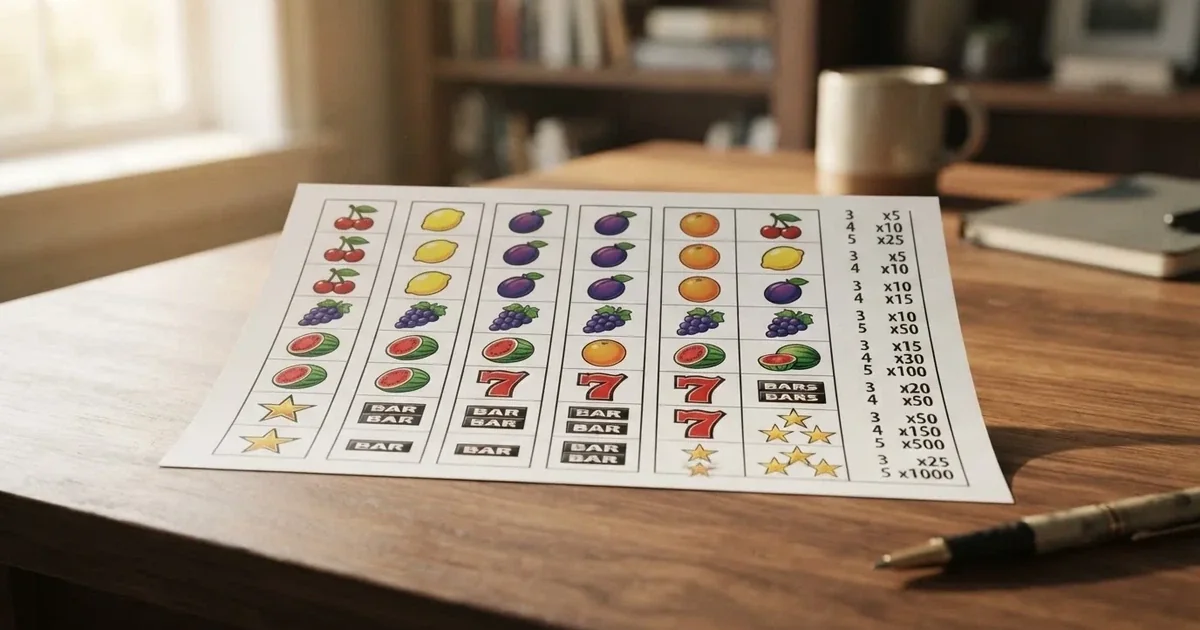
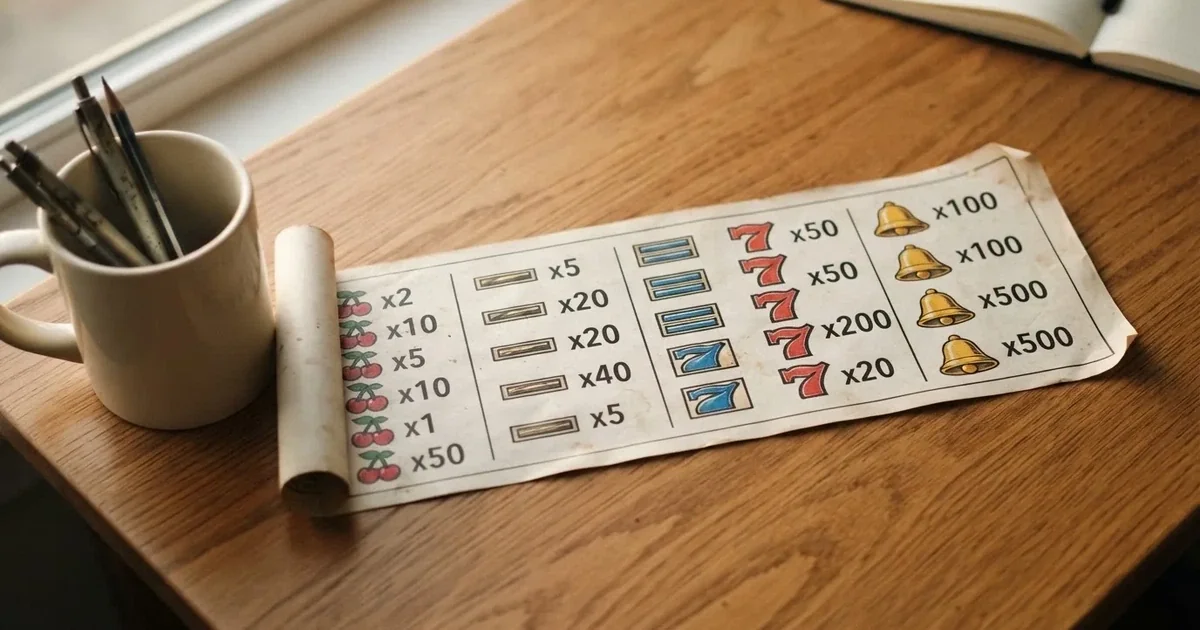
A paytable on a five-reel slot lists the value of every symbol, every line or cluster pattern, and every bonus feature the game runs. On a classic five-reel machine, the symbols are usually fruit, bars, sevens and a top-paying icon (sometimes a bell, sometimes a logo) — a holdover from the late-nineteenth-century mechanism that Charles Fey built in San Francisco with five symbols: horseshoes, diamonds, spades, hearts and the Liberty Bell. Three bells in a row was the top prize, and the format that became the modern slot grew from there.
Modern five-reel video slots look almost nothing like that mechanism but read the same way on a paytable. The reel count is the visible structure: five columns, three rows, twenty or twenty-five fixed paylines or a “ways” engine that pays on every left-to-right combination. What changed is what sits behind it. A modern video slot can carry fifty or more symbols per reel, and the odds against a top combination can run as high as 300 million to one. A mechanical three-reel machine with about ten symbols per reel offered something closer to a thousand possible combinations. The five-reel format sits between the two, and its paytable usually shows the same information in a denser layout: symbol value, line patterns, scatter pays, bonus triggers.
Two things on a five-reel paytable matter more than the rest. The first is the return-to-player percentage, which a licensed operator publishes and an offshore site often does not. The second is the volatility class — low, medium or high — which describes how the game’s payouts are distributed across a session. A low-volatility game pays small amounts frequently; a high-volatility game pays less often and in larger chunks. Neither number is a prediction of what any individual session returns.
What the paytable does not show is the house edge in the same way a blackjack or baccarat table does. Blackjack, played with optimal strategy under liberal Las Vegas Strip rules, runs a house edge of about 0.28%; under Atlantic City rules, about 0.43%. Baccarat runs 1.06% on the Banker bet, 1.24% on the Player bet and 14.36% on the Tie. A five-reel slot’s edge runs higher — typically between 4% and 10%, depending on the title and the jurisdiction. The reason the slot still dominates the casino floor is the pace: a slot can run six hundred spins an hour, and the volume makes the edge work for the house in a way a slow table game cannot match.
The Eleven Brands the ACMA Has Named
The featured set on this page is not a ranking. The eleven brands below appear because the ACMA itself has issued a formal warning over each of them for offering prohibited interactive gambling services to customers in Australia. Several carry older warnings under earlier corporate parents. None of them can be lawfully licensed to offer online casino games to an Australian, whatever offshore licence the site displays at the footer.
The wider point is that the ACMA’s enforcement queue is its own ranking — the regulator is not picking favourites, it is working through a backlog of named brands — and the table below is the part of that queue the page has room to show. A player who reads the table as “the eleven best five-reel slot sites for Australians” has misread it.
| Brand | ACMA action and date | Operator named by the ACMA | Subject support |
|---|---|---|---|
| RocketPlay | Formal warning, March 2026; earlier warning May 2022 | Pulsup Ltd (Rocketplay.com.au); earlier Dama N.V. | — |
| Level Up Casino | Formal warning, May 2022 | Dama N.V. | Listed by Bgaming.com |
| Woo Casino | Formal warning, March 2025 | Dama N.V. | — |
| Spirit Casino | Formal warning, May 2025 | Dama N.V. | — |
| National Casino | Formal warning, July 2025 | Consolutetish S.R.L. | Listed by en.wikipedia.org |
| Bizzo Casino | Formal warning, July 2025; earlier warning 2022 | Consolutetish S.R.L.; earlier TechSolutions | — |
| Ignition Casino | Formal warning, July 2025 | Bamboo Media | — |
| Instant Casino | Formal warning, February 2025 | EOD Code SRL | — |
| Jackbit | Formal warning, April 2026 | Ryker B.V. | — |
| Casino Intense | Formal warning, April 2025 | Sterplay Holding Ltd | Listed by Abc.net.au, acma.gov.au, Crownmelbourne.com.au |
| Sky Crown | Formal warning, September 2022 | Hollycorn N.V. | — |
A few of the brands carry a “Subject support” column entry where an industry listing site has named them as carrying five-reel content — Bgaming.com for Level Up, en.wikipedia.org for National Casino, a small cluster of Australian media references for Casino Intense. The listing is what it is: a third-party directory’s note that the brand offers five-reel slot content, not an endorsement and not a licence. None of the eleven is licensed in Australia. None can be.
RocketPlay
RocketPlay draws two formal warnings across four years: the May 2022 warning to Dama N.V. covered the brand alongside five others, and the March 2026 warning named Pulsup Ltd directly over Rocketplay.com.au. The same brand, two different corporate parents on the ACMA’s record, and the same prohibition applying to both. The consequence for a punter is that RocketPlay has now been named by the regulator twice under two different owners, which is exactly the migration pattern the ACMA’s enforcement is designed to expose.
Level Up Casino
Level Up Casino sits inside the original May 2022 Dama N.V. six-brand warning. The listing at Bgaming.com, a studio that supplies five-reel content to offshore operators, places it inside the wider ecosystem of games available to Australian-facing sites. The warning itself is what marks it for the reader here — the listing tells the player the brand exists, the ACMA tells the player the brand is unlawful to use from Australia.
Woo Casino
Woo Casino’s March 2025 warning came two and a half years after the original Dama N.V. action. Same parent, fresh letter, fresh notice of breach. The gap is short enough to suggest the regulator treats the original warning as ongoing rather than settled when the first letter lands.
Spirit Casino
Spirit Casino’s May 2025 warning is the third Dama N.V. entry on this page, and the most recent of the three. Three warnings to one operator across three years is the clearest picture the ACMA’s register offers of how an offshore group responds to enforcement: slowly, partially, and under a series of fresh letters rather than a single compliance programme.
National Casino
National Casino’s July 2025 warning to Consolutetish S.R.L. sits alongside the Bizzo Casino warning from the same month. The en.wikipedia.org listing places the brand in the same offshore directory as Level Up Casino — two different operators, the same prohibition. The reader looking at this entry is looking at a brand the ACMA has named within the last year of publication.
Bizzo Casino
Bizzo Casino’s July 2025 warning to Consolutetish S.R.L. is its second. The 2022 warning went to TechSolutions (CY) Group Limited and TechSolutions Group N.V., so the brand has now been named under two different corporate parents across three years. That is the migration the regulator’s enforcement is built to catch, and the register is the evidence the mechanism works.
Ignition Casino
Ignition Casino’s July 2025 warning named Bamboo Media as the operator. The brand has not appeared in any earlier warning on this register, which is what makes it a useful marker for the table — a single formal warning, a single corporate parent, and the same prohibition applying regardless.
Instant Casino
Instant Casino’s February 2025 warning named EOD Code SRL. The brand is one of the newer entries on the register and is named only once. The same prohibition applies — offshore licence or no, the offer to Australians is unlawful.
Jackbit
Jackbit’s April 2026 warning to Ryker B.V. sits alongside a warning to CasinOK from the same operator in the same month. Ryker B.V. is the corporate parent on the ACMA’s record, and the warning is the freshest on the page. Two named brands from one enforcement letter is a less common shape than the usual single-brand touch.
Casino Intense
Casino Intense’s April 2025 warning to Sterplay Holding Ltd sits inside a wider cluster of references in Australian media — the Abc.net.au coverage of NT regulator reform, the acma.gov.au register itself, and the Crownmelbourne.com.au reference material for the offline Melbourne casino. The references are not endorsements; they are the trail of where Australian journalism and regulation have touched the brand. The ACMA’s letter is the part of that trail that matters for a punter.
Sky Crown
Sky Crown’s formal warning is the oldest on the page — September 2022, to Hollycorn N.V., covering Sky Crown and Blue Leo together. The brand has not been named again under a different parent on the register, which makes it a useful marker for the bottom of the timeline: same operator, same prohibition, three and a half years later.
The Wider Picture: How Many Sites the Regulator Has Blocked
The ACMA’s first blocking request went out in November 2019. By the most recent published round, on 26 June 2026, the authority had asked Australian internet service providers to block 1,751 illegal gambling and affiliate marketing websites in total, and more than 230 unlicensed services had left the Australian market since enforcement was strengthened in 2017. Those two figures — the running total of blocked sites and the count of operators that withdrew — are the closest thing Australia has to a measure of how much offshore supply has been turned off at the source.
What a reader can take from the totals is bounded. The 1,751 figure is a running count across seven years; the rate of new blocks has not been linear, and the regulator’s published rounds are batched rather than continuous. A punter looking at the figure as “the regulator has stopped 1,751 sites I might have used” is overstating it: many of those blocks were duplicate sites under the same operator, mirror domains, and affiliate pages rather than playable casinos. The figure understates it in a different way: a blocked site can reappear under a new domain within days, and the count of operators that have withdrawn is the count that left, not the count that stayed out.
The arithmetic that belongs to this page is the rate at which the block list has grown. From November 2019 to June 2026 is roughly eighty months. Spread across that period, 1,751 blocked sites averages to a little under twenty-two sites per month across the seven-year window, or a touch under two and a half blocks for every week the authority has been running the programme. The figure is a band rather than a single number — the published rounds have varied in size from a handful to the twelve-site round reported on 26 June 2026 — but the average is the closest thing to a steady-state the programme has produced, and it is also a useful ceiling on how quickly the regulator expects to absorb new supply.
The H2 Gambling Capital estimate puts the wider market at about A$3.9 billion a year in losses to illegal gambling sites, and notes that the share of gambling going through legal channels fell from 74% in 2021 to 64%. The fall is small in absolute terms and large in policy terms: the regulator’s enforcement is not stopping Australians from gambling, it is shifting where the money goes, and the trend line is in the wrong direction.
The Offline Market the Prohibition Sits Beside
The reason offshore five-reel slots exist at the scale they do is that Australia has the densest slot machine market in the English-speaking world. New South Wales alone has 87,298 pokie-style machines outside casinos as of June 2023; Victoria has 26,380 as of 2021–22; Queensland 21,122 as of October 2023; South Australia 11,672 as of September 2023; and the ACT 3,587 as of November 2023. Across those five jurisdictions, more than 150,000 machines sit in clubs, pubs and hotels outside the casino floor — physical five-reel and video reel machines that operate under state-level regulation and pre-commitment rules that vary by jurisdiction.
That density is the market the offshore five-reel slot is reaching for. The Australian legal market offers the product in physical form, at regulated venues, with consumer protections and self-exclusion mechanisms — and the offshore product offers the same format, online, to the same customers, outside the protections. The two are not parallel offerings; one is licensed under state law, the other is prohibited under federal law.
For a punter weighing the choice, the structural difference matters before any of the marketing does. A venue-based machine sits inside a state gambling regulator’s framework: harm-minimisation requirements, mandatory closure periods, complaints mechanisms, and the option to set a pre-commitment cap. An offshore online slot sits inside none of that. The format is the same; the wrapper around it is not.
What the Northern Territory Does Licence
What Australia does licence online is wagering — betting on races and sporting events placed before the event, lotteries and keno. The Northern Territory Racing and Wagering Commission regulates fifty-two of Australia’s online bookmakers — Sportsbet, Bet365 and Ladbrokes among them — issuing Territory licences for tax reasons. The commission has no full-time staff and meets once a month in Darwin, which is the structural detail that sits behind every Australian news story about offshore bookmakers and consumer protection.
The Territory framework is what makes BetStop possible. Because licensed wagering sits under a single regulator’s oversight, the National Self-Exclusion Register can be enforced across every licensed product. An offshore casino has no comparable hook in Australian law, and the register cannot reach it.
What a Punter Reading This Actually Faces
The cleanest way to state the picture is in the order the reader meets it. A five-reel slot search returns a long list of offshore sites, all offering the same format under different brand names and corporate parents. Several of the brands at the top of any such list have been named in a formal warning by the ACMA in the last four years, and a few have been named more than once under different parents. A punter who clicks through is depositing on a site the regulator has, at some point, written to about its Australian business.
The legal risk sits on the operator, not the punter. The IGA targets the provider; the individual player is not prosecuted. The practical risk is everything else. The site can be blocked while a balance is still on it. A withdrawal can be refused with no Australian complaints body to escalate to. A bonus can carry terms the punter did not read before depositing. The credit-card ban that took effect on 11 June 2024 applies to licensed wagering, not to offshore casinos, which means an offshore site asking for a credit card or a crypto deposit is operating outside the Australian rules in a second way at the same time.
The reform that took shape in 2026 — the Interactive Gambling Amendment (Gambling Reform) Bill 2026, passed on 19 August 2026 — is law with a commencement date. Its advertising and inducement measures commence on 1 January 2027, which means a punter reading this in the second half of 2026 is reading it under law that has been passed but not yet brought into force on those measures. The prohibition on the offer itself is already in force. The new layer is the marketing around it.
What the tax treatment looks like
Gambling winnings of a recreational player are not assessable income under section 6-5 of the ITAA 1997, and losses are not deductible — unless the person is carrying on a business of gambling, which is a model rather than a useful category for an occasional punter. The Australian Taxation Office is the right place to confirm the position for any individual case, and the “check with the ATO” caveat is the honest one rather than a hedge: tax treatment of gambling income depends on the structure of the activity, and a one-line answer is not a substitute for the ATO’s view.
What Has Changed and What Has Not
The 2026 amendments to the Interactive Gambling Act are the visible movement. The invisible movement is the regulator’s running total, which is what the ACMA’s June 2026 round confirmed: 1,751 blocked sites, 230-plus operators withdrawn, and a queue of fresh names still to be worked through. The next published round will add to the running total; the queue refills faster than it empties.
What has not changed is the underlying prohibition. Online casino games and online pokies remain prohibited interactive gambling services under federal law, and no state or territory issues a licence for them. The five-reel slot is one of the formats the prohibition catches; the offshore sites that offer it are the targets the ACMA’s enforcement is built around. A punter reading this in 2026 is reading it under law that has been in place since 2001, strengthened in 2017, and amended again in August 2026.
The honest position is the one the page opened with. The format is real, the offline market is the largest in the English-speaking world, and the online version sits outside Australian law. The marketing that wraps the offshore offer assumes the player does not know that; the rest of this page is the material that lets the player know it.
Frequently Asked Questions
What’s the difference between a five-reel slot and a standard five-reel video slot?
A five-reel slot refers to the reel count itself — five columns that carry symbols across a paytable. A modern five-reel video slot can layer fifty or more symbols per reel on top of that structure, with bonus features, scatter pays and “ways” engines. The reel count is the visible part; the symbol count and the feature set are what changed the format between Charles Fey’s original mechanism and a 2026 video release.
Can five-reel slot machines be found in licensed Australian venues?
Yes — the physical format is the densest part of the Australian gambling market. New South Wales had 87,298 pokie-style machines outside casinos as of June 2023; Victoria had 26,380 as of 2021–22; Queensland 21,122 as of October 2023; South Australia 11,672 as of September 2023; and the ACT 3,587 as of November 2023. What is not licensed in Australia is the online version of the same format.
Do five-reel slots pay out differently than newer reel formats?
The mechanics are different, but the paytable reads the same way — symbol value, line patterns, scatter pays and bonus triggers. Modern video reels with fifty-plus symbols per reel run odds against the top combination as high as 300 million to one. A mechanical three-reel machine with about ten symbols per reel runs closer to a thousand possible combinations. The five-reel format sits in between.
Is a five-reel slot online the same game as a five-reel machine in a venue?
The format is the same; the regulation is not. A venue machine sits inside a state regulator’s framework — harm-minimisation requirements, mandatory closure periods, complaints mechanisms. An offshore online slot sits inside none of that. The same five reels, different wrapper.
Are five-reel slots for real money available legally from an Australian-based site?
No. Online casino games and online pokies — the category a five-reel slot falls into — are prohibited interactive gambling services under the Interactive Gambling Act 2001. No state or territory issues a licence for them. What is licensed is wagering on races and sport placed before the event, lotteries and keno.
Does a slot’s reel count change how the paytable is usually described?
Yes — a five-reel paytable is denser than a three-reel one because there are more line patterns to list. What does not change is the structure: symbol values, the patterns that pay, scatter pays, and the bonus triggers. The volatility class — low, medium or high — is usually stated separately, and is a description of how payouts are distributed rather than a prediction of any single session.
Written by the editors at Casino Deposit Info.