
Dragon Link online pokies in Australia: what the reels actually are, and what the IGA does about them
A punter searching for Dragon Link online pokies in Australia is searching for a game whose only lawful Australian home is a club or casino floor. Every website that takes real-money play on it from an Australian address is offering a prohibited service under the Interactive Gambling Act 2001. The ACMA has spent six years blocking that traffic and naming the operators behind it. None of that changes the reels themselves, which is what the rest of this page is about — the linked jackpot mechanic, the reel-set family, and the bonus round the cabinet format was built around. Read the game first, then the legal frame around it.
Current as of 7 November 2026 — licence and ACMA action claims verified against the ACMA’s published formal-warning notices and the Interactive Gambling Act 2001 (Cth).
Table of Contents
- Why a “top 11” of Dragon Link pokies sites is a list of prohibited offers
- The reel set the regulator has been warning about: how Dragon Link actually plays
- The phone is not a loophole
- What the game costs the player: the math the marketing does not show
- Responsible play: the routes that exist and the ones that don’t
- The eleven brands the ACMA has named
- What this page is, and what it is not
- The legal frame: state by state, and offshore by definition
- What a player who wants to play anyway is looking at
- The math this page did
- What to take from this page
- Frequently asked questions
Why a “top 11” of Dragon Link pokies sites is a list of prohibited offers
Any page ranking offshore casinos for Australian residents is ranking businesses the ACMA has asked to be blocked. Eleven brands sit on the published warning list with their operator companies named, and they appear in roughly the order the regulator named them. Their order on the regulator’s page is the only ordering the law recognises; the rest is marketing copy that Australia never licensed.
What the ACMA has done, and how that adds up
The first ACMA blocking request was issued in November 2019. By the snapshot reported on 26 June 2026, the regulator had directed Australian ISPs to block 1,751 illegal gambling and affiliate websites across that span, and more than 230 unlicensed services had withdrawn from the Australian market since enforcement was strengthened in 2017. A single round announced on the same date added another twelve domains — 7Signs, ChromaBet, Donbet, Duospin, Freshbet, Slots Gem, Jacks Club, Lucky Start, Pointsbetz.com, Spinrise, Vinyl Casino and Wildsino — to that running total. That is the blocking rate: roughly 1,751 blocked sites over the six-and-a-bit years from November 2019 to June 2026, with the figure driven by repeated rounds against the same handful of operator groups, and a single round sometimes moving the count by a dozen names at a time. Where the count climbs fastest is on the affiliate end — the affiliate marketing pages that point Australian traffic at the operators — rather than on the operator brands themselves.

The broader cost sits in a different ledger. H2 Gambling Capital’s 2025 report puts Australian losses to illegal gambling sites at about A$3.9 billion a year, and finds the share of gambling going through legal channels falling from 74% in 2021 to 64% in 2025. The ACMA’s blocking programme is a response to that drift. The numbers do not say the blocks are working; they say the drift is large enough to keep the regulator publishing fresh lists.
Where the regulator sits in the federal scheme
Online casino games and online pokies are not licensed in any Australian state or territory. The Interactive Gambling Act 2001 (IGA), tightened by the Interactive Gambling Amendment Act 2017, makes it an offence to provide those services to a person physically in Australia, and the ACMA is the body that investigates, issues formal warnings and asks ISPs to block. The individual player is not prosecuted — the IGA targets the provider — but an offshore site carries no Australian consumer protection, no local complaints body and no recourse if a withdrawal stalls. A site can be blocked with a balance still sitting on it.

The licensable activity is wagering on races and sport placed before the event, lotteries and keno. In practice those online and phone wagering services are licensed by the Northern Territory Racing and Wagering Commission (NTRWC), which regulates 52 of Australia’s online bookmakers including Sportsbet, Bet365 and Ladbrokes — a quirk driven by Territory tax settings rather than a sporting preference. The commission has no full-time staff and meets once a month in Darwin.
The reel set the regulator has been warning about: how Dragon Link actually plays
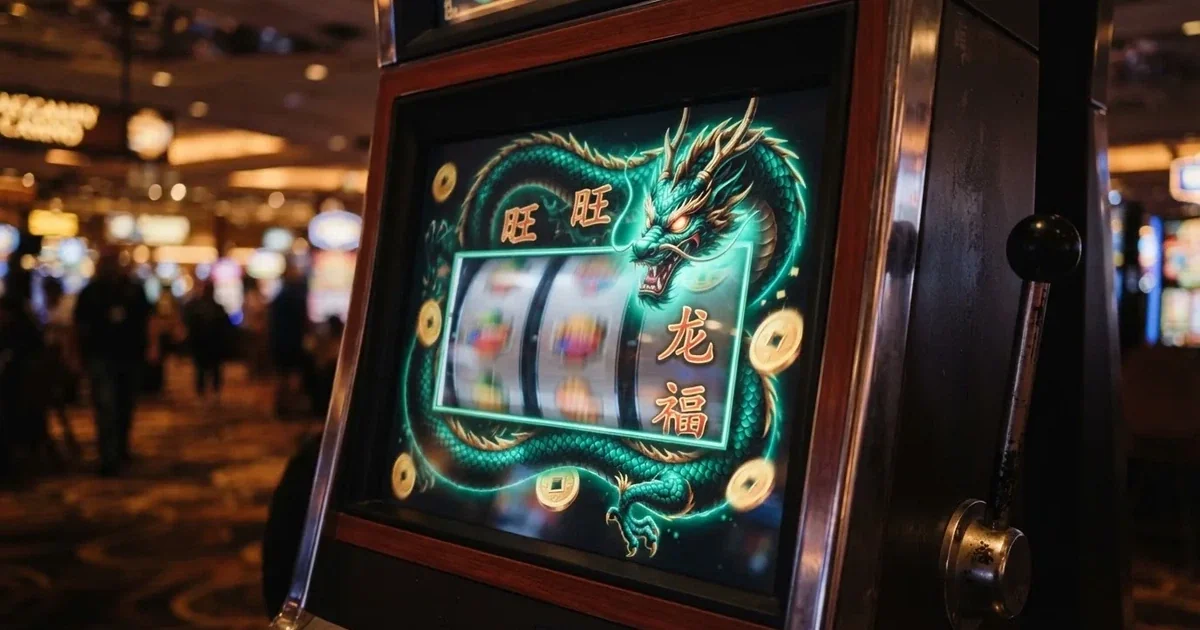
Dragon Link is a cabinet format, not a website. It began as a land-based linked progressive, and the mechanics that travel into any description of an “online” version are the same ones a player meets in front of a machine in a club. That matters because the marketing around an offshore copy of the game tends to describe the bonus round and leave out what feeds it.
The linked jackpot mechanic
Dragon Link runs a cluster of linked reel sets, each with its own paytable and its own progressive jackpot tier. The cluster is the point — the top jackpots across the linked machines rise together, and a spin on one machine in the cluster is a spin on the same jackpot ladder as every other. A standalone progressive rises only when its own machine is played; a linked progressive rises when every machine in the cluster is played. The advertised top prize is therefore a function of how many cabinets in how many venues feed it, which is why a cabinet in a quiet club on a Wednesday morning is not paying the same top prize as one in a major casino on a Saturday night.
That is also why the cabinet format and the online format diverge the moment they are described in the same sentence. A linked jackpot is wired to a physical estate of machines. An offshore website offering “Dragon Link” has no machines, no linked estate, and no jackpot ladder to climb. What it has is artwork lifted from the cabinet game and a random-number generator doing whatever the operator configures it to do. The label is shared; the architecture is not.
The bonus round
The bonus round on Dragon Link is triggered by six or more scattered “orb” symbols landing on the triggering spin. The orbs are the game’s hook — a feature symbol that arrives often enough to be visible to a casual player and rare enough that a “near miss” reading is plausible — and the round plays out as a hold-and-spin: the orbs lock in place, the rest of the reels reset, and the player gets a fixed number of re-spins to land more orbs. Each new orb extends the count back to the original number. The round ends when the re-spins run out without another orb, at which point the locked orbs reveal their values and the total is paid.
Three of those values, picked at random from the bonus pool, are the game’s Mini, Minor and Major jackpots. The fourth tier — the Grand — sits at the top of the linked cluster and is paid when every orb in the round reveals the Grand symbol. The Grand is what the linked architecture exists to fund, and it is what the cabinet format’s marketing language is built around.
The reel-set family
Dragon Link is a family of titles rather than a single game, each with its own reel art and its own symbol set running across the same engine. The titles in the family differ on what they show on the reels rather than on what they pay, and the cluster’s jackpots sit across the family rather than being locked to a single title. The titles that recur in the family — “Happy & Prosperous”, “Pearl River”, “Autumn Moon”, “Panda Magic” — share the orb-and-bonus structure and differ on the symbols that fall on the reels outside the bonus round.
That distinction is the one that disappears in any “online Dragon Link” pitch. The reel-set family is a real engineering choice in the cabinet game; on an offshore website, the choice of which reel art is shown is a cosmetic setting on a single random-number generator. The pearl-and-dragon motif that names one title in the family is, online, a set of bitmaps rather than a separate paytable.
The phone is not a loophole
A Dragon Link app is one of two things. It is either an app published by a venue — a club or casino with a real cabinet estate — for things like loyalty points, promotions and floor maps, or it is an app published by an offshore operator offering real-money play on a “Dragon Link” branded product to a person in Australia. The first kind is harmless and useful. The second kind is offering the same prohibited service as the desktop site, repackaged for a smaller screen. The IGA does not care what the URL looks like, and the ACMA does not distinguish between the mobile and desktop versions of the same offering.
The search traffic around Dragon Link apps runs heavier than the traffic around the desktop offering, partly because a phone is where people play and partly because app-store listings and short-form marketing copy are easier for an affiliate network to push. The “free” version is the most-searched variant — a free-spin demo of the game, often running in an app or in a browser tab, that takes no real money and is harmless on its own. The step from free-spin demo to a real-money app on the same screen is the step the IGA is built to police.
An app that runs in Australia and takes deposits over PayID, BPAY or a credit card is, in the Australian framework, taking deposits for a prohibited interactive gambling service. Credit cards and crypto are not legal payment routes for licensed Australian wagering at all — the credit-card ban took effect on 11 June 2024 and carries penalties up to $247,500 for an operator who accepts one — and PayID, BPAY and bank transfer are routes into licensed Australian wagering only. An app asking for any of those in connection with an offshore casino game is operating outside the rules those routes were built around.
What the game costs the player: the math the marketing does not show
Pokies are built to keep a player watching the reels, and a linked jackpot feature like Dragon Link’s is built to keep a player watching for the orb symbols. The minimum return-to-player the law requires varies by jurisdiction: 85% in New South Wales, the Northern Territory, Queensland and (generally) Victoria — 87% at Crown Melbourne — 87% in the ACT and Tasmania, 87.5% in South Australia, and 90% in Western Australia. Each state sets its own floor, and each venue configures its machines within that floor. The house edge is whatever sits above it, and the linked jackpot pools are funded out of that margin — a small slice of every spin across the cluster is routed into the rising Grand.
In 2020-21 Australians bet almost A$150 billion through gaming machines and lost A$12.18 billion on them, which is a 8.1% aggregate loss rate over a year of play across the country’s roughly 200,000 pub and club machines. Australia has about 3% of the world’s pub and club poker machines, on a population that is 0.3% of the global total. New South Wales alone runs 87,298 gaming machines outside casinos across 2,195 venues, with player losses of A$8.18 billion in 2022-23. Queensland has 21,122 machines in 351 venues; Victoria has 26,380 outside Crown Casino in 488 venues under a statewide cap of 30,000. The density of machines is what the marketing language about a “linked jackpot” sits on top of.
The bonus round is where the math does most of its work. A player chasing the Grand is paying for a hold-and-spin feature that, on average, lands its top prize once in tens of millions of triggering spins across the cluster. The Mini, Minor and Major jackpots are paid more often but at much lower figures. The expected loss on the bonus round is the expected loss on the base game plus whatever extra the hold-and-spin adds in time-on-machine, because each re-spin during the round costs the player a stake and runs on the same random-number generator as the base game.
A player who sets a fixed time limit before they sit down — and a hard ceiling on what they are willing to lose — will, on average, lose less than a player who lets the bonus round decide when they leave. The cabinet does not prompt a player to stop; the reels do not slow down at a threshold; the orb symbols do not arrive less often as the session runs long. A fixed time limit is the lever the player has, and it is the lever that matters most on a game built around a feature that does not end on its own.
Responsible play: the routes that exist and the ones that don’t
BetStop, the National Self-Exclusion Register, has been live since August 2023 and binds every Australian-licensed online and phone wagering service. An offshore casino is not connected to it. A player who has registered with BetStop cannot place a bet with Sportsbet, Ladbrokes or Bet365 by phone or online, but they can still reach an offshore site through a VPN, a different email and a payment route the offshore operator accepts. The register’s reach is the licensed market’s reach, and the licensed market is wagering — not casino games and not pokies.
The National Gambling Helpline on 1800 858 858 is free, runs 24/7 and offers web chat through Gambling Help Online. The helpline is for the player, not for the operator: it does not resolve a complaint about an unpaid withdrawal from an offshore casino, and it does not have any way to compel one. What it does is provide counselling, financial counselling referrals and the kind of practical advice a player needs when they have decided to stop.
State-level help exists alongside the national line. Each state and territory runs its own problem-gambling program — GambleAware in NSW, Gambler’s Help in Victoria, Gambling Help in Queensland — and a player can self-exclude from a venue by asking the venue. Tasmania’s planned mandatory pre-commitment cards — the nation-leading reform that would have forced a player to set a hard loss limit before they could play — were delayed until late 2025 after several missed implementation dates. The reform exists on paper; the cards do not yet exist in a player’s wallet.
The land-based machine is also where self-exclusion happens fastest. A venue can bar a player on the spot. An offshore website can ignore a self-exclusion request, accept a deposit from the same player the next day and route the loss through a payment system the player has no Australian recourse on. That asymmetry is what the responsible-gaming frame is built around: every protection that exists on a licensed machine — pre-commitment, self-exclusion, venue bans, complaint routes — is missing from the offshore version of the same game.
The eleven brands the ACMA has named
The list below is not a ranking. The order is the regulator’s, and every brand sits on the list because the ACMA itself issued a formal warning over it for offering prohibited services to Australians.
| Brand | ACMA action and date | Operator named by the ACMA | Subject support |
|---|---|---|---|
| RocketPlay | March 2026; May 2022 | Pulsup Ltd; Dama N.V. | no-data |
| Level Up Casino | May 2022 | Dama N.V. | listings-only |
| Woo Casino | March 2025 | Dama N.V. | no-data |
| Spirit Casino | May 2025 | Dama N.V. | no-data |
| National Casino | July 2025 | Consolutetish S.R.L. | listings-only |
| Bizzo Casino | July 2025; 2022 | Consolutetish S.R.L.; TechSolutions | no-data |
| Ignition Casino | July 2025 | Bamboo Media | no-data |
| Instant Casino | February 2025 | EOD Code SRL | no-data |
| Jackbit | April 2026 | Ryker B.V. | no-data |
| Casino Intense | April 2025 | Sterplay Holding Ltd | listings-only |
| Sky Crown | September 2022 | Hollycorn N.V. | no-data |
A reader scanning this list will notice the operator companies cluster. Dama N.V. sits behind four of the eleven brands — RocketPlay, Level Up, Woo Casino and Spirit Casino — and the ACMA has warned it at least three separate times across four years. Consolutetish S.R.L. sits behind National Casino and Bizzo Casino, and Bizzo Casino had already been the subject of a 2022 formal warning to TechSolutions. The same handful of operator groups are why the blocking rate stays high — a single round of warnings against one group can put several brand names on the blocked list at once.
RocketPlay
The ACMA’s most recent action against RocketPlay is a March 2026 formal warning to Pulsup Ltd over Rocketplay.com.au. The same brand was the subject of an earlier May 2022 warning to Dama N.V. — one of four Dama N.V. brands the regulator named on that date — and the change in parent company between the two warnings is itself a pattern: when the ACMA warns one company about a brand, the brand reappears under a new parent. The “online casino games cannot be licensed anywhere in Australia, whatever licence the site displays” line in the ACMA’s notice is the legal position the regulator has held since the 2017 amendments, and RocketPlay has been on the wrong side of it twice.
Level Up Casino
The May 2022 warning to Dama N.V. covered six brands in a single notice — Bambet, Dazard, Level Up, Rocketplay, Wild Tornado and Cobra Casinos — of which Level Up is the one that still surfaces in Dragon Link-related affiliate copy. A 2022 warning is six years old at the snapshot date, and an operator named then has had the option to withdraw from the Australian market, change its corporate structure or simply continue to operate knowing the ACMA’s next move is another formal warning. None of those is a comfortable place for a player to be, and the affiliate listings that route Australian traffic to Level Up are themselves the kind of page the ACMA has been blocking in the same rounds.
Woo Casino
The ACMA warned Dama N.V. again in March 2025, this time over Woo Casino, having already warned the same operator about other brands. A second warning to the same parent is a regulator signalling that the first warning did not change the operator’s behaviour, and the ACMA’s published enforcement record is full of operators who have been named three or four times. Woo Casino sits in the middle of that pattern.
Spirit Casino
The May 2025 warning to Dama N.V. over Spirit Casino is the regulator’s third formal action against the same operator group within three years. The repetition is the point: a brand change does not put an operator outside the ACMA’s reach, and the regulator’s enforcement model is built to follow a parent company from one brand name to the next.
National Casino
The July 2025 warning to Consolutetish S.R.L. covered National Casino and Bizzo Casino together, with Bizzo Casino carrying an earlier 2022 warning to TechSolutions on top. Two warnings against two different parent companies for the same brand is the RocketPlay pattern again, and the regulator’s published record shows it happening across multiple operators.
Bizzo Casino
The July 2025 warning added a second layer to a brand that was already on the ACMA’s list. The earlier 2022 warning to TechSolutions (CY) Group Limited and TechSolutions Group N.V. did not move the brand off the market, and the regulator’s response was to name the new parent. The pattern is the same one the ACMA has run against Dama N.V., and the implication for a player is the same: the corporate identity behind a brand is not the protection it looks like.
Ignition Casino
The July 2025 warning to Bamboo Media is the regulator’s first action against this operator group, and Ignition Casino is one of the brands that has run heaviest in affiliate marketing for Australian traffic. The ACMA’s enforcement record shows new parent companies appearing on the list roughly once a year, and Bamboo Media is on the latest round.
Instant Casino
The February 2025 warning to EOD Code SRL is the regulator’s published action against Instant Casino, and the brand sits in the affiliate marketing channels that route Australian traffic at offshore casinos. The ACMA’s record on Instant Casino is the shortest of any brand on this list, and that is the part that is easy to misread — a single warning does not mean the brand is small.
Jackbit
The April 2026 warning to Ryker B.V. covers Jackbit and CasinOK together, with the same pattern as the National Casino / Bizzo Casino pairing. A single warning against a parent that runs two brands is two brands off the Australian market by name, and the ACMA’s blocking rounds have followed.
Casino Intense
The April 2025 warning to Sterplay Holding Ltd is the regulator’s published action, and Casino Intense is one of the older brands on the list in terms of continuous affiliate marketing for Australian traffic. The ACMA has not published a second warning against Sterplay, but the regulator’s pattern is to follow a brand from one parent to the next once a first warning does not change behaviour.
Sky Crown
The Hollycorn N.V. warning covers Sky Crown and Blue Leo together. The September 2022 warning date makes Sky Crown the oldest published action on the list, and the ACMA’s record on Hollycorn shows the regulator willing to return to the same operator group with a second warning if the first does not change behaviour. The brand is still surfacing in Australian-facing affiliate copy.
What this page is, and what it is not
This is not a review of where to play. The Interactive Gambling Act 2001 prohibits online casino games and online pokies for people in Australia, and every website offering them to an Australian address is offering a prohibited service. The eleven brands named above are the ones the regulator has chosen to publish formal warnings against; there are more, and the warning list is the regulator’s, not a ranking.
What this page is: a description of what the Dragon Link cabinet game actually is, what the linked jackpot mechanic does, what the bonus round looks like on the reels, what an “online Dragon Link” is doing under the bonnet, and what the responsible-play routes are for a player who decides to keep playing. The legal frame is in the next section.
The legal frame: state by state, and offshore by definition
The legal position is federal on the prohibition side and state-by-state on the licensed side. The IGA prohibits the supply of online casino games and online pokies to Australian residents; each state and territory separately regulates the land-based machines that exist within its borders. The two regimes do not overlap.
What the state-by-state regulation looks like
Registered clubs operated Australia’s first legal poker machines from 1956, in New South Wales. Every Australian state and territory now has gaming machines operating within its borders, and each jurisdiction sets its own minimum return-to-player — 85% in NSW, the NT, Queensland and (generally) Victoria, 87% at Crown Melbourne, 87% in the ACT and Tasmania, 87.5% in South Australia, and 90% in Western Australia. The variation is small but it is real, and a player who moves from one state to another can be playing a machine with a different minimum RTP without noticing.
Western Australia banned poker machines in pubs and clubs when Crown Perth opened in 1985; Crown Perth’s own machine count has since grown from about 200 in 1985 to roughly 2,500, all approved by the state’s Gaming and Wagering Commission. Tasmania held a Federal Group monopoly on poker machines from 1968 until November 2021, when legislation ended it and moved oversight to the Tasmanian Liquor and Gaming Commission. The state-level regulation is not uniform and never has been, and the IGA sits over the top of all of it.
What “offshore” means in practice
A brand licensed in Curaçao, Malta, the Isle of Man or any other offshore jurisdiction is not licensed in Australia. The licence the brand displays is real in its own jurisdiction and irrelevant under the IGA. The site is offering a prohibited service to an Australian address, and the ACMA’s enforcement model is built around that single point: a warning first, then a block, then another warning against the next parent company that runs the same brand.
What the 2026 reform does
The Interactive Gambling Amendment (Gambling Reform) Bill 2026 passed Parliament on 19 August 2026. Its advertising and inducement measures commence on 1 January 2027 — law with a start date, not yet in force on a page read in 2026. The reform tightens the rules around how licensed wagering services can advertise and what inducements they can offer; it does not change the prohibition on online casino games.
Tax and recreational play
Gambling winnings of a recreational player are not assessable income under section 6-5 of the ITAA 1997, and losses are not deductible. A player whose gambling activity rises to the level of carrying on a business is in a different position, and the Australian Taxation Office is the body that makes that call. The default for the bulk of players is that winnings are tax-free and losses are a personal expense, and that is the only position this page takes.
What a player who wants to play anyway is looking at
A player who decides to play an offshore Dragon Link game is choosing between every protection that exists on a licensed Australian machine and a website that has none of them. The balance on the site can be frozen by a blocking request. The withdrawal can be refused with no local complaints body to take the complaint to. The self-exclusion request goes into a queue the operator can read once and then ignore. The deposit route — credit card, crypto, or a debit card routed through an offshore payment processor — sits outside the Australian framework that bans credit cards for licensed wagering from 11 June 2024.
A player who decides to play on a licensed Australian machine is choosing a machine with a state-set minimum RTP, a venue that can bar them, a complaint route to the state regulator, and the option of registering with BetStop if they want to be excluded from licensed online and phone wagering. The licensed machine is not a harmless product — the maths the cabinet sits on is the same maths the offshore copy uses — but the framework around the licensed machine exists to do something when the maths lands.
A player who decides to stop is choosing between a venue that will bar them and a website that will not. The National Gambling Helpline on 1800 858 858 is free, runs 24/7 and offers web chat through Gambling Help Online. The choice is not between playing and not playing; it is between the version of the game where the framework around it works and the version where it does not.
The math this page did
The blocking rate shows how fast the regulator is moving against the operators behind the illegal sites. The first ACMA blocking request was issued in November 2019, and the snapshot published on 26 June 2026 put the running total at 1,751 blocked sites. The figure is a band — somewhere in the low hundreds of blocked sites per year on the multi-year average, with a single round sometimes moving the count by twelve names — and that band represents the overall trend. The exact monthly rate depends on the rounds included in the window and how the regulator counts operator footprint, and the ACMA does not publish a per-round breakdown. The direction is one-way; the rate itself is a band.
What to take from this page
The game is a cabinet format with a linked jackpot cluster and a hold-and-spin bonus round. The format is not licensed online in Australia. The eleven brands on the ACMA’s published warning list are the regulator’s list, not a ranking. The legal frame is the IGA and the state-by-state regulation; the responsible-play routes are BetStop, the National Gambling Helpline, and the venue-level self-exclusion that exists on a licensed machine and not on an offshore website. The maths is the maths, on a licensed machine and on its offshore copy alike, and the difference between the two is the framework around them. That is the page.
Frequently asked questions
Is Dragon Link available as an online pokies game for real-money play in Australia?
No. The Interactive Gambling Act 2001 prohibits the supply of online casino games and online pokies to a person in Australia, and the ACMA enforces that prohibition. Every website offering Dragon Link for real money to an Australian address is offering a prohibited service, and the ACMA has warned eleven named operators about it across 2022 to 2026.
What is the bonus round on a Dragon Link pokies machine, and how does it trigger?
Six or more orb symbols on the triggering spin start a hold-and-spin round. The orbs lock, the rest of the reels reset, and the player gets a fixed number of re-spins to land more orbs. Each new orb extends the count; the round ends when the re-spins run out, and the locked orbs reveal their values, including the Mini, Minor, Major and Grand jackpots.
Is Dragon Link available at regulated land-based venues in Australia?
Yes, on the cabinet format. Dragon Link is a linked progressive cabinet game installed in clubs and casinos across the country, with the density of machines highest in New South Wales, Queensland and Victoria. Western Australia runs the game only at Crown Perth; Tasmania’s machines sit under the Tasmanian Liquor and Gaming Commission after the November 2021 reform ended Federal Group’s monopoly.
How is a linked jackpot different from a standalone jackpot on a pokies machine?
A standalone jackpot rises only when its own machine is played. A linked jackpot rises when every machine in the cluster is played, and the advertised top prize is therefore a function of the size of the cluster. Dragon Link’s Grand sits at the top of the cluster and is paid when every orb in the bonus round reveals the Grand symbol, which is the linked architecture’s main purpose.
Does a Dragon Link app on a phone offer a different game to the desktop version?
No, and that is not the right question. The right question is whether the app is offering real-money play on a “Dragon Link”-branded product to a person in Australia. If it is, the IGA treats it the same as the desktop offering, and the ACMA’s enforcement record does not distinguish between mobile and desktop. A free-play demo is a free-play demo; a real-money app is a prohibited service.
What separates the different Dragon Link reel sets from each other?
The titles in the Dragon Link family — “Happy & Prosperous”, “Pearl River”, “Autumn Moon”, “Panda Magic” and others — share the same orb-and-bonus engine and the same linked jackpot cluster. They differ on the reel art and the symbols that fall on the reels outside the bonus round, not on the paytable or the jackpot ladder. The distinction is cosmetic on the cabinet and collapses entirely on an offshore copy.