
Playing a crash casino game in Australia in 2026
Currency snapshot is current as of 7 November 2026 against the ACMA’s published blocking actions and formal warning register.
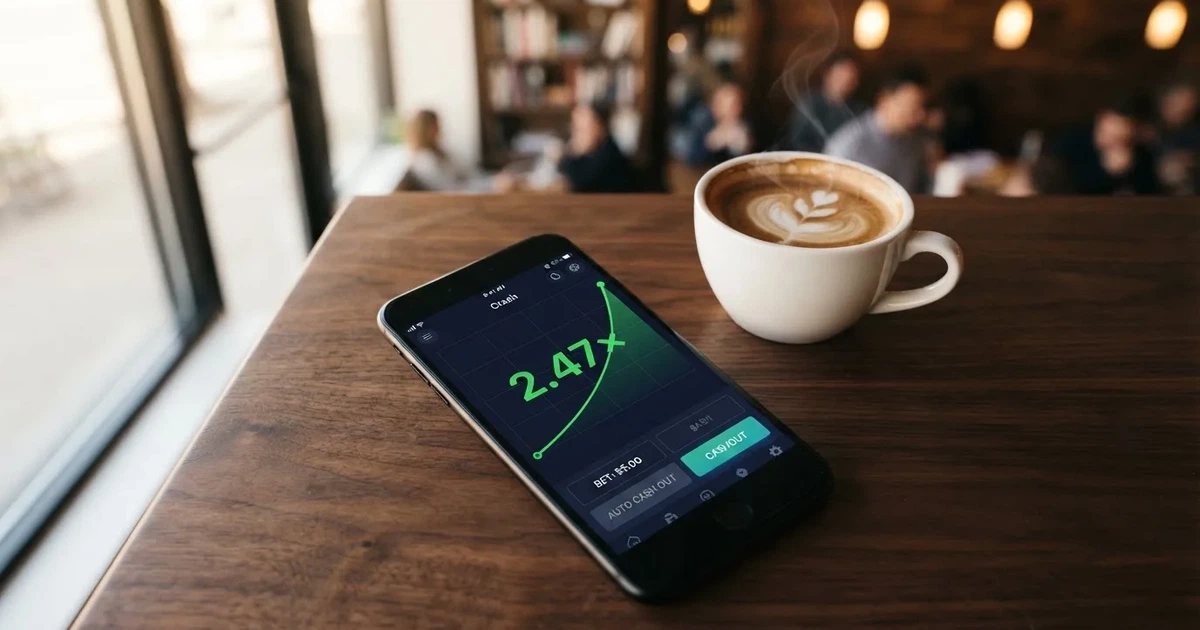
A crash game looks like this: a multiplier climbs from 1.00×, and a player decides when to cash out before the round ends. End the round at 1.47× and the stake returns multiplied by that figure. End it at zero and the stake goes. The format is fast, the rounds last seconds, and the bet sits or leaves with the click of one button. That is the product. It is also, for an Australian resident, a prohibited interactive gambling service under the Interactive Gambling Act 2001, regardless of who claims to license it.
This page looks at what the format actually is, what offshore sites list it, and where the regulator has stood against it. The same thing runs through both halves: the marketing promise of a “provably fair” multiplier is real enough to inspect, and so is the legal frame the marketing skips.
Table of Contents
- The crash format and how the round actually resolves
- Crypto-funded crash games and the anonymity frame
- Top sites that list crash and what the ACMA has done about them
- The legal frame
- The numbers behind the illegal market
- Responsible play and the limits worth setting before a round starts
- What an Australian reader actually has
- A pre-play checklist for the format, for anyone who plays it elsewhere
- How the operator structure moves across the table
- What the baccarat comparison makes clear
- Frequently asked questions
The crash format and how the round actually resolves
The round is a rising curve. The multiplier starts at 1.00× and ticks upward; the player sets a stake and either takes a manual cash-out, or sets an auto cash-out at a chosen multiplier, before the curve ends. When the curve ends, the round is over. There is no decision after the crash and there is no second chance inside a single round — the next round is a fresh multiplier from 1.00×.

The engine underneath is a random-number generator. Spribe’s Aviator, the top-ranked crash game, runs on a provably-fair system that lets the operator and player verify the round’s outcome after the fact — meaning the result is decided in advance of the visible climb, then revealed as the multiplier ticks. That detail matters because the visible curve is theatre; the bet is decided before it starts. The shape of the visible curve is part of the product, not part of the gamble.
Why a “max multiplier” claim is not the relevant figure
The marketing line at most crash sites is a maximum multiplier: 10,000×, 100,000×, sometimes higher. The figure exists because the round can theoretically run that long, and past rounds have been recorded at it. It is not a probability statement. A 10,000× ceiling means the round will sometimes end very quickly and very occasionally run long. The average round ends well below it. The headline number is a ceiling, not an expectation, and a player sizing a session off it is sizing off the wrong figure.
Auto cash-out and what it changes
Setting an auto cash-out at, say, 1.50× takes the timing decision out of the round. The bet still wins or loses on the underlying random outcome, but the player no longer reacts to the visible curve. It converts a real-time decision game into a fixed-stake fixed-target bet on a fast random event. The gambling is the same. The reflex is gone.
Crypto-funded crash games and the anonymity frame
A cluster of offshore brands lists crash alongside Bitcoin, Ethereum and USDT deposits. The marketing promise there is two-fold: faster deposits and withdrawals than a bank route, and a degree of privacy an Australian bank does not offer. Both claims have a limit worth knowing.
The deposit side is genuinely faster. Crypto settles in minutes where a debit-card route can take a working day. The withdrawal side is faster only relative to a slow operator, since a regulated bank transfer from a licensed Australian wagering account can settle within hours. The privacy side is narrower than it reads. Crypto transactions are pseudonymous, not anonymous — every transfer sits on a public ledger — and the wallet address a player pays from links to every other address that has touched it. A player who has used the same wallet once is not anonymous on the second visit.
For an Australian resident, a third layer sits on top. The 11 June 2024 ban on credit cards and digital currency as payment for licensed online wagering applies only to Australian-licensed services. An offshore crash casino is not subject to it. But an Australian who funds that offshore site with crypto is still funding a site that is itself outside the Interactive Gambling Act 2001, and the same consequences follow: no Australian consumer protection, no complaints body, no recourse if the operator refuses a withdrawal.
“Provably fair” — what the claim covers
Provably fair is a verification system, not a guarantee of return. A provably-fair crash round generates its outcome using inputs the player can see after the round (a server seed, a client seed, a nonce). The player can re-derive the outcome and confirm it matches what the game paid. The system rules out the operator quietly changing a result after the round. It does not rule out the operator choosing the inputs, and it does not change the house edge. The format is auditable; the gamble is unchanged.
Top sites that list crash and what the ACMA has done about them
The product at this address is prohibited. The brands on the table below are not ranked by quality, are not recommended, and are not a starting point for play. They are listed because the Australian Communications and Media Authority has, in published formal warnings, named them for offering prohibited interactive gambling services to Australians.
| Brand | ACMA action and date | Operator named by the ACMA | Subject support |
|---|---|---|---|
| RocketPlay | Formal warning March 2026 (Pulsup Ltd); earlier Dama N.V. warning May 2022 | Pulsup Ltd; Dama N.V. | — |
| Level Up Casino | Formal warning May 2022 | Dama N.V. | listings reference (BGaming distribution) |
| Woo Casino | Formal warning March 2025 | Dama N.V. | — |
| Spirit Casino | Formal warning May 2025 | Dama N.V. | — |
| National Casino | Formal warning July 2025 | Consolutetish S.R.L. | listings reference (en.wikipedia.org) |
| Bizzo Casino | Formal warning July 2025 (Consolutetish S.R.L.); earlier TechSolutions warning 2022 | Consolutetish S.R.L.; TechSolutions (CY) Group Limited; TechSolutions Group N.V. | — |
| Ignition Casino | Formal warning July 2025 | Bamboo Media | — |
| Instant Casino | Formal warning February 2025 | EOD Code SRL | — |
| Jackbit | Formal warning April 2026 | Ryker B.V. | — |
| Casino Intense | Formal warning April 2025 | Sterplay Holding Ltd | listings reference (ABC, ACMA, Crown Melbourne) |
| Sky Crown | Formal warning under the IGA | Hollycorn N.V. | — |
Two operators in this set were warned twice. Dama N.V. was named in May 2022 across six brands and again in March 2025 (Woo Casino) and May 2025 (Spirit Casino). Bizzo Casino’s July 2025 warning to Consolutetish S.R.L. was the second formal warning the brand itself has attracted, the first having gone to TechSolutions in 2022. A repeat warning is not a heavier fine by itself — formal warnings under the IGA precede further enforcement steps — but it does tell the regulator has returned to the same operator or the same brand and found the same conduct.
RocketPlay
The March 2026 warning to Pulsup Ltd is the most recent action in the table. RocketPlay was first named in the May 2022 warning to Dama N.V., which covered six brands including RocketPlay. The brand moved between operators; the conduct stayed. For a player reading the table, RocketPlay is the freshest example of the regulator’s pace in 2026: a brand named in 2022, transferred between operators, and warned again in March 2026 under a new corporate name. The brand is also one of the bigger offshore names to carry crash alongside its slot library, which is part of why it appears in the search results this page is answering.
Level Up Casino
The May 2022 warning to Dama N.V. covered six brands. Level Up Casino was one of them. The brand has carried BGaming content — a studio known for crash-format games — and is named in BGaming’s own distribution listings, which is what the source for “Subject support” reflects. A brand on a studio’s distribution list is not a brand regulated to operate in Australia.
Woo Casino
The March 2025 warning to Dama N.V. was the second Dama N.V. warning in twelve months — the first went to Spirit Casino’s May 2025 action two months later. Woo Casino carries crash alongside its slot catalogue and uses a Curaçao operator structure. The 2025 warning does not change the underlying offer: a Curaçao licence does not authorise the supply of online casino games to an Australian resident under the Interactive Gambling Act 2001, whichever licensing seal the site displays.
Spirit Casino
The May 2025 warning to Dama N.V. arrived two months after the Woo Casino warning. The operator is the same as Woo Casino. The pattern is the one the regulator’s enforcement record shows elsewhere: a single corporate group running multiple brands, warned once, warned again under a different brand name.
National Casino
The July 2025 warning went to Consolutetish S.R.L. Bizzo Casino received the same warning the same month — both brands named in the same regulator action. National Casino’s listing reference is a single Wikipedia article citation in the source base, not a verification of any other claim about the brand. Treat it as a name on the regulator’s list, nothing more.
Bizzo Casino
Bizzo Casino has been the subject of two ACMA formal warnings — the 2022 warning to TechSolutions and the July 2025 warning to Consolutetish S.R.L. Two warnings to the same brand, across different operators, is the strongest repeat signal in the table. For an Australian reading the record, Bizzo Casino is the brand the regulator has returned to most clearly.
Ignition Casino
The July 2025 warning went to Bamboo Media. Ignition Casino is a poker-and-casino brand that has run for over a decade under various corporate structures; the warning places it under Bamboo Media in 2025. The product range is broader than crash alone — but a brand that the regulator has named is, by definition, a brand that has offered prohibited services to Australians.
Instant Casino
The February 2025 warning to EOD Code SRL is one of the earlier 2025 actions. Instant Casino markets itself around speed and crypto routes. The brand sits inside the same offshore cluster as the rest of the table.
Jackbit
The April 2026 warning to Ryker B.V. is recent. Jackbit is a crypto-first brand. For a reader who reached this page looking for a crypto-funded crash site, the Jackbit row is the relevant one: it carries crash, it accepts crypto, and it has been formally warned under the IGA in 2026.
Casino Intense
The April 2025 warning went to Sterplay Holding Ltd. The brand’s “Subject support” row carries three source references — the ACMA’s own warning page, the ABC’s coverage of the Northern Territory regulator, and Crown Melbourne’s site — which together reflect Casino Intense’s appearance in the broader regulator-and-operator environment, not a recommendation of any kind.
Sky Crown
The ACMA’s formal warning to Hollycorn N.V. named Sky Crown and Blue Leo together. Hollycorn is a known multi-brand operator group, and a single warning covering two brands is the typical regulator pattern for that structure. Sky Crown is the brand from that pair that appears most often in crash-game search results.
The legal frame
The Interactive Gambling Act 2001, tightened by the Interactive Gambling Amendment Act 2017, makes it an offence to provide an Australian resident with an online casino game, an online pokie, or in-play betting. No Australian state or territory licenses any of those products. What is licensable is wagering on races and sport placed before the event, lotteries, and keno — in practice licensed through the Northern Territory, where the Northern Territory Racing and Wagering Commission regulates 52 online bookmakers (Sportsbet, Bet365 and Ladbrokes among them). The commission has no full-time staff and meets once a month in Darwin. That is the regulator that licenses the wagering services an Australian can lawfully use.
Where the regulator stands on the brands above
The ACMA’s enforcement register is the one source an Australian can use to check what the regulator has actually done. As of June 2026, the ACMA reported that 1,751 illegal gambling and affiliate marketing websites had been blocked since the first blocking request in November 2019, and that more than 230 unlicensed gambling services had left the Australian market since 2017. The June 2026 round alone added 12 more: 7Signs, ChromaBet, Donbet, Duospin, Freshbet, Slots Gem, Jacks Club, Lucky Start, Pointsbetz, Spinrise, Vinyl Casino and Wildsino.
The blocking-rate that follows from those two figures — 1,751 blocked sites over a roughly 79-month span from the first blocking request in November 2019 to the June 2026 round — sits at roughly 22 blocked sites per month, give or take the lumpiness of monthly rounds. That is the pace at which new names have entered the ACMA’s pipeline. The number tells the reader how often the regulator is finding new brands to act against, not how often the brands above are being individually targeted.
What an offshore crash casino does not offer an Australian
The licensed wagering route exists for a reason. A bet365 or Sportsbet account comes with an Australian complaints path, a regulated withdrawal process, and connection to BetStop — the National Self-Exclusion Register, live since August 2023. An offshore crash casino offers none of those. A withdrawal refused at an offshore site cannot be escalated to an Australian body. A balance stuck on a blocked site cannot be retrieved through any channel the regulator recognises. The offshore cluster is faster on deposits and lighter on friction at sign-up; the friction moves to the withdrawal side, where the regulator cannot help.
What the IGA does not do
The IGA targets the provider, not the player. An Australian who plays at an offshore crash casino is not personally prosecuted for it. The fine and the formal warning go to the operator. That does not change what the player is doing — it changes who carries the legal cost when the regulator acts. The practical consequence is that the player is unprotected, not the player is targeted.
Payment routes after the 11 June 2024 changes
Credit cards, credit-related products, and digital currency have been banned as payment for licensed online wagering since 11 June 2024. The ban applies to Australian-licensed services. An Australian-licensed wagering operator accepting crypto would face penalties up to $247,500 per breach. The legal deposit routes are debit card, bank transfer, PayID/Osko, and BPAY. An offshore crash casino that asks for a credit card or a crypto deposit is not subject to that ban, but it is also not a service the ban was designed to exclude — it was designed to protect players who are already at licensed services.
The numbers behind the illegal market
H2 Gambling Capital’s 2025 report puts annual Australian losses to illegal gambling sites at about A$3.9 billion. The share of gambling going through legal channels fell from 74% in 2021 to 64% by the time of the report. The illegal-market figure is an estimate — H2 Gambling Capital models it from payment and operator data rather than measuring it directly — and the 64% legal share tells the reader that more than a third of Australian gambling spend, by that estimate, leaves the regulated system. That is the audience the offshore crash casinos are sized for.
The same report sits behind the case the regulator makes for the 2026 reform package. The Interactive Gambling Amendment (Gambling Reform) Bill 2026 passed Parliament on 19 August 2026. Its advertising and inducement measures commence on 1 January 2027 — law with a start date, not yet in force on a 2026 page. A reader who reaches this page in late 2026 is reading under the old rules; the new advertising and inducement measures are a date ahead, not a rule today.
Responsible play and the limits worth setting before a round starts
A crash round runs in seconds. The decision-to-cash-out reflex happens inside that window, often more than once per minute at a fast table. The format rewards a loss limit set before play begins, not a recovery bet placed after a round ends badly. A player who steps in without a pre-set ceiling is the player the format is built for — and not in the way the marketing reads.
The Australian help services exist whether a player is at a licensed wagering site or at an offshore casino. The National Gambling Helpline (1800 858 858) is free, runs 24/7, and offers chat through Gambling Help Online. BetStop is the self-exclusion register. It binds Australian-licensed online and phone wagering services — an offshore crash casino is not connected to it, which is one more reason an offshore site is a different category of risk from a regulated Australian bookmaker.
What “set a loss limit” looks like in practice
A loss limit is a number the player decides on before the session: the most they are willing to lose across the session, in dollars. The point is not the number — any number works as a starting point — but the order: limit first, then play. A player who sits down without a limit and sets one after three losing rounds has, in practice, not set a limit; they have set a recovery target. The crash format will run as many rounds as the player funds, and the recovery bet is the most expensive bet a session contains.
Why auto cash-out does not replace a loss limit
Setting an auto cash-out at 1.50× makes each round a small, fixed-target bet. It does not set a session ceiling. A player using auto cash-out can still run a hundred rounds in a session and lose a hundred small bets. The reflex is gone; the exposure is unchanged. A loss limit is a session-level decision; auto cash-out is a round-level one.
What an Australian reader actually has
The wagering services an Australian can lawfully use are licensed through the Northern Territory Racing and Wagering Commission and offer pre-event betting on races and sport. The 52 bookmakers on the commission’s books include Sportsbet, Bet365 and Ladbrokes. None of them offer crash. Crash, as a product, sits on the prohibited side of the IGA, and the Australian-licensed wagering market does not list it.
The licensed wagering market is what the regulator can connect to BetStop, what a bank transfer or PayID route will settle into, and what the National Gambling Helpline is set up to support. An offshore crash casino is none of those. A reader who wants crash and is reading this page is at the moment of choosing between the product and the framework — and the framework does not contain the product.
A pre-play checklist for the format, for anyone who plays it elsewhere
The format itself is the same in any market that offers it. A reader who plays crash in a jurisdiction where it is regulated, or who reads this page from outside Australia, faces the same round-by-round mechanics. The pre-play checklist is a session-level one, not a brand-level one:
- Set a loss ceiling in dollars before the first round.
- Decide whether auto cash-out or manual cash-out fits the session, and stick to one.
- Walk away at the ceiling, not after it.
- Treat the “max multiplier” figure as a ceiling, not an expectation.
The checklist does not change the legality. It changes the size of the loss a session can produce. A reader who runs the checklist has fewer sessions end as the worst-case scenario; a reader who runs it at an offshore site has the same reduced exposure and the same withdrawal-side risk the regulator cannot help with.
How the operator structure moves across the table
A pattern in the regulator’s record worth naming plainly: a single operator group can run several brands, and the regulator’s warning follows the operator, not the brand. Dama N.V. was warned in May 2022 across six brands — Bambet, Dazard, Level Up, Rocketplay, Wild Tornado and Cobra Casinos — and warned again in 2025 for two of the same group’s brands (Woo Casino and Spirit Casino). Hollycorn N.V. was warned with two brands in the same action. A reader looking at the table is not looking at eleven independent operators; they are looking at a smaller set of corporate groups, with the brand names chosen for marketing rather than for accountability.
That is also why a repeat warning can happen without a change in legal status. A warning to a new brand under the same operator is the same conduct, the same regulator response, and the same IGA outcome — and it does not convert the brand into a licensed one. The licensing seal the site displays is not an Australian one; the regulator’s formal warning is, and it is the one with legal force in this jurisdiction.
What the baccarat comparison makes clear
The image caption next to the opening picture cites baccarat’s house edge — 1.06% on the Banker bet, 1.24% on the Player bet, and 14.36% on the Tie. Those are the figures for a regulated table game in a licensed venue. A crash game’s house edge is built into the multiplier curve in a different way — the format returns less than the stake-implied fair value across a large sample of rounds — but it is not a smaller edge. A round that crashes at 1.00× returns zero. A round that crashes at 1.20× returns less than the cumulative fair value of the multiplier at 1.20× over enough rounds. The math is the same kind of math; the visibility of it is different. Baccarat’s edge sits in the published rules. The crash format’s edge sits in the distribution of crash points, which the operator controls.
Frequently asked questions
Is it legal to play a crash casino game for real money in Australia?
No. Online casino games — and crash is one — cannot be licensed in any Australian state or territory. The Interactive Gambling Act 2001 makes the supply of these services to an Australian resident an offence, and the ACMA enforces it through formal warnings and ISP blocking. The provider is the target, not the player, but the player is unprotected.
How does the rising multiplier in a crash game actually work?
A round starts at 1.00×. The multiplier ticks upward; the player decides when to cash out. Cash out before the crash and the stake returns multiplied. The round crashes at a random point — somewhere between 1.00× and the maximum the format allows — and the bet is lost. The visible curve is theatre; the result is decided at the start of the round.
Is a crash game’s outcome decided before or during the multiplier’s rise?
Before. The random outcome is generated at round start and revealed as the multiplier ticks. A provably-fair system lets the player verify the round’s inputs after the fact, but the inputs are not chosen by the player. The decision the player makes — when to cash out — is real; the outcome the round returns is fixed.
Do crypto casino crash games use a different random outcome system to a standard one?
Not in any meaningful way. The random-number generator underneath is the same kind of system, and a provably-fair verification layer sits on top. Crypto changes the deposit and withdrawal rail; it does not change the gamble. The 11 June 2024 ban on digital currency as payment applies to Australian-licensed services only, and an offshore crypto-funded crash casino is not covered by it.
What is a sensible way to set a loss limit before starting a crash game round?
Set a dollar ceiling before the first round, walk away when the session reaches it, and do not raise it mid-session. Auto cash-out is a round-level tool; it does not replace a session ceiling. The National Gambling Helpline (1800 858 858) and Gambling Help Online are free and run 24/7 for any reader who needs them.
Can a crash game round be cashed out at any point before it ends?
Within the round, yes. Once the multiplier has started, the player can cash out at any tick until the crash. Once the round has crashed, there is no decision left in that round — the next round is a new bet from 1.00×. A player who missed the cash-out in one round has not delayed it; they have lost it.