
What accepting Skrill at an offshore casino site actually means in Australia
The headline question — which offshore casino sites accept Skrill from an Australian visitor — has a cleaner answer than it looks. The market for online casino games is prohibited in this country. Skrill is simply one of the e-wallets those offshore sites advertise at the cashier. The interesting question is what happens when an Australian clicks deposit, what the Australian Communications and Media Authority has been doing about those sites, and what Skrill itself costs the person paying through it.

Current as of 31 October 2026 · Verified against the ACMA register and the Skrill Australian fee schedule.
Table of Contents
- The landscape the ACMA has been working through
- How blocking has accumulated since the first request
- What Skrill is and what it costs at the cashier
- The law underneath the cashier
- Responsible gambling supports that actually apply here
- Why an Australian bank may decline a Skrill deposit
- PayID and Osko, and why the cashier sometimes shows them
- The Reserve Bank’s review and what it leaves out
- The eleven brands, one verdict each
- What an Australian actually walks away with from the page
- What a player should actually do with this
- What the offshore route costs and what it doesn’t deliver
- Frequently asked questions
The landscape the ACMA has been working through
The Australian picture is one regulator and a long queue. The ACMA, the Australian Communications and Media Authority, can ask Australian internet service providers to block an illegal site, issue a formal warning to the operator behind it, and refer matters to the courts. By the June 2026 blocking round, the running total since the first blocking request in November 2019 had reached 1,751 illegal gambling and affiliate marketing websites, and more than 230 unlicensed gambling services had left the Australian market since enforcement was strengthened in 2017.
In that June 2026 round alone the ACMA asked ISPs to block 12 more: 7Signs, ChromaBet, Donbet, Duospin, Freshbet, Slots Gem, Jacks Club, Lucky Start, Pointsbetz, Spinrise, Vinyl Casino and Wildsino. Each sits on top of a longer history of warnings to the operators behind them, going back through 2022. The point of reading the register in one place is that the names change faster than the operators do. Dama N.V. has been warned over Bambet, Dazard, Level Up, Rocketplay, Wild Tornado and Cobra Casinos in a single 2022 action, then again over Woo Casino in March 2025 and Spirit Casino in May 2025. A new domain on a fresh TLD is, more often than not, the same company under a different banner.
H2 Gambling Capital’s 2025 estimate puts Australians’ annual losses to illegal gambling sites at about A$3.9 billion. The same report tracks the share of gambling going through legal channels sliding from 74% in 2021 to 64% four years later. The block list keeps growing because the demand the offshore market meets is real, even if the supply is unlawful.
| Brand | ACMA action and date | Operator named by the ACMA | Skrill support as listings report |
|---|---|---|---|
| RocketPlay | Formal warning, March 2026; earlier May 2022 | Pulsup Ltd; Dama N.V. | — |
| Level Up Casino | Formal warning, May 2022 | Dama N.V. | Listed in Westpac merchant data |
| Woo Casino | Formal warning, March 2025 | Dama N.V. | — |
| Spirit Casino | Formal warning, May 2025 | Dama N.V. | — |
| National Casino | Formal warning, July 2025 | Consolutetish S.R.L. | AUSTRAC and Wikipedia listings |
| Bizzo Casino | Formal warning, July 2025; earlier 2022 | Consolutetish S.R.L.; TechSolutions | — |
| Ignition Casino | Formal warning, July 2025 | Bamboo Media | — |
| Instant Casino | Formal warning, February 2025 | EOD Code SRL | EcoPayz and PayID directories list it |
| Jackbit | Formal warning, April 2026 | Ryker B.V. | — |
| Casino Intense | Formal warning, April 2025 | Sterplay Holding Ltd | AUSTRAC, ITnews and NAB listings |
| Sky Crown | Formal warning, September 2022 | Hollycorn N.V. | — |
A row that ends in an em dash carries no published Skrill listing for the brand in the sources the table is built from. The signal is that absence, not presence. The 11 brands are here because the ACMA acted over each of them. Skrill at the cashier is incidental, and the table records it where listings do.
How blocking has accumulated since the first request
The blocking register is the cleanest measure of how the offshore market moves against enforcement. The ACMA issued its first blocking request in November 2019. By the end of the June 2026 round, the running total had reached 1,751 blocked sites and affiliate marketing pages. The interval between those two dates is roughly six and a half years, and the arithmetic behind that headline figure provides a clear sense of the enforcement scale.
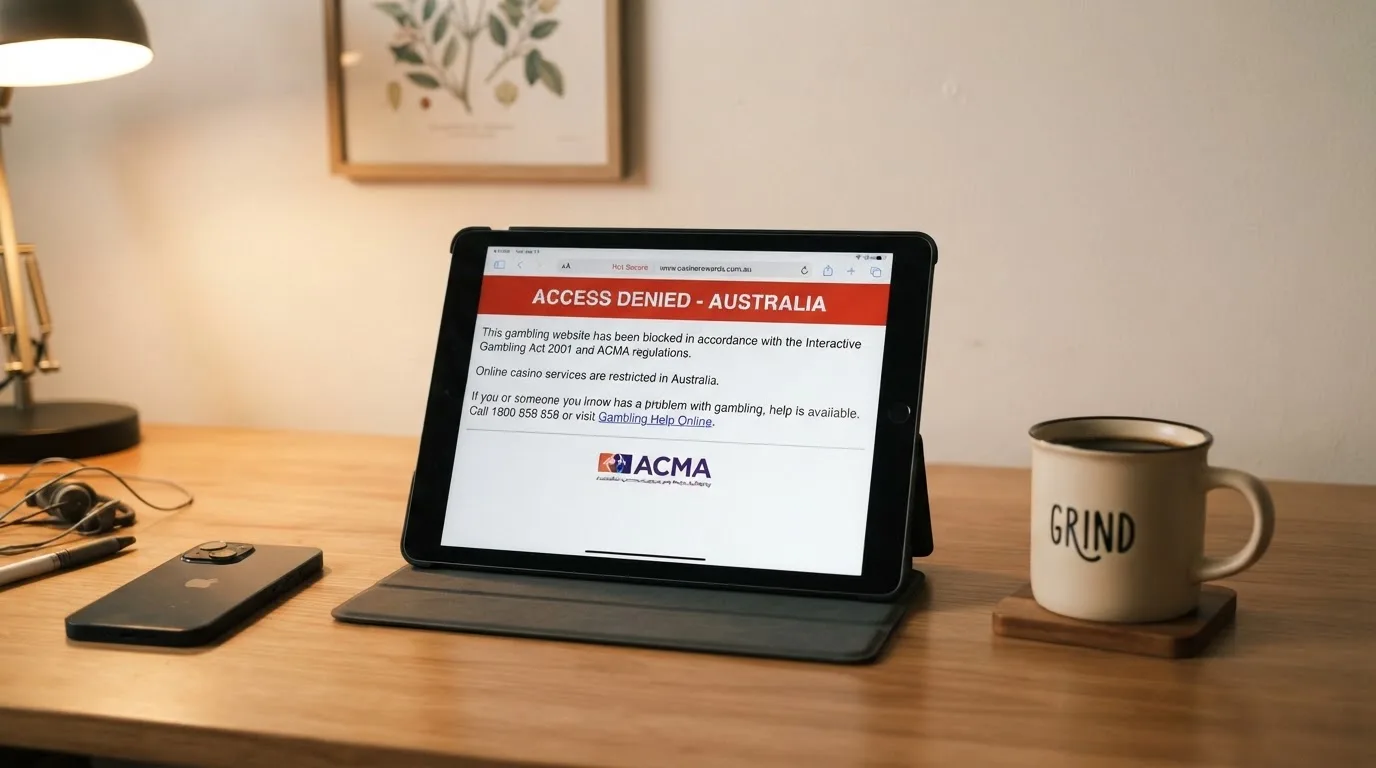
Divide 1,751 by the months between November 2019 and June 2026 — about 80 — and the implied rate is roughly 22 blocked sites and affiliate pages a month, or close to 260 a year. That is a band, not a single figure. The first year of enforcement was necessarily quieter while the legal mechanics were tested in court, and the latest two years have been heavier because new operators keep entering through the same handful of company vehicles. Read the band as the order of magnitude, not as a forecast: a new TLD is usually a relaunch, not a market expansion, and one successful block tends to bring two or three replacement domains in behind it.
The second band is the one that matters more for a player. About 230 unlicensed gambling services have left the Australian market since 2017. Leaving the market means the operator either pulled out voluntarily after a warning or found the traffic dropped enough to make it uneconomic. That is the slow half of the regime’s effect. Blocking stops a domain in Australia; withdrawal stops the company behind it. Either way the loss of A$3.9 billion a year keeps being earned, mostly by operators who simply route around the block.
What Skrill is and what it costs at the cashier
Skrill started in 2001 as Moneybookers. It was acquired by Investcorp in March 2007, sold to CVC Capital Partners for EUR 600 million in August 2013 and bought by Optimal Payments — later renamed Paysafe — for EUR 1.1 billion in 2015. Paysafe is authorised by the UK Financial Conduct Authority as an Electronic Money Institution and reported consolidated FY2022 revenue of about US$1.496 billion across Skrill, Neteller and paysafecard. By 2007 the company was already counted among the top three e-payment providers in Europe.
Skrill runs Silver, Gold and Diamond VIP tiers that trim its standard 1.50% fee on cryptocurrency purchases to 1.40% for Silver and 1.30% for Gold or Diamond members. None of that matters for an Australian using Skrill to move Australian dollars into an offshore casino cashier. What matters is the Australian fee schedule.
Deposits by local payment methods are charged at up to 5.00% of the deposit amount. Withdrawals carry a fee of 2.00% to 3.00% with a minimum of EUR 3.50. A foreign-exchange fee of 4.49% applies to currency conversions. Skrill also warns that funding a gambling account with a credit card can trigger a cash-advance fee from the card issuer, a charge Skrill itself does not control and cannot refund.
A small Australian wallet left untouched for six months starts attracting a EUR 5.00 monthly inactivity service fee. That is the kind of detail a Skrill account picks up quietly, and is the kind of detail a player who deposits once and never logs back in for half a year will meet on the next statement.
The law underneath the cashier
The Interactive Gambling Act 2001, strengthened by the Interactive Gambling Amendment Act 2017, makes it an offence to provide online casino games, online pokies or in-play betting to a person in Australia. No state or territory licenses any of those products. The only gambling products that are licensed for online supply in Australia are wagering on races and sport placed before the event, lotteries and keno. In practice, online wagering is regulated by the Northern Territory Racing and Wagering Commission, which oversees 52 of Australia’s online bookmakers — Sportsbet, Bet365 and Ladbrokes among them — and which has no full-time staff of its own and meets once a month in Darwin.
The minimum age to gamble in Australia is 18. The individual player is not prosecuted under the IGA; the Act targets the provider. An offshore site gives no Australian consumer protection, no Australian complaints body and no recourse if a withdrawal is refused. It can be blocked with a balance still on it, and the player has nowhere to take the complaint.
The legal payment surface is narrower than the marketing surface. Credit cards, credit-related products and digital currency are banned as payment for licensed online wagering in Australia, a rule that took effect on 11 June 2024 with operator penalties of up to A$247,500. The legal deposit routes for licensed wagering are debit card, bank transfer, PayID and Osko, and BPAY. A site asking an Australian for a credit card or a crypto deposit is operating outside the Australian rules. A site asking for Skrill alone, as the only listed method, is in a different position again: Skrill is the rail, and the rail does not legalise the destination.
The Interactive Gambling Amendment (Gambling Reform) Bill 2026 passed Parliament on 19 August 2026. Its advertising and inducement measures commence on 1 January 2027, so for the rest of this year it is a law with a start date rather than an active instrument.
On tax: gambling winnings of a recreational player are not assessable income under section 6-5 of the ITAA 1997, and losses are not deductible. A player who carries on a business of gambling sits in a different box, and the ATO is the right place to ask about that case.
Responsible gambling supports that actually apply here
BetStop, the National Self-Exclusion Register, has been live since August 2023 and binds every Australian-licensed online and phone wagering service. It does not bind an offshore casino, and the offshore casino is not connected to it. Registering with BetStop will not stop an Australian from depositing at an offshore site that accepts Skrill; it will stop them at Sportsbet, Ladbrokes, Bet365 and the other licensed bookmakers. State-level self-exclusion registers sit alongside BetStop and apply to land-based venues in their jurisdiction.
The National Gambling Helpline on 1800 858 858 is free and operates 24 hours a day, with chat through Gambling Help Online. Gambling Help Online is the right first call for an Australian who is trying to work out whether the offshore route is the right one for them at all, and it is the right call regardless of how the deposits are being made.
Why an Australian bank may decline a Skrill deposit
The Australian banks have built gambling blocks directly into their card products. Westpac’s gambling block refuses authorisation of any transaction registered under the merchant category code ‘Betting/Casino Gambling’ on eligible personal credit and debit cards. ANZ’s block, activated inside the ANZ app, also blocks gambling transactions made through a digital wallet such as Apple Pay on an eligible card. Once ANZ’s block is on, removing it again requires a 48-hour waiting period. ANZ warns that not all gambling transactions will be blocked and that some non-gambling transactions might be blocked in error.
Apple Pay itself adds no consumer fees — any surcharge comes from the merchant’s own card-processing costs — and Apple sets no transaction limits or PIN requirements of its own; those sit with the card issuer or the merchant. By the end of 2025, Apple Pay, Google Pay and Samsung Pay collectively accounted for around 45% of all card payments in Australia by number, so the bank blocks are biting at the rail most Australians now use by default.
The card-and-wallet block is one reason an Australian often sees a Skrill deposit declined at the source. Funding the Skrill wallet from a blocked card fails before the Skrill side of the journey starts. Funding it from a debit card on which the block has not been turned on can still route a transaction through Skrill to the offshore cashier, and that is the path most players on the offshore side of the market actually walk.
PayID and Osko, and why the cashier sometimes shows them
Osko, run by Australian Payments Plus, settles a bank transfer between participating Australian banks in under a minute, twenty-four hours a day and seven days a week, whether the transfer is addressed to a BSB and account number or to a PayID. Paying to a PayID shows the account holder’s name before the transfer is sent, and AP+ warns that being asked to transfer money to a PayID on an illegal gambling site almost certainly means a scam site. PayID-based instant transfers are available at more than 100 Australian financial institutions. More than 25 million PayID identifiers had been registered on Australia’s New Payments Platform by April 2025.
The platform itself became accessible to the public on 13 February 2018. It is owned by New Payments Platform Australia Ltd, a non-profit whose 13 shareholders include the Reserve Bank of Australia and the country’s major banks. In 2021 the ACCC authorised the merger of NPP Australia with BPAY and eftpos into a single company, Australian Payments Plus. Participants in the platform must keep monthly outages to no more than two minutes.
The reason PayID shows up at an offshore cashier at all is convenience for the operator, not legality. It is a fast rail that does not run through Visa or Mastercard’s merchant category controls, and the operator can advertise a deposit that lands in seconds. The same speed is the reason a player will not see a warning from the bank that the merchant is on the ACMA’s list.
The Reserve Bank’s review and what it leaves out
The Reserve Bank of Australia’s July 2025 review of merchant card payment costs and surcharging proposes removing surcharges only on eftpos, Mastercard and Visa card transactions. American Express sits outside the scope of the proposed ban. That is a small point for an offshore Skrill transaction — American Express’s three-party scheme means Amex issues cards and processes transactions itself, and the surcharge mechanics that apply to a four-party network do not apply to it the same way. The review is also unrelated to whether the destination of the payment is a lawful one. The bank can remove a surcharge and the regulator can still block the site.
The eleven brands, one verdict each
Each operator below sits on the ACMA register for offering prohibited online casino games to Australians. The list is the register’s order. The verdict in each block answers a different question, because what each brand is best known for is not the same.
RocketPlay
RocketPlay was the subject of a formal ACMA warning to Pulsup Ltd in March 2026, on top of the earlier May 2022 warning to Dama N.V. over the same brand and a longer list of sister casinos. A site that has been warned, re-launched and warned again is a site the ACMA has had to spend two enforcement cycles on. For a player who has been told once, that is a meaningful signal. For a player who reads the warning list as a marketing channel, it is an asset.
Level Up Casino
Level Up was named in the May 2022 Dama N.V. warning alongside Bambet, Dazard, Rocketplay, Wild Tornado and Cobra Casinos. It is one of six Dama N.V. brands the ACMA acted against in a single enforcement action, which is the cleanest indicator of how concentrated the offshore market actually is. A player who has only ever seen one brand has usually been seeing the same operator.
Woo Casino
Woo Casino drew a fresh formal warning to Dama N.V. in March 2025, three years after the 2022 round. The pattern — warning, period of quiet, fresh warning — is the one the ACMA’s own register rewards a reader who follows it month by month. Woo’s 2025 action is the data point that makes the 2022 one look like the start of a sequence rather than a one-off.
Spirit Casino
Spirit Casino is the second of Dama N.V.’s 2025 warnings, dated May 2025. Two Dama N.V. warnings in three months is the rate the ACMA has been warning at since the 2017 amendments. The brand being newer than Woo is not a defence: the operator behind it is the same.
National Casino
National Casino was named in the July 2025 warning to Consolutetish S.R.L., alongside Bizzo Casino. AUSTRAC and the Wikipedia entry on Consolutetish list the brand, which is the kind of cross-listing that helps a player confirm who is actually behind a domain before depositing. It is not, by itself, a clearance.
Bizzo Casino
Bizzo Casino was warned twice — by Consolutetish S.R.L. in July 2025 and by TechSolutions (CY) Group Limited and TechSolutions Group N.V. in 2022. Two operators, one brand, four years apart, is the clearest demonstration on the register that the brand on the homepage is not always the company behind the cashier.
Ignition Casino
Ignition Casino was the subject of a July 2025 warning to Bamboo Media. The ACMA’s record on Bamboo Media is shorter than on Dama N.V. or Consolutetish, but the warning is on the register in the same form. A player who weighs the warning by the company’s history will weigh it less heavily than a Dama N.V. entry; a player who weighs it by what the warning actually says will weigh it the same.
Instant Casino
Instant Casino drew the February 2025 warning to EOD Code SRL. EcoPayz and PayID directory listings name the brand, which is unusual for an offshore casino — most of the eleven are absent from those listings — and tells a reader something about how the site presents itself at the cashier. It does not tell a reader anything about whether the site is lawful in Australia.
Jackbit
Jackbit drew the April 2026 warning to Ryker B.V., alongside CasinOK. The April 2026 date makes Jackbit the freshest formal warning on the register at the time of writing. A player who treats the ACMA register as a freshness signal will treat Jackbit and CasinOK as the brands to be most cautious about, and the same caution will not be misplaced on Dama N.V. brands three enforcement cycles later.
Casino Intense
Casino Intense drew the April 2025 warning to Sterplay Holding Ltd. AUSTRAC, ITnews and NAB listings all carry the brand, and that is the unusual case where an offshore casino is named in mainstream Australian business and banking press. The wider the net of Australian institutions that have had to handle a complaint about the brand, the wider the reader’s sense of what the brand has cost Australian players before.
Sky Crown
Sky Crown was named in the September 2022 warning to Hollycorn N.V., alongside Blue Leo. Hollycorn’s brand count is smaller than Dama N.V.’s, but the warning is the same kind of warning under the same provision of the Interactive Gambling Act. A player looking only at the brand will not see Hollycorn behind Sky Crown; the ACMA warning is what makes the connection.
What an Australian actually walks away with from the page
Three things stand out and one is the consequence of the other two. The first is that the ACMA has had to issue formal warnings to the same handful of operators multiple times, and a new brand is almost always the same company under a fresh domain. The second is that Skrill at the cashier is a payment rail, and the rail is not the regulator. The third is the consequence: the legal status of the product the rail leads to is unchanged by the choice of rail, and an Australian who deposits at any of the eleven brands above is depositing at a site the regulator has already warned.
The Skrill side of the cost — up to 5.00% on deposits, 2.00% to 3.00% on withdrawals with a EUR 3.50 minimum, and 4.49% on currency conversions — is small relative to the house edge of any product the cashier offers, but it is paid every time. A player who treats Skrill fees as the deciding cost is not paying attention to the larger one. The larger one is that the site is unlawful in Australia and that the block list will keep growing at roughly 22 sites a month until either the demand falls or the supply does.
What a player should actually do with this
The shortest version: if a site is on the ACMA’s register, the ACMA has already told the operator to stop offering to Australians. A formal warning is not a request; it is a recorded notice. The Skrill deposit will still work because Skrill does not screen its merchants against the IGA. The withdrawal will work when the operator chooses to send it and not when the player needs it. The block can land at any time, with a balance still on the site. None of these are predictions; they are the shape of the last six and a half years of the register.
For a player who wants to gamble online in Australia within the law, the legal products are wagering on sport and racing before the event, lotteries and keno. The legal payment rails are debit card, bank transfer, PayID and Osko, and BPAY. The legal support if anything goes wrong is the National Gambling Helpline on 1800 858 858, the Gambling Help Online chat, BetStop for self-exclusion from licensed operators, and the state-level self-exclusion registers for land-based venues. None of that helps at an offshore casino, and none of it was ever meant to.
What the offshore route costs and what it doesn’t deliver
The cost line is the easy part. A Skrill deposit fee of up to 5.00% sits on top of the operator’s own house edge on every product the cashier offers. A 4.49% foreign-exchange fee sits on top of any currency conversion Skrill has to run. A EUR 3.50 minimum on a withdrawal fee means that a small, occasional withdrawal costs the player proportionally more than a large one — a 3% fee on a EUR 100 withdrawal is EUR 3.00, which is under the minimum, so the floor kicks in at EUR 3.50. None of those costs is large in isolation; together they sit between the player and any winnings.
What the offshore route does not deliver is what the legal one does. There is no Australian consumer protection. There is no Australian complaints body. There is no recourse when a withdrawal is refused. There is no guarantee that the site will still be reachable the next time the player logs in, because the ACMA blocks roughly 22 sites a month. There is no connection to BetStop. There is no AUSTRAC supervision at the cashier, only at the reporting threshold. The page’s own angle is consequence, and the consequence of the offshore route is that the player pays the cost above and receives none of the protections below.
Frequently asked questions
Skrill deposit and withdrawal fees for Australians
| Transaction type | Fee |
|---|---|
| Deposits by local methods | Up to 5.00% |
| Withdrawals | 2.00%–3.00% (min. EUR 3.50) |
| Foreign exchange | 4.49% |
| Inactivity fee | EUR 5.00/month after 6 months |
No. The Interactive Gambling Act 2001, as amended in 2017, makes it an offence to provide online casino games or online pokies to a person in Australia, and the ACMA has issued formal warnings to the operators behind all eleven brands covered above for doing exactly that. Skrill is the rail, not the regulator, and the choice of rail does not change the legal status of the product the rail leads to.
How quickly does a Skrill transaction typically settle?
Skrill itself moves the funds inside its wallet within minutes, but the question that matters is how quickly the offshore casino credits the deposit or releases the withdrawal. That depends on the operator’s own processing window, not on Skrill’s, and is the part of the journey the player has the least control over. A withdrawal request approved on a Friday can sit in review over a weekend on sites with a manual approval queue.
Does using Skrill offer any buyer protection if an offshore site refuses to pay out?
Skrill is an e-money institution, not a dispute resolution body for merchants. Once funds are inside the merchant’s account, Skrill’s buyer-protection tools — where they apply at all — are narrower than a card chargeback and depend on Skrill’s own terms. A player who has been refused a withdrawal by an offshore casino is, in practice, dealing with a merchant Skrill cannot compel, and the practical remedy is to escalate through Skrill’s support rather than to expect a guaranteed outcome.
Can Skrill be used to fund a licensed, land-based venue in Australia the same way it’s used online?
Skrill is an online wallet and is not the standard funding method at Australian land-based venues, which take cash, EFTPOS and, in some cases, their own loyalty cards at the counter. The legal online wagering market in Australia runs on debit card, bank transfer, PayID and Osko, and BPAY, not on Skrill. A player who wants to bet with Sportsbet, Bet365 or Ladbrokes does not need a Skrill account at all.
Are there any other costs involved with Skrill?
Beyond the transaction and exchange fees, Skrill accounts may incur inactivity fees if left dormant. Users should also be aware that funding their Skrill wallet via credit card may trigger cash-advance fees from their bank, which are separate from Skrill’s own charges and remain entirely outside of Skrill’s control.
Can a player get a refund if an offshore site goes offline?
No. Because offshore sites operate outside Australian law, there is no consumer protection or national complaints body for Australian players. If a site is blocked by the ACMA or ceases operations unexpectedly, players have no legal recourse to recover balances or deposits held on the site. Players should avoid depositing funds they cannot afford to lose.