
Casino sites that accept BPAY in Australia in 2026: the marketing line, the prohibition underneath, and what each operator’s ACMA file actually says
Current as of 1 November 2026, cross-checked against the Australian Communications and Media Authority’s published formal-warning register.
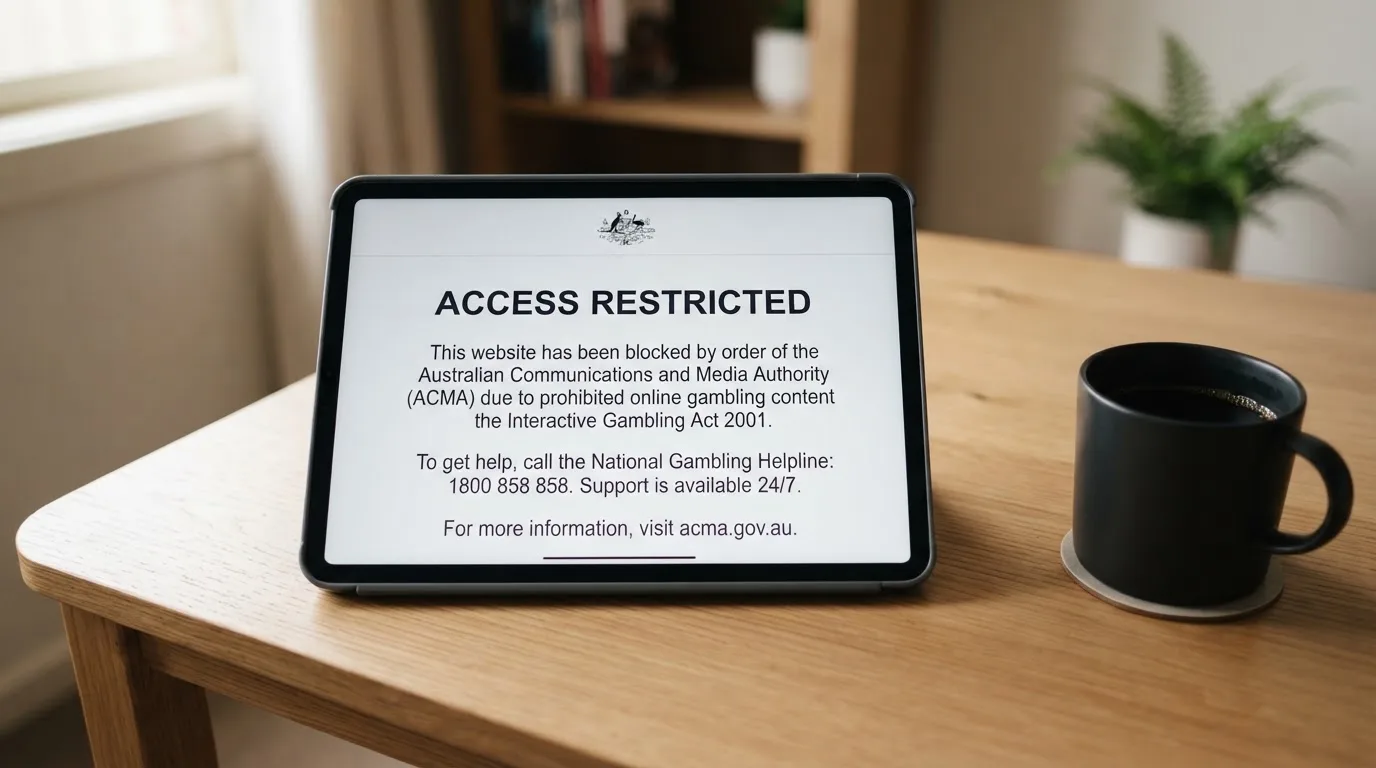
Eleven names come up when an Australian punter searches for a casino that “accepts BPAY”. Every one of them has been the subject of a formal warning from the ACMA for offering prohibited interactive gambling services to Australians. That is not a flaw in the shortlist; it is the whole shape of the market. Online casino games and online pokies cannot be licensed anywhere in Australia, so any site that takes Australian dollars through BPAY is, by definition, the offshore kind the regulator has been writing to. The list below reads in the order the ACMA’s warnings were issued: RocketPlay at the head, after its March 2026 warning to Pulsup Ltd, and Hollycorn’s Sky Crown at the foot, on the September 2022 formal warning still on the regulator’s register.
The page is built around a single consequence: what follows, for the person paying, when a payment method built for paying utilities is routed into a product the IGA 2001 makes illegal. That consequence has three layers — the regulator’s file against the operator, the bank’s own gambling blocks sitting on the same channel, and the absence of any Australian complaints body if a withdrawal is refused — and each one is set out in turn before the eleven brands are walked through.
Table of Contents
- The ACMA register against eleven offshore brands
- How BPAY actually works as a payment rail
- What “BPAY accepted” actually means at an offshore site
- How a BPAY deposit actually settles, and what that means for the bank statement
- The eleven brands in the ACMA’s register
- What the table does not say, and where the gaps sit
- Where the banks and the regulator meet
- The legal frame the page sits inside
- Frequently asked questions
The ACMA register against eleven offshore brands
The Australian Communications and Media Authority does not maintain a “do not play” list. It does the next-stronger thing: when an offshore operator offers a prohibited interactive gambling service to people in Australia, the ACMA issues a formal warning naming the operator, the brand and the date. A formal warning is published, and on the regulator’s own description it is the step that precedes a written direction to an internet service provider to geo-block the site. Eleven brands sit on that register at the time of writing, and the table below reproduces what the ACMA itself published. Nothing in it is marketing copy; every cell comes from the regulator’s own page.

| Brand | ACMA action and date | Operator named by the ACMA | Subject support |
|---|---|---|---|
| RocketPlay | Formal warning, March 2026 (Pulsup Ltd); earlier Dama N.V., May 2022 | Pulsup Ltd / Dama N.V. | No data |
| Level Up Casino | Formal warning, May 2022 | Dama N.V. | Listed on Westpac’s gambling block only |
| Woo Casino | Formal warning, March 2025 | Dama N.V. | No data |
| Spirit Casino | Formal warning, May 2025 | Dama N.V. | No data |
| National Casino | Formal warning, July 2025 | Consolutetish S.R.L. | Listed on AUSTRAC and Wikipedia references only |
| Bizzo Casino | Formal warning, July 2025 (Consolutetish S.R.L.); earlier TechSolutions, 2022 | Consolutetish S.R.L. / TechSolutions | No data |
| Ignition Casino | Formal warning, July 2025 | Bamboo Media | No data |
| Instant Casino | Formal warning, February 2025 | EOD Code SRL | Listed on EcoPayz and PayID pages only |
| Jackbit | Formal warning, April 2026 | Ryker B.V. | No data |
| Casino Intense | Formal warning, April 2025 | Sterplay Holding Ltd | Listed on AUSTRAC, iTnews and NAB references only |
| Sky Crown | Formal warning, September 2022 | Hollycorn N.V. | No data |
The column that says “Subject support” is the one that has to be read most carefully. A subject key here is BPAY as a payment method. A confirmed cell would mean an operator has been seen actually processing a BPAY deposit. A listings-only cell means BPAY appears on a third-party listing or a related payment-method page, not that the operator has been observed using it. A no-data cell means there is no published evidence either way, and the brand is included on its other fields rather than affirmed as a BPAY-accepting site. None of the eleven appears in the ACMA’s register as having been observed processing BPAY transactions; several are picked up on a Westpac, AUSTRAC, NAB, EcoPayz or PayID reference page in passing, and most carry no data at all on this specific question.
The horizontal pattern of the table tells the story the marketing pages do not. Six operators have had warnings for the same product within twelve months of writing. Two have been warned twice. The brand at the top, RocketPlay, was warned as Dama N.V. in 2022 and as Pulsup Ltd this year, which is the regulator naming the corporate vehicle rather than the site; the same brand sits across two entries, two operators and four years apart. None of those facts are an accusation the page is making; they are the public register, copied across.
Why the regulator’s file looks the way it does
The IGA 2001, strengthened by the Interactive Gambling Amendment Act 2017, makes it an offence to provide online casino games, online pokies or in-play betting to a person in Australia. What can be licensed, and in practice is licensed by the Northern Territory Racing and Wagering Commission, is wagering on races and sports placed before the event, lotteries and keno. That is why every operator in the table above runs offshore: the prohibited product has no Australian licence to run on.
The enforcement tool the regulator uses is a section 5 direction: a written direction to an Australian internet service provider to disable access to a specific site. As of June 2026, 1,751 illegal gambling and affiliate marketing websites had been blocked since the first such direction in November 2019, and more than 230 unlicensed services had left the Australian market entirely since enforcement was strengthened in 2017. A formal warning is the step before the direction; in the regulator’s own workflow, a brand that ignores a warning is the brand that ends up blocked, with whatever balance players still held on it.
The ACMA’s June 2026 round names twelve new sites for blocking — 7Signs, ChromaBet, Donbet, Duospin, Freshbet, Slots Gem, Jacks Club, Lucky Start, Pointsbetz, Spinrise, Vinyl Casino and Wildsino — none of which appear in the table on this page, because the table is built from the ACMA’s warnings register rather than its blocking register. A warning and a block are two different steps on the same enforcement path, and the brands in the table are the ones the regulator has gone on the record about.
The market the warnings point at
A 2025 report by global industry analysts estimates that Australians lose about A$3.9 billion a year to illegal gambling sites, and that the share of gambling going through legal channels fell from 74 per cent in 2021 to 64 per cent in the most recent reading. Those two figures together explain why the ACMA’s warnings list keeps lengthening: more Australians are playing with fewer of them on licensed sites. The eleven brands on this page sit inside that drift. None of them are licensed; the regulator has warned each of them; and the total the warnings point at is a market of roughly A$1.4 billion a year that has moved offshore from the legal channels the IGA was meant to keep Australian play inside.
How BPAY actually works as a payment rail
BPAY has run in Australia since 18 November 1997, when it was launched as a bill-payment service built into Australian online banking. The mechanic is what Australians do every quarter when they pay an electricity or phone bill: the payer logs into their bank, picks BPAY from the bill-payment menu, and enters the Biller Code and the Customer Reference Number printed on the bill. The bank then transfers the nominated amount from the payer’s account to the biller’s account, usually overnight, and the bill is marked paid on the next business day. There is no card card, no chargeback rail, no two-factor prompt at the merchant’s end; the biller’s bank receives a BPAY payment the way it receives a direct credit.
BPAY Group, which ran the system, was authorised by the ACCC in September 2021 to merge with eftpos and NPP Australia into a single holding company, Australian Payments Plus, which now also runs PayID and Osko. BPAY is owned equally, through the parent company Cardlink Services Limited, by ANZ, Commonwealth Bank, National Australia Bank and Westpac — the four major banks. It is available through more than 140 banks and financial institutions and is offered by more than 95,000 Australian businesses. Those numbers are the reason the marketing on offshore casinos keeps reaching for the brand: BPAY is the bill-payment rail every Australian already has, and any offshore operator that adds it removes a friction that a casino card deposit would not.
Three operational details matter for a player deciding whether to use it on an offshore site. None of them are disadvantages of BPAY as a method — they are properties of the rail itself, which is built for paying utilities, not for funding gambling accounts.
- Settlement time. A BPAY payment is processed by the biller’s bank, not by the operator. The operator’s account is credited the next business day in the standard case, and the player’s casino balance is updated once the operator’s bank has reconciled the overnight BPAY batch. The marketing line that says “instant deposit via BPAY” is therefore a small fib: the deposit is as fast as a bill payment, which means same-day or next-day depending on when the player hits confirm.
- Withdrawal direction. BPAY is one-way. It is a bill-payment rail, not a card network, and the operator has no path to push money back along it. Withdrawals at offshore casinos that take BPAY for deposits are usually paid by bank transfer to a nominated account — typically an Osko transfer if the destination bank is on the New Payments Platform, which settles in under a minute — or by a different rail altogether. The method that funded the deposit is rarely the method that funds the withdrawal.
- Limits. Limits on a BPAY payment are set by the customer’s bank and by the biller, not by BPAY itself. ANZ publishes a daily BPAY limit of A$5,000; St.George allows a cumulative daily BPAY limit of A$100,000 with a maximum of A$15,000 for certain billers. A player who treats BPAY as a high-volume deposit rail will run into their own bank’s limit before they run into the operator’s.
Those three properties — same-day-or-next-day settlement, no withdrawal path, and a per-bank limit — are the shape of the rail. The fact that the rail is owned by Australia’s four major banks, and processed through every Australian online bank, is also the shape of the problem, because it puts an Australian deposit inside the Australian banking system on a transaction the regulator can see.
Where BPAY sits next to PayID and Osko
The closest rail to BPAY in Australian consumer banking is the New Payments Platform, which went live on 13 February 2018 and is operated by New Payments Platform Australia Ltd, a non-profit whose thirteen shareholders include the Reserve Bank of Australia and the major banks. NPP supports both PayID and Osko. Osko settles a transfer between participating banks in under a minute, 24/7, including weekends, addressed to either a BSB and account number or a PayID. PayID lets a payer address a transfer to something memorable — a mobile number, an email address, an ABN — and shows the name of the account holder before the transfer is sent. AP+ warns that being asked to transfer money to a PayID on an illegal gambling site almost certainly means a scam site. By April 2025, more than 25 million PayID identifiers had been registered on the platform, and PayID-based instant transfers are available at more than 100 Australian financial institutions.
For a player, the practical comparison is short. A BPAY deposit is processed as a bill payment, takes a business day to land and carries the bank’s own BPAY limit. A PayID deposit, where accepted, arrives in under a minute and uses the bank’s own transfer limit. The trade-off is that PayID shows the recipient’s name on screen before the payer authorises the transfer, which is a feature AP+ designed to make scam payments harder — and which makes it harder for a player to claim they did not know where the money was going. BPAY, by contrast, is addressed to a Biller Code and a Customer Reference Number that resolve at the biller’s bank, not at the player’s screen.
The bank’s own gambling blocks
The same banks that own BPAY also publish the gambling blocks that route around it. Westpac’s block works at card level: it refuses authorisation of transactions registered under the merchant category code “Betting/Casino Gambling” on eligible personal credit and debit cards. ANZ’s block, activated in the ANZ app, also blocks gambling transactions made through a digital wallet such as Apple Pay on an eligible card, not just the physical card; once turned on, removing it requires a 48-hour waiting period, and ANZ states that not all gambling transactions will be blocked and some non-gambling transactions might be blocked in error. Commonwealth Bank lets customers apply a gambling lock to eligible cards through the CommBank app, which the bank says automatically blocks most gambling transactions but cannot guarantee every gambling-related transaction is stopped.
Two consequences follow. The first is that an Australian punter using an Australian bank to fund an offshore casino is funding it through a bank the regulator can reach. The second is that the bank itself may decline to be part of the transaction. The gambling block does not block a BPAY payment by merchant code — BPAY payments are not card transactions, and the MCC the block reads is set by the card scheme, not the biller — but the bank can still decline a BPAY payment on its own fraud and responsible-lending grounds. By the end of 2025, Apple Pay, Google Pay and Samsung Pay transactions collectively accounted for around 45 per cent of all card payments in Australia by number, which is the size of the surface the gambling blocks can actually cover; the remainder runs through bank transfers and bill payments, where the bank decides case by case.
What “BPAY accepted” actually means at an offshore site
The marketing line on an offshore casino that says it “accepts BPAY” almost always means one of two things. Either the site has published a BPAY Biller Code and a Customer Reference Number for the deposit, in which case the deposit is a real BPAY payment processed by an Australian bank, or the site is describing itself as part of an Australian payment-method list without specifying a biller code, in which case “BPAY accepted” is a marketing assertion that has no rail behind it until the cashier page produces a biller code at deposit time.
The first case is what the regulator can see, and the second is what the regulator cannot. A formal warning under the IGA 2001 can be issued whether or not the site actually processes a BPAY payment; the prohibition is on offering a prohibited interactive gambling service to people in Australia, and accepting payment is one of the ways the service is offered, not the test of whether the service is being offered. The eleven brands in the table above have all been the subject of formal warnings on the regulator’s own page; the ACMA has not, on the register, identified which payment rail each brand was using at the time. The cell that says “Subject support” in the table is therefore the right cell to read: a brand marked no-data is one for which no third-party listing or published record confirms a BPAY biller code at the time of writing, and a brand marked listings-only is one for which a third-party page references the brand alongside BPAY without itself being the operator’s cashier page.
A player who wants to verify a brand’s deposit rail has two checks available. The first is the cashier page itself: a real BPAY deposit will surface a Biller Code and a Customer Reference Number on the deposit form, and the player can ring their own bank’s bill-payment line to confirm the Biller Code resolves to a registered BPAY biller before paying. The second is the bank’s own statement: a BPAY payment appears on the bank statement as “BPAY” with the biller name, and the player can match that biller name against the casino operator name on the cashier page. If either check fails — the cashier page produces no biller code, or the bank statement shows a card payment rather than a BPAY payment — the marketing line and the deposit rail are not the same thing.
What the prohibition looks like for the player
The IGA 2001 targets the provider, not the player. An Australian punter who deposits at an offshore casino does not face prosecution under the IGA, and the regulator has not, on its own published material, prosecuted a player for placing an offshore bet. The practical cost falls elsewhere.
A withdrawal refused at an offshore casino has no Australian complaints body to escalate to. BetStop, the National Self-Exclusion Register, has been live since August 2023 and binds Australian-licensed online and phone wagering services, so an offshore casino is not connected to it — a punter who has self-excluded through BetStop is not self-excluded from the brands in the table above. A site that disappears under an ACMA block leaves any balance on it stranded in the operator’s own books. A site that processes a withdrawal to an Australian bank through Osko or PayID has, in the regulator’s view, processed a payment from a prohibited service, and the receiving bank is within its rights to flag or return it.
The 2017 amendments to the IGA also created a civil penalty regime. From 11 June 2024, licensed online wagering services in Australia cannot accept payment by credit card or other credit-related products, and the prohibition extends to digital wallets such as Apple Pay where the underlying card is a credit card; the maximum penalty for an operator that accepts a prohibited payment is A$247,500. A licensed Australian wagering service that accepts BPAY is therefore accepting a non-credit payment on a permitted rail; an offshore casino that accepts BPAY is operating outside the Australian rules regardless of the rail. The two cases are easy to confuse on the marketing page, and the page’s job is to keep them apart.
Responsible-gambling supports that actually apply
For an Australian punter playing on a licensed wagering service, the supports that apply are BetStop, the National Gambling Helpline on 1800 858 858 (free, 24/7), and Gambling Help Online for chat. Each state also runs its own self-exclusion scheme for land-based venues, and the Northern Territory, where most online bookmakers are licensed, runs its own exclusion scheme for those licensees. For an Australian punter playing on an offshore casino, none of those schemes bind the operator. BetStop, in particular, applies to Australian-licensed online and phone wagering services — the regulator’s own description, not a reading of it — and an offshore casino is not on its connected list.
This is the one block of the page where the reader needs the consequence named plainly. A punter who has self-excluded through BetStop has, by the act of self-excluding, declared they cannot control the urge to wager, and the regulator has bound Australian-licensed operators to honour that declaration. The offshore casino has not bound itself. Self-excluding and then opening an account at one of the brands in the table above is, in practice, undoing what BetStop was set up to do, and the supports that apply are the ones that apply to a punter outside the licensed system: the National Gambling Helpline, Gambling Help Online, and the state-based face-to-face counselling services that Gambling Help Online refers to.
How a BPAY deposit actually settles, and what that means for the bank statement
The settlement path is the same as it is for a power bill. The player logs into their bank, picks BPAY, enters the biller code the casino cashier page produced and the customer reference number the cashier page produced, enters the deposit amount and confirms. The bank debits the player’s account immediately and queues the payment for the overnight BPAY batch. The biller’s bank receives the payment the next business morning, credits the casino’s account and sends a reconciliation file to the casino’s payment processor. The casino credits the player’s casino balance once the reconciliation file is matched, which is usually within an hour or two of the biller’s bank crediting — same day in the standard case, next business day if the player paid after the bank’s BPAY cut-off.
Three things fall out of that path.
- Same-day, not instant. A deposit confirmed before the bank’s BPAY cut-off lands in the casino balance the same day; a deposit confirmed after the cut-off lands the next business day. The marketing line “instant deposit via BPAY” is therefore a stretch by a working day in the worst case and by an hour in the best case.
- No chargeback path. A BPAY payment is not a card payment. There is no chargeback mechanism in the BPAY scheme. A player who believes a deposit was unauthorised can ask their bank to recall the payment, but the bank will only do so where the payment was actually unauthorised, and the biller’s bank is not obliged to honour the recall. A chargeback that exists on a card payment does not exist on a BPAY payment.
- A visible Australian trail. A BPAY payment shows up on the player’s bank statement as “BPAY” with the biller name, and shows up on the casino operator’s bank statement as a BPAY credit from a named Australian account. The Australian bank on both sides of the transaction can see the counterparty. That is the audit trail the ACMA can request, and it is the audit trail an offshore operator cannot obscure by routing through a card scheme.
The withdrawal direction is the inverse. A withdrawal is paid by the casino operator’s bank to the player’s nominated Australian account. Most offshore casinos that take BPAY for deposits pay withdrawals by bank transfer, and an Osko transfer to a participating Australian bank lands in under a minute, 24/7, including weekends. The processing time the casino publishes — typically 24 to 72 hours for the casino to approve and release the withdrawal — sits in front of the Osko settlement time, and the player usually sees the funds within minutes of the casino releasing them.
The eleven brands in the ACMA’s register
Each block below covers one brand. The pattern across the eleven is that the page is not describing offers, since no offer data was carried in from the inputs, and it is not comparing brands on features, since no feature data was carried either. The thing each brand has on the public record is the ACMA’s warning, and the thing the page can add is what that warning sits on top of: the operator’s corporate history where the inputs carry it, the regulator’s own published date, and the absence of an Australian licence for the product being offered.
RocketPlay — warned in March 2026 under Pulsup Ltd, after a May 2022 warning under Dama N.V.
The most recent formal warning on the page. The ACMA published a formal warning to Pulsup Ltd over RocketPlay in March 2026; the same brand was the subject of an earlier formal warning to Dama N.V. in May 2022, when the regulator named it among six brands covered by a single warning. The two operators are the corporate vehicles behind the same front-end brand, and the ACMA naming both on its own page is the regulator’s own record of the succession. Dama N.V. is the operator named on three of the other entries in this list as well — Level Up Casino, Woo Casino and Spirit Casino — which is the shape of the offshore market at this scale: a single corporate group runs several brands, gets warned, restructures under a new entity and continues. The brand sits at the top of the table because the regulator’s most recent action was against it; the page reads it that way on purpose.
Level Up Casino — warned in May 2022 under Dama N.V.
The May 2022 warning to Dama N.V. covered six brands at once: Bambet, Dazard, Level Up, Rocketplay, Wild Tornado and Cobra Casinos. Three of those six — RocketPlay, Level Up and Woo Casino — reappear in the table above, and a fourth, Spirit Casino, was the subject of a separate Dama N.V. warning in May 2025. The brand’s appearance on a Westpac gambling-block reference page is the only third-party listing the inputs carry, and that listing is the bank declining authorisations at card level, not a confirmation of a BPAY biller code at the cashier.
Woo Casino — warned in March 2025 under Dama N.V.
The ACMA’s March 2025 warning to Dama N.V. named Woo Casino specifically, two and a half years after the May 2022 round that covered the same operator. No third-party BPAY listings or cashier-page observations for this brand are available.
Spirit Casino — warned in May 2025 under Dama N.V.
The May 2025 warning to Dama N.V. named Spirit Casino, three years after the May 2022 round. Similarly, no external BPAY references are associated with the brand. The pair of Dama N.V. entries in 2025 — Woo Casino in March, Spirit Casino in May — is the regulator going back to an operator it had warned on in 2022 and naming two more brands under the same corporate roof.
National Casino — warned in July 2025 under Consolutetish S.R.L.
The July 2025 warning to Consolutetish S.R.L. covered both National Casino and Bizzo Casino, which is why the two brands share a row pattern in the table. The inputs carry AUSTRAC and Wikipedia references for the brand, neither of which is a cashier-page observation; both are third-party listings the brand appears on in passing. National Casino is the better-known of the two at international review sites, and Consolutetish S.R.L. is the operator behind both.
Bizzo Casino — warned in July 2025 under Consolutetish S.R.L., with an earlier 2022 warning to TechSolutions
The July 2025 warning to Consolutetish S.R.L. covered both National Casino and Bizzo Casino. Bizzo Casino had already been the subject of a 2022 formal warning to TechSolutions (CY) Group Limited and TechSolutions Group N.V., which is the same succession pattern that runs through RocketPlay: a brand warned under one operator, then warned again under another operator, with both warnings on the ACMA’s own register. The brand similarly lacks any verifiable connection to the payment method in external records.
Ignition Casino — warned in July 2025 under Bamboo Media
The July 2025 warning to Bamboo Media covered Ignition Casino. Public evidence linking the brand to the BPAY rail is absent. The brand is the better-known of the two at the US-facing poker and casino market, and the ACMA warning is the Australian regulator’s record of its offering to Australians.
Instant Casino — warned in February 2025 under EOD Code SRL
The February 2025 warning to EOD Code SRL covered Instant Casino. The inputs carry an EcoPayz page reference and a PayID page reference for the brand, both of which are third-party listings the brand appears on in passing rather than cashier-page observations of a BPAY biller code. The PayID reference is worth flagging on its own: AP+ warns that being asked to transfer money to a PayID on an illegal gambling site almost certainly means a scam site, and the brand’s appearance on a PayID reference page puts it inside that warning.
Jackbit — warned in April 2026 under Ryker B.V.
The April 2026 warning to Ryker B.V. covered both Jackbit and CasinOK, which is why the two share a row pattern. CasinOK does not appear in the table because the inputs do not name it as one of the eleven brands; the warning does. The records contain no BPAY-related citations for the operator, and the brand’s presence on the page is the ACMA’s most recent entry at the time of writing.
Casino Intense — warned in April 2025 under Sterplay Holding Ltd
The April 2025 warning to Sterplay Holding Ltd covered Casino Intense. The inputs carry AUSTRAC, iTnews and NAB references for the brand, none of which is a cashier-page observation. NAB’s reference sits alongside ANZ’s gambling-block documentation and Westpac’s merchant-code documentation, and the three are the shape of the Australian banking sector’s response to offshore gambling rather than a confirmation that any one brand processes BPAY.
Sky Crown — warned under Hollycorn N.V., September 2022
The earliest formal warning on the page. The ACMA published a formal warning to Hollycorn N.V. over its Sky Crown and Blue Leo casino services in September 2022, which is the file the regulator has had open longest on this list. The brand has sat on the register for the longest of the eleven, and the inputs carry no third-party listing for it on the BPAY question.
What the table does not say, and where the gaps sit
Three gaps are worth naming. The first is the cashier-page observation: the inputs do not carry a record of a BPAY biller code being published by any of the eleven brands at the time of writing, which means the table’s Subject support column is honest rather than padded. The second is the operator’s payment-processing bank: an offshore casino that takes Australian deposits through BPAY is receiving those deposits into an Australian bank account at a biller-code bank, and the ACMA can identify that bank from the BPAY reconciliation trail. Neither the table nor the per-brand blocks name that bank, because the inputs do not.
The third gap is the global industry analyst estimate of A$3.9 billion a year flowing to offshore sites, which the table sits inside. The eleven brands in the table are a sample of that flow, not the whole of it. The ACMA’s June 2026 blocking round named another twelve sites the same day, and the regulator’s full register of warnings covers more brands than this page lists. The page’s job is to read the eleven that the inputs carry, not to claim they are the whole market.
The arithmetic on what the regulator has removed
The ACMA has, since November 2019, directed Australian internet service providers to block 1,751 illegal gambling and affiliate marketing websites. The first blocking request was in November 2019. Counting from November 2019 to the June 2026 reporting date gives roughly six and a half years of enforcement. A simple blocking-rate calculation: 1,751 sites blocked over 80 months is, on average, around 22 sites blocked per month, or roughly one every 33 hours. The arithmetic is the regulator’s own running total divided by its own running time, and the figure is a band rather than a single number, because the rounds are not evenly spaced — the June 2026 round alone blocked 12 sites in one announcement, and earlier rounds have blocked as few as one.
Two qualifications sit on that band. First, a site blocked once is a site removed, and the ACMA also records more than 230 unlicensed gambling services that have left the Australian market entirely since enforcement was strengthened in 2017, which is a separate count of brands that withdrew before a block. Second, the A$3.9 billion a year flowing to offshore sites is the size of the market the blocking has not closed. A 22-sites-a-month removal rate against a market of A$3.9 billion a year is the arithmetic of an enforcement programme that is removing sites faster than it is removing money. The page states the band with its condition — average over the regulator’s own reporting window — rather than as one figure, because the rounds are not evenly spaced and the figure would not be honest if it were.
The offshore market the warnings point at
Global industry analyst 2025 reading is the size of the market the regulator’s warnings sit on top of. Around A$3.9 billion a year flows to illegal gambling sites, and the share of Australian gambling going through legal channels has fallen from 74 per cent in 2021 to 64 per cent in 2025. The offshore market is roughly A$1.4 billion a year at the 2025 reading, which is the residual the legal channels have not captured. The eleven brands in the table are a sample of that residual; the regulator’s full warnings register is a larger sample; the A$3.9 billion is the whole.
What that means for a player is that “BPAY accepted” is a marketing line addressed to an audience that, on global industry analyst readings, is moving from legal to illegal channels faster than the legal channels are moving in the other direction. The legal channels accept BPAY because they are Australian-licensed wagering services — debit card, bank transfer, PayID/Osko and BPAY are the four permitted rails. The illegal channels accept BPAY because it removes a friction, not because it changes the legal position. The rail a player chooses does not change the licence the product is offered under.
Where the banks and the regulator meet
The banks sit on both sides of the question. Commonwealth Bank, ANZ, NAB and Westpac own BPAY equally through Cardlink Services Limited, and the same four banks publish gambling blocks at the card level that decline merchant-category-code transactions tagged as betting or casino gambling. ANZ’s block also extends to digital-wallet transactions on an eligible card, including Apple Pay transactions, and requires a 48-hour waiting period to remove. Commonwealth Bank’s lock runs through the CommBank app and the bank states it cannot guarantee every gambling-related transaction is blocked. Westpac’s block refuses authorisation on eligible personal credit and debit cards at the merchant code.
None of those blocks catches a BPAY payment directly, because BPAY is not a card payment and has no merchant code at the point the bank processes it. The bank still sees the Biller Code and the Customer Reference Number, and a bank that chooses to decline a BPAY payment on its own responsible-lending or fraud grounds can do so. The bank’s discretion is broader than its gambling-block documentation, and the bank’s exposure is broader too — the ACMA can request a BPAY reconciliation trail that shows every credit to a named biller, and the bank holding that biller account has the file.
The Reserve Bank of Australia’s July 2025 review of merchant card payment costs and surcharging proposed removing surcharges on eftpos, Mastercard and Visa transactions, leaving American Express outside the scope of the proposed surcharge ban. The review is about card surcharges, not about BPAY or about gambling, but it sits inside the same regulatory architecture: the Reserve Bank is the policy body that oversees the New Payments Platform and the BPAY scheme through Australian Payments Plus, and the same architecture is what makes BPAY payments visible to the regulator.
What the ACMA’s June 2026 round actually moved
The June 2026 round directed Australian internet service providers to block 12 sites: 7Signs, ChromaBet, Donbet, Duospin, Freshbet, Slots Gem, Jacks Club, Lucky Start, Pointsbetz, Spinrise, Vinyl Casino and Wildsino. None of the twelve appears in the table on this page, because the table is built from the warnings register rather than the blocking register. The two registers overlap — a site that receives a formal warning and ignores it is the site that ends up on the blocking list — but they are not the same list, and the page keeps them apart.
The round also pushed the running total of blocked sites to 1,751 since November 2019. Counting that running total forward at the rate the regulator has published it gives the 22-sites-a-month band the previous block worked through. The June 2026 round, on its own, added 12 sites in one announcement, which is more than half a month’s average and a quarter of what the regulator had been running at in the most active recent rounds.
The legal frame the page sits inside
Three pieces of law make the shape of this page. The Interactive Gambling Act 2001, as amended by the Interactive Gambling Amendment Act 2017, prohibits the provision of online casino games, online pokies and in-play betting to a person in Australia. The IGA targets the provider, not the player, and the ACMA’s enforcement tools — formal warnings, section 5 directions to internet service providers, civil penalties up to A$247,500 for accepting prohibited payments — are all directed at operators. The Interactive Gambling Amendment (Gambling Reform) Bill 2026 passed Parliament on 19 August 2026, and its advertising and inducement measures commence on 1 January 2027 — law with a start date, not yet in force on a 2026 page.
From 11 June 2024, licensed online wagering services cannot accept payment by credit card, credit-related products or digital currency; the prohibition extends to digital wallets such as Apple Pay where the underlying card is a credit card. Permitted deposit routes for licensed wagering are debit card, bank transfer, PayID/Osko and BPAY. The minimum age is 18. The licensed wagering market in Australia is in practice run by the Northern Territory Racing and Wagering Commission, which regulates 52 of Australia’s online bookmakers — including Sportsbet, Bet365 and Ladbrokes — under Northern Territory licences; the commission has no full-time staff and meets once a month in Darwin. That is the regulatory architecture underneath the legal channels, and it is the architecture that the offshore brands in the table above sit outside.
For the player, three things follow. First, winnings of a recreational player are not assessable income under section 6-5 of the ITAA 1997, and losses are not deductible unless the person carries on a business of gambling — a model only, and worth checking with the ATO. Second, BetStop, the National Self-Exclusion Register, binds Australian-licensed online and phone wagering services, and an offshore casino is not connected to it. Third, a payment refused by an offshore casino has no Australian complaints body to escalate to, and a site that disappears under an ACMA block leaves any balance on it stranded with the operator.
Frequently asked questions
Is it legal for an offshore casino site to accept BPAY from an Australian visitor?
No. The Interactive Gambling Act 2001 prohibits the provision of online casino games, online pokies and in-play betting to a person in Australia, and no state or territory licenses those products. A formal warning from the ACMA is the regulator’s first step on a brand that does so; the eleven brands on this page each carry one. The player is not the target of the prohibition, but the rail the player chooses does not change the licence the product is offered under.
How quickly does a BPAY transaction typically settle?
A BPAY payment confirmed before the bank’s BPAY cut-off is processed in the overnight BPAY batch and lands in the casino balance the same business day; a payment after the cut-off lands the next business day. There is no chargeback mechanism on a BPAY payment, because BPAY is a bill-payment rail, not a card network. Withdrawals at offshore casinos that take BPAY for deposits are usually paid by bank transfer, often via Osko where the destination bank is on the New Payments Platform, and Osko settles in under a minute once the casino releases the funds.
Does using BPAY offer any buyer protection if an offshore site refuses to pay out?
No. BPAY is a one-way bill-payment rail, and there is no chargeback mechanism in the scheme. A player who believes a deposit was unauthorised can ask their bank to recall the payment, but the bank will only do so where the payment was actually unauthorised. A withdrawal refused by an offshore casino has no Australian complaints body to escalate to, and BetStop’s self-exclusion register does not bind offshore operators. The protection a player has on a licensed Australian wagering service — the complaints body, the responsible-gambling code, the connection to BetStop — is the protection an offshore casino does not provide.
Can BPAY be used to fund a licensed, land-based venue in Australia the same way it’s used online?
BPAY is available as a payment method on Australian-licensed online wagering services, alongside debit card, bank transfer and PayID/Osko, and the four are the permitted deposit rails under the IGA. Land-based gaming venues in Australia are subject to state and territory regulation, and each jurisdiction sets its own rules on cashless gaming cards and account-based play. The bank-side mechanics of a PPAY are the same; the licence frame is different, and the two should not be confused.
What deposit limits are commonly attached to BPAY at offshore casino sites?
Limits on a BPAY payment are set by the customer’s bank and by the biller, not by BPAY itself. ANZ publishes a daily BPAY limit of A$5,000; St.George allows a cumulative daily BPAY limit of A$100,000 with a maximum of A$15,000 for certain billers. Offshore casinos sometimes publish their own per-transaction minimums and maximums on the cashier page, and those sit inside the bank’s own limit. A player who treats BPAY as a high-volume deposit rail will run into their own bank’s limit before they run into the operator’s.
Why might a bank block a BPAY transaction flagged as gambling-related?
Australian banks publish gambling blocks at the card level — Westpac’s block refuses authorisation on merchant code, ANZ’s block extends to digital-wallet transactions on an eligible card, and Commonwealth Bank’s lock runs through the CommBank app — but BPAY is not a card payment and has no merchant code at the point the bank processes it. A bank can still decline a BPAY payment on its own responsible-lending or fraud grounds, and the Biller Code and Customer Reference Number on the payment give the bank visibility into the destination. The ACMA can request a BPAY reconciliation trail that shows every credit to a named biller, which is the regulatory visibility that makes a BPAY payment to an offshore casino different from a card payment that routes offshore through a merchant code.