
Casino bonus codes in Australia: what the code is, what it unlocks, and why it sits offshore
A casino bonus code in Australia is almost always an inducement that an unlicensed offshore operator uses to draw in a customer the Australian market does not authorise it to serve. The Interactive Gambling Act 2001 prohibits the supply of online casino games and online pokies to anyone in Australia, and no state or territory licenses them. The code itself is a small piece of marketing plumbing — a string a player types at the cashier, or a link that pre-fills the offer — but in the Australian context the string is the visible hook of a transaction that the regulator has already determined should not be happening at all.
This page works through what the code technically does at the sites that issue them, what conditions usually attach when the bonus is real money rather than spins, and what an Australian punter gives up by dealing with a brand the ACMA has already moved against. The aim is not to help anyone find a working code. The aim is to make the offer legible so that anyone who already has one in front of them knows what they are looking at, what it costs, and where the protections stop.
Current as of 30 October 2026 · licence and ACMA enforcement data checked against the ACMA register and the Interactive Gambling Act 2001.
Table of Contents
- Why the responsible-gambling shelf sits first
- How payments and payout speed actually work for a bonus-code deposit
- What a casino bonus code actually is
- The Australian market at a glance
- The legal frame around the offer
- The brands the ACMA has warned
- What the blocking rate tells a punter about the trajectory
- What this page is not for
- Frequently asked questions
Why the responsible-gambling shelf sits first
Responsible-gambling support is the first thing to establish on a page about a product the law already says Australians should not be consuming. The reason is not stylistic. The reason is that anyone reading the rest of this page — about wagering requirements, payout times, offshore complaint bodies that do not exist — has already moved past the first question, which is whether to engage at all. The answers below are what you reach for after that decision has been made; the supports below are what you reach for before it, or after the fact.

Where an Australian punter can get help
Gambling Help Online runs the National Gambling Helpline on 1800 858 858 — free, twenty-four hours a day, with web chat available through the same service. The line is operated by a national network of counsellors and is the single point of contact for anyone in Australia, regardless of which state or territory they are in or which product set off the call. It is paid for by the Commonwealth and the states, so the call is not routed through any operator, onshore or offshore.
BetStop — the National Self-Exclusion Register — went live in August 2023 and binds every Australian-licensed online and phone wagering service. That is a meaningful protection, and a meaningful limit on it: a self-exclusion registered with BetStop does not bind an offshore casino, because the offshore casino has no integration with the register and is not licensed to be. A punter who excludes themselves from Sportsbet and Ladbrokes is still welcome at every brand on the list further down this page. The exclusion covers the legal channels; the prohibition covers the illegal ones separately.
State and territory bodies run their own support lines and face-to-face counselling: GambleAware in New South Wales, Gambler’s Help in Victoria, Gambling Help SA in South Australia, and equivalents elsewhere. These services are not connected to the offshore brands, and an offshore brand cannot refer a customer to them because the offshore brand has no contractual relationship with them. The brand will, in practice, refer to whatever third-party exclusion service it has paid for, which is not the same thing.
What offshore brands cannot offer
An offshore casino cannot put a customer onto BetStop. It cannot guarantee that winnings will be paid at all — there is no Australian complaints body with jurisdiction over a Curaçao orcy-based operator, and the eGaming licence the site displays gives the holder a route to a regulator that will hear the complaint but offers no guarantee of enforcement against the operator’s own corporate vehicle. It cannot guarantee that the site will still be online next week: ACMA blocking requests, which are the active enforcement mechanism under the Interactive Gambling Act, take a brand off the Australian internet inside days, and any balance still on the account goes with it. The player is not the target of the law, but the player is also not the beneficiary of any of the law’s protections.
Why this shelf leads the page
The pattern on this subject is that the offer looks like the headline and the consequences look like the footnote. They are not. The first thing a code unlocks is a transaction that has no Australian consumer protection attached to it. The wagering requirements further down this page matter because they tell the punter what they have to do to get the money out; the responsible-gambling matters because it tells the punter what is in place if the wagering requirements themselves become the problem. Both belong on the page, and the order matters: a reader who reads the responsible-gambling shelf first has the rest of the page in a different frame than a reader who reads the offer first.
See also A promo code from an offshore casino in Australia, 2026.
How payments and payout speed actually work for a bonus-code deposit
Deposits and withdrawals on offshore sites are the section most often glossed in the marketing — “instant deposits” and “fast withdrawals” appear in almost every banner — and the section most often misunderstood. The mechanics on the Australian side of the transaction are not under the offshore brand’s control: the bank, the card scheme, the wallet and the New Payments Platform all have their own rules, and several of them are stacked against a gambling transaction specifically.
What changes when the deposit is a bonus
A bonus-code offer does not change the deposit rail. The punter still pays through whatever method the site accepts, and that method is what determines when the deposit clears, whether it is blocked, and whether a surcharge applies. The bonus is a credit on the site side — a balance added to the player’s account once the code is entered and the qualifying deposit has cleared — not a separate transaction. What changes is what the player has to do to get any of it back out, which is the wagering requirement the bonus carries with it.
The rails themselves, and how they behave
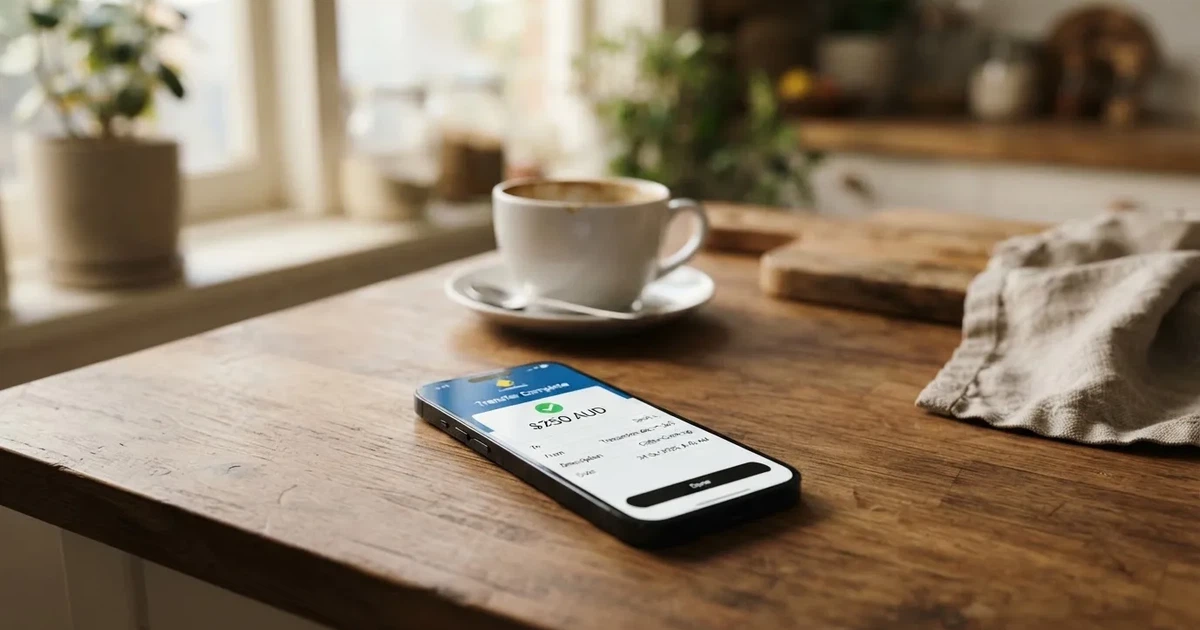
Bank transfer through Osko arrives in under a minute, twenty-four hours a day, including weekends, when both banks are participants in the New Payments Platform. Paying to a PayID shows the name on the receiving account before the transfer is sent — a feature that, in the gambling context, is not a convenience. AusPayPlus warns that being asked to transfer to a PayID on an illegal gambling site is almost certainly the shape of a scam: the PayID name will not be a known operator name, the transfer will be to a corporate vehicle that cannot be traced back to a registered Australian business, and the receipt itself will be the only record of the transaction. Osko and PayID are available at over a hundred Australian financial institutions, and more than 25 million PayID identifiers were registered on the platform by April 2025. The speed that makes the rails useful for paying a bill also makes them a poor choice for sending money to a site the ACMA has blocked at the network level.
BPAY is the bill-payment rail inside online banking — the punter enters a Biller Code and a Customer Reference Number, the way they would pay a utilities bill. It has operated in Australia since 1997 and is available at over a hundred and forty banks; the platform is owned jointly by the four majors through Australian Payments Plus. BPAY is, in principle, available on the deposit side of licensed wagering services. For offshore casino deposits, its relevance is different: the bill-payment format means the transaction is a clean, named, audit-trailed transfer, and AUSTRAC’s threshold-transaction-report rule does not capture it (the rule applies only to physical cash above A$10,000). That is, a BPAY transfer is one of the easier deposits to reconstruct after the fact.
Apple Pay, Google Pay and Samsung Pay accounted for around 45% of all card payments in Australia by number at the end of 2025, which makes a wallet payment the single most common way a punter will try to move money to a gambling site. That has two consequences. The first is the surcharge: Apple does not charge consumers for Apple Pay, but the merchant pays its own card-processing fees, and the Reserve Bank’s July 2025 review on surcharging proposes removing surcharges only on eftpos, Mastercard and Visa — American Express stays outside the proposed ban. Whether a punter eats a surcharge at the offshore casino depends on the card behind the wallet, not on the wallet itself. The second is the credit-card prohibition under the Interactive Gambling Act as amended in 2023: Australian-licensed wagering services cannot accept payment by credit card or credit-related products, and the prohibition constrains the use of linked digital wallets as well. An offshore site asking for a credit-card-funded Apple Pay deposit is asking for a payment the law already prohibits a licensed operator from taking.
What the bank’s gambling block actually does
Westpac’s gambling block works at the card level: it refuses authorisation of any transaction registered under the merchant category code for Betting and Casino Gambling on an eligible personal credit or debit card. The block is set by the customer, not the bank. ANZ’s version is the same idea with a wider net — when activated in the ANZ app, it blocks gambling transactions made through a digital wallet such as Apple Pay on the underlying card, not just on the card itself, because the merchant category code is the same code at the point of authorisation regardless of which wallet wrapped the card. Turning the ANZ block on is one switch; turning it off again requires a 48-hour waiting period, and ANZ warns that some non-gambling transactions may be blocked in error. Commonwealth Bank offers the same lock via the CommBank app. None of these banks guarantee that every gambling transaction will be blocked, because the merchant category code is set by the merchant and not every offshore operator codes itself correctly.
Why payout speed is hard to verify before the fact
Offshore brands quote payout times that are real numbers — twenty-four hours, forty-eight hours, “instant” — but those numbers describe what the brand does with the withdrawal request on its own end. They do not describe what the bank does once the request hits it. A withdrawal to a bank account via Osko arrives within a minute at the receiving bank; a withdrawal to a card goes through the card scheme’s own clearing cycle and may take several business days even when the site has approved it instantly. The site’s advertised payout time is a best case. The bank’s processing time is a separate best case, and they are not always the same number.
What a casino bonus code actually is
A bonus code is a string — usually a short alphanumeric token, sometimes a longer alphanumeric phrase — that the punter enters at the cashier or that the punter clicks through from an affiliate link that pre-fills the offer. The string is the visible part of a small data structure: it identifies which promotion the player is claiming, what the headline amount is, what the wagering requirement is, what the maximum cashout is, and which games the bonus can be played on. None of these are negotiable after the fact. They are the offer.
What the code unlocks, in plain language
The code does two things. The first is that it identifies which offer the player wants among several that may be running on the same site — a welcome package for new sign-ups, a reload for existing customers, a free-spin bundle tied to a specific slot. The second is that it commits the site to the terms published alongside that specific offer, rather than to whatever default the site would otherwise apply. If the punter does not enter the code, they usually do not get the headline offer; if they enter the wrong code, they get whatever that code unlocks instead, which may be nothing.
The bonus itself is, in most cases, not real money. It is a credit on the player’s account that can be wagered but not withdrawn directly. The punter deposits their own money, plays with a balance that includes both the deposit and the bonus, and only the winnings — not the bonus itself — are eligible for withdrawal once the wagering requirement has been cleared. This is the standard structure, and the variations are about how steep the requirement is, not whether the requirement exists.
Free spins versus bonus cash
A free-spin bundle is a fixed number of spins on a fixed slot at a fixed stake value, with any winnings credited as bonus cash. Free spins are the easier offer to assess because the headline number is also the upper bound on what the player can get out of it: a hundred spins at twenty cents a spin is, before wagering, at most twenty dollars in slot credit, and after wagering whatever the slot actually paid out across those spins. A bonus-cash offer — “100% match up to A$500” — has no such ceiling on the upside, because the punter is playing with the bonus money on whatever game they choose. The downside is the same in both cases: the bonus is not real money until the wagering requirement has been cleared.
The wagering requirement, and what it actually costs
The wagering requirement is a multiple — usually between thirty-five and fifty times the bonus — that sets how much the punter has to wager before any winnings become withdrawable. A A$100 bonus with a 40x wagering requirement is A$4,000 of wagering before the winnings are unlocked. At a slot with a 96% return-to-player, A$4,000 of wagering produces, on average, A$160 of loss — the cost of clearing the bonus. That is not a charge anyone is making; it is the house edge doing its work across the volume of play the requirement forces.
Different games contribute differently to the wagering requirement. Slots typically contribute 100% — every dollar wagered counts as a dollar toward the requirement. Table games often contribute less — sometimes 10%, sometimes nothing. The punter who plays blackjack to clear a bonus is doing ten times the wagering the requirement says, which is a problem nobody surfaces in the marketing.
Maximum cashout and game restrictions
Most bonus-code offers carry a maximum cashout — a cap on what the punter can actually withdraw from bonus-derived winnings once the wagering requirement is cleared. A common shape is a cap of five or ten times the bonus amount. A cap on a A$100 bonus at 5x is a A$500 ceiling on what the bonus can produce, regardless of how much the punter actually wins. This is the rule that converts a fifty-times-the-bonus upside into a finite number.
Game restrictions are layered on top. Some slots are excluded from the bonus entirely — usually the higher-volatility titles — and playing them with bonus money either does not contribute to the wagering or voids the bonus. The punter who picks the wrong game loses the bonus and, often, the winnings that were attributed to it. The terms are long, the language is dense, and the consequence of misreading them is asymmetric.
Why codes expire, and how
Codes expire. A code is tied to a campaign, and campaigns run for a fixed window — sometimes a week, sometimes a season, sometimes indefinitely. Most sites publish an expiry date alongside the offer; many do not. The punter who picks up a code from an affiliate page and tries to use it three months later is, in the most common case, simply not getting the offer at all, because the site no longer recognises the string. Affiliate pages stay up longer than the offers they describe, because there is no cost to leaving an expired page live. The presence of a code on a marketing page is not evidence that the code works.
The Australian market at a glance
What is licensed onshore
Wagering on races and sport, placed before the event, is licensed in Australia. Lotteries and keno are licensed at state and territory level. The Northern Territory Racing and Wagering Commission regulates fifty-two of Australia’s online bookmakers — Sportsbet, Bet365, Ladbrokes among them — licensed in the Territory for tax reasons; the commission has no full-time staff and meets once a month in Darwin. What is not licensed, anywhere in the country, is online casino games, online pokies, or in-play betting on sport.
What is not licensed
The Interactive Gambling Act 2001, strengthened by the Interactive Gambling Amendment Act 2017, makes it an offence to provide online casino games, online pokies or in-play betting to a person physically in Australia. No state or territory license covers these products. An offshore brand that displays a Curaçao or Kahnawake or Anjouan license is licensed in that jurisdiction to provide casino games; it is not licensed to provide them to Australians.
What the ACMA does about it
The ACMA investigates, issues formal warnings, and directs Australian internet service providers to block illegal sites. The enforcement figures published in June 2026 are the headline: 1,751 illegal gambling and affiliate marketing websites blocked since the first blocking request in November 2019, and more than 230 unlicensed gambling services have left the Australian market since enforcement was strengthened in 2017. In the round reported on 26 June 2026 alone, the ACMA asked ISPs to block twelve more sites, including 7Signs, ChromaBet, Donbet, Duospin, Freshbet, Slots Gem, Jacks Club, Lucky Start, Pointsbetz, Spinrise, Vinyl Casino and Wildsino. These are not isolated actions. They are the steady output of an enforcement regime that has been running for nearly a decade.
The market shape underneath the enforcement
H2 Gambling Capital’s 2025 report estimates that Australians lose about A$3.9 billion a year to illegal gambling sites. The legal share of total gambling has fallen from 74% in 2021 to 64% — a ten-point swing in four years, against a backdrop of a regulator blocking sites and operators leaving voluntarily. The shape that produces this is exactly what the bonus code is for: a marketing channel aimed at Australian customers, by operators the law already says should not be serving them, with offers designed to convert the visit into a deposit. Removing the marketing channel — the code, the affiliate page, the banner — does not remove the underlying demand. It does remove the most measurable part of the funnel.
The 2026 reform that has not yet commenced
The Interactive Gambling Amendment (Gambling Reform) Bill 2026 passed Parliament on 19 August 2026. Its advertising and inducement measures commence on 1 January 2027. This is a law with a start date, not a law in force: anything written about the bonus-code advertising regime before that date is writing about the regime as the regulator interprets the existing Interactive Gambling Act, not about the regime the new bill describes. The two will overlap for a window of months.
Casino bonus codes in Australia — More on this topic at casino deposit.
The legal frame around the offer
The Interactive Gambling Act in operation
The IGA targets the provider, not the player. An Australian who deposits at an offshore casino is not committing an offence under the Act; the operator that accepts the deposit is. This is not a get-out: it means the consequence of the offshore transaction falls on the operator through the regulator’s enforcement tools, not on the player through the criminal law. The consequence for the player is that the protection the law gives a consumer of a licensed service — recourse through a regulator, a binding complaints process, intervention if a self-exclusion is breached — does not attach.
What the formal warnings actually do
A formal ACMA warning is a published finding that the operator has offered a prohibited interactive gambling service to Australians. It is not a prosecution; it is the precursor to one if the conduct continues. It is also the closest thing to a public record of which brands are actively marketing to Australians at any given moment. The brands on the table further down this page are there because the ACMA has named them in a formal warning, not because any reviewer has rated their offers.
Credit cards, crypto, and what the law already prohibits
Credit cards and credit-related products cannot be used to fund licensed Australian wagering since the 11 June 2024 prohibition took effect; penalties for operators that breach the rule run up to A$247,500. Digital currency is in the same category for licensed operators. The legal deposit routes for licensed wagering are debit card, bank transfer, PayID/Osko and BPAY. An offshore site that asks an Australian for a credit card or a crypto deposit is, on the deposit method alone, asking for a payment that a licensed operator would not be allowed to take. Whether the offshore operator takes it anyway is a question of which set of rules the operator is operating under.
Tax and what an Australian punter should know
Gambling winnings of a recreational player are not assessable income in Australia — section 6-5 of the ITAA 1997 is the line in the tax law that settles this — and losses are not deductible. The exception is a person who carries on a business of gambling, which is the ATO’s “professional gambler” model and not the situation a recreational punter is in. The point of saying it: any winnings paid out from an offshore casino are not taxable income, and any losses the wagering requirement produces are not deductible. The tax side of the transaction is neutral. The economic side — the house edge doing its work across the volume of play — is not.
The brands the ACMA has warned
Each brand below is a brand the ACMA itself has named in a formal warning under the Interactive Gambling Act 2001. The table is a record of regulator action, not a ranking, not a recommendation, and not a comparison of bonus terms — affiliate pages were the only sources for those, and the marketing does not survive the comparison. The order is the order the ACMA’s actions are recorded in, with the most recent first.
| Brand | ACMA action and date | Operator named by the ACMA | Subject support (sources) |
|---|---|---|---|
| RocketPlay | Formal warning, March 2026; earlier Dama N.V., May 2022 | Pulsup Ltd | Gambling Insider (listings only) |
| Jackbit | Formal warning, April 2026 | Ryker B.V. | — |
| Ignition Casino | Formal warning, July 2025 | Bamboo Media | — |
| National Casino | Formal warning, July 2025 | Consolutetish S.R.L. | ACMA register; AUSTRAC; BetStop (listings only) |
| Bizzo Casino | Formal warning, July 2025; earlier TechSolutions, 2022 | Consolutetish S.R.L. | Gambling Insider (listings only) |
| Casino Intense | Formal warning, April 2025 | Sterplay Holding Ltd | AUSTRAC; BetStop; Gambling Insider (listings only) |
| Woo Casino | Formal warning, March 2025 | Dama N.V. | — |
| Spirit Casino | Formal warning, May 2025 | Dama N.V. | — |
| Instant Casino | Formal warning, February 2025 | EOD Code SRL | EcoPayz; PayID (listings only) |
| Sky Crown | Formal warning, September 2022 | Hollycorn N.V. | — |
| Level Up Casino | Formal warning, May 2022 | Dama N.V. | Westpac (listings only) |
The brands are connected to the ACMA’s actions through their operating companies, not through the brand name. Dama N.V. operates Woo Casino, Spirit Casino and Level Up Casino, and has been warned in 2022 and again in 2025; Consolutetish S.R.L. operates National Casino and Bizzo Casino. The corporate layering matters because the warning is published against the company that holds the eGaming licence, and a brand swap — the same operator launching under a new name — is one of the patterns the regulator’s enforcement has to track.
The “Subject support” column reflects what the consulted sources carry for each brand. A listing in Gambling Insider is not an endorsement; it is a presence on a directory that aggregates offshore brands. A listing at acma.gov.au is the warning itself. A listing at betstop.gov.au is the National Self-Exclusion Register — relevant because it shows where the brand sits in the Australian consumer-protection landscape, not because it sits inside it.
RocketPlay
The most recent ACMA action: a formal warning to Pulsup Ltd in March 2026 over RocketPlay, on top of the May 2022 warning to Dama N.V. that also covered RocketPlay. Two warnings, four years apart, against the same brand through two different corporate vehicles. The brand appears in the Gambling Insider directory. Online casino games cannot be licensed anywhere in Australia, whatever licence the site displays.
The verdict: a brand the regulator has had to warn twice, through two different operating companies, is not a brand that has changed its behaviour in response to the first warning. For a punter who has already decided to engage with an offshore casino, RocketPlay is the case where the regulator’s record is the most legible.
Level Up Casino
Warned in May 2022 as part of the six-brand Dama N.V. action, alongside Bambet, Dazard, Rocketplay, Wild Tornado and Cobra Casinos. The brand has a single appearance on Westpac’s gambling-block materials in the consulted sources. This service is not authorized in Australia.
The verdict: the brand’s profile on the consulted sources is thin — a single listing in a bank-block context, the original 2022 warning, and the consistent statement that no Australian license covers the product. A punter weighing Level Up against the others has nothing in the data that distinguishes it from any other Dama N.V. brand except the name.
Woo Casino
Warned in March 2025 as a separate Dama N.V. action. Online casino games are unauthorized here.
The verdict: a brand with a single regulator action and no other presence in the consulted sources. The only thing the data tells a punter is that Dama N.V. was warned again in 2025 after the 2022 round, which is the broader pattern rather than the Woo-specific detail.
Spirit Casino
Warned in May 2025, also a Dama N.V. action. Casino games remain unauthorized in this market.
The verdict: same shape as Woo Casino — a single regulator action, no other source presence. The punter-facing distinction between Woo and Spirit is the name and the date of the warning; the structural shape is identical.
National Casino
Warned in July 2025 alongside Bizzo Casino under Consolutetish S.R.L. The brand has the broadest source footprint in the consulted set: a presence in the ACMA’s own register, in the AUSTRAC materials, and in the BetStop self-exclusion materials. These services are not authorized in Australia.
The verdict: the brand is the most visible in the consulted sources outside the ACMA’s own actions. That visibility is not a positive — it is the footprint of a brand that has been marketed aggressively enough to show up in three different regulator and consumer-protection contexts. For a punter who reads the regulatory materials, National Casino is the brand whose name they will recognise fastest.
Bizzo Casino
Warned in July 2025 alongside National Casino under Consolutetish S.R.L., and warned earlier in 2022 to TechSolutions (CY) Group Limited and TechSolutions Group N.V. Two warnings, three years apart, two different corporate vehicles. The brand has a Gambling Insider listing. This brand is unlicensed in Australia.
The verdict: a brand that has survived a regulator warning by changing corporate vehicles. The punter-facing shape is the same as National Casino — same operator, same warning — but the 2022 record adds weight to the 2025 action. The regulator has had to name this brand twice.
Ignition Casino
Warned in July 2025 to Bamboo Media. Unlicensed in Australia.
The verdict: a single regulator action, no other source presence. The consulted data does not give a punter a way to distinguish Ignition Casino from the other 2025 warnees except through the brand name.
Instant Casino
Warned in February 2025 to EOD Code SRL. The brand has an EcoPayz listing and a PayID listing. The PayID listing is the one to pay attention to: a brand that turns up in the materials of a payment platform that warns against illegal-gambling-site PayIDs is a brand whose payment method has been the subject of consumer warnings by the platform itself. This service is unauthorized in Australia.
The verdict: the only brand in the consulted set with a payment-platform warning attached. The punter-facing shape is the Instant Casino offer plus a PayID context that the payment platform has flagged.
Jackbit
Warned in April 2026 to Ryker B.V., alongside CasinOK. Gambling services here remain unauthorized.
The verdict: the most recent ACMA action in the consulted set. The brand is named through Ryker B.V. alongside a second brand, which is the corporate pattern this table shows repeatedly — one operating company, several brand names.
Casino Intense
Warned in April 2025 to Sterplay Holding Ltd. The brand has listings in the AUSTRAC materials, in BetStop, and in Gambling Insider. This site is unauthorized in Australia.
The verdict: a brand with a regulator warning and a footprint across three of the consulted regulator and consumer-protection sources. The same pattern as National Casino — visibility across the regulatory set, not a positive distinction.
Sky Crown
Warned in September 2022 to Hollycorn N.V., alongside Blue Leo. This operator is not authorized here.
The verdict: the oldest formal warning in the consulted set, the smallest source footprint. A punter weighing Sky Crown against the others has the 2022 warning and a regulatory statement about Australian licensing, and nothing else from the data.
What the blocking rate tells a punter about the trajectory
The arithmetic of the ACMA’s blocking programme is a simple matter of looking at the data. The data is straightforward: 1,751 illegal gambling and affiliate marketing websites blocked since the first blocking request in November 2019, and the June 2026 round alone added twelve more. The shape of the number over time is the interesting part.
Computing the blocking rate
From November 2019 to June 2026 is roughly seven years and seven months, or about ninety months. Dividing 1,751 by ninety gives an average of roughly 19 sites blocked per month — a rate that the regulator has held steadily through several rounds of legislative strengthening and a pandemic-era surge in online gambling. The June 2026 round alone, at twelve sites, runs above that monthly average in a single week. A band of fifteen to twenty-five sites per month over the period is the shape the figure takes when the assumptions are stated honestly: steady-state enforcement with periodic bursts when a cluster of related sites is identified and actioned together.
What the rate tells a punter
The rate is the regulator’s tempo, and the tempo is the answer to a specific question: how long does an offshore casino that starts marketing to Australians today stay reachable from an Australian IP address before it is blocked? The honest answer is that some sites are blocked within weeks and some stay up for years, because the ACMA’s enforcement is triggered by complaints, monitoring, and referral, not by the act of launching a site. The aggregate rate is the backdrop; the per-site timeline is what the punter sees. A bonus-code offer from a brand that has been blocked once is, on average, the kind of offer a punter sees only briefly before the next blocking round.
Why the rate matters more than any single brand
The block list is not the marketing page. A punter looking at an offer from one of the brands on the table above is not looking at an offer the regulator has yet to act on — they are looking at an offer that has already been acted on, and the question is what the regulator will do next. The blocking rate is the proxy for that: an enforcement regime that adds roughly twenty sites per month is a regime that will add more sites. A punter who has chosen to engage with an offshore brand has chosen to engage with a brand whose shelf life in Australia is shorter than the brand’s shelf life in any other market it serves.
What this page is not for
This is a page about what a casino bonus code is, what it costs the punter, and why the Australian legal frame treats the offer as the visible part of an illegal transaction. It is not a page that will give anyone a working code. The brands on the table above are brands the ACMA has named; they are not brands to play at, and the order they appear in is the order of regulator action, not the order of merit.
A punter reading this page who has already decided to engage with an offshore casino has the responsible-gambling shelf first, the payment mechanics second, and the bonus-code mechanics third, in that order. The order is not arbitrary. The first shelf is what to reach for before the decision. The second is what to know about the rails before the deposit. The third is what to know about the offer before the wagering begins. A punter reading this page who has not yet decided has the legal frame, the responsible-gambling shelf, and the responsible-gambling support line: 1800 858 858, free, twenty-four hours a day.
Frequently asked questions
What does a casino bonus code technically unlock at the site that issues it?
A bonus code identifies a specific promotion among those the site is running — usually a welcome match, a reload, or a free-spin bundle — and commits the site to the terms published alongside it. The bonus itself is a credit on the player’s account that can be wagered but not withdrawn directly; only the winnings become withdrawable, and only after a wagering requirement has been cleared. No bonus code changes the underlying legal status of the offer in Australia.
Is it legal for an offshore casino site to advertise bonus codes to visitors in Australia?
No. The Interactive Gambling Act 2001 makes it an offence to provide online casino games — including offers made through bonus codes — to a person in Australia. The IGA targets the provider, not the player. The consequence is that an Australian who deposits at an offshore casino is not committing an offence, but is also outside the consumer-protection regime the IGA sets up for licensed wagering.
Do bonus codes typically expire, and how is that usually disclosed?
Codes are tied to campaigns, and campaigns run for a fixed window. Some sites publish an explicit expiry date; many do not. Affiliate pages that carry the code often stay live longer than the offer they describe. A code that no longer works is not a refundable transaction — the punter cannot recover the deposit because the offer was not honoured. This is one of the consumer-protection gaps the offshore site cannot bridge.
What wagering requirements are commonly attached to a bonus-code offer?
Wagering requirements are usually between thirty-five and fifty times the bonus amount. Slots typically contribute 100% of each wager to the requirement; table games often contribute less, sometimes 10% or nothing. A A$100 bonus at 40x is A$4,000 of required wagering. At a 96% return-to-player slot, the house edge across that volume is the actual cost of clearing the bonus — a cost the punter pays whether or not they win.
Can entering a bonus code change the minimum deposit an offshore site requires?
Some codes are deposit-gated — the offer unlocks only when the punter deposits a specified minimum. Entering the code does not lower the minimum; the code either attaches to the deposit the punter has already made or fails to attach because the deposit was below the threshold. The minimum is part of the offer’s terms and is not negotiable after the fact. The minimum is rarely the binding constraint; the wagering requirement usually is.
Why does the ACMA warn about offshore sites regardless of what bonus codes they advertise?
A formal warning under the Interactive Gambling Act 2001 is a finding that the operator has provided a prohibited interactive gambling service to Australians — the provision of the service is the offence, not the inducement. The bonus code is evidence that the service is being marketed, but the underlying offence is the supply of the product. A site can run no bonus code at all and still be providing a prohibited service; the warning follows the provision, not the marketing. The ACMA’s enforcement tempo, at roughly twenty sites blocked per month across the November 2019 to June 2026 period, is the proxy for the question of how long an offshore offer stays reachable from Australia.