
iPad casinos in Australia in 2026: the gap between a working tablet site and a lawful one
The shortest honest answer to whether an iPad casino exists for an Australian player is that the hardware has nothing to do with it. A site rendering on a Safari or Chrome tab inside a tablet frame is the same site rendering on a desktop monitor in another room. The Interactive Gambling Act 2001 does not care which screen loaded it. What changes between a desktop and an iPad is the session — when it starts, how long it lasts, and how easy it is to mistake a real-money wager for a thumb-scroll through pokies between emails. The brands that load cleanly on a tablet, that accept a PayID transfer, that hand out a no-deposit bonus and that run Bitcoin funding all exist; what does not exist is an Australian licence for any of them. Every name on the ACMA’s published warning list is the same shape of offer, repackaged for a different screen.

Current as of 31 October 2026 against the ACMA’s formal-warning register and the Interactive Gambling Act 2001 as amended.
Table of Contents
- The bottom line for an iPad casino in Australia
- Why tablet play is its own conversation, not a smaller desktop
- The Interactive Gambling Act 2001 and what it actually covers
- Responsible gaming on a tablet, with no Australian licence to lean on
- Payments, payout speed and the instrument that matters
- The mobile layer: browser, app, and what Apple actually allows
- Comparison of ACMA-warned brands
- What the warning list does not tell a reader
- The bonus layer, and what it really costs
- What an Australian player actually controls, layer by layer
- What a reader should take from this
- Frequently asked questions
The bottom line for an iPad casino in Australia
Three sentences carry the page before anything else needs to.
No online casino, online pokie or in-play betting service may be supplied to a person physically in Australia. The IGA, as strengthened by the 2017 amendments, makes the supply itself the offence — not the player, but the provider offering the prohibited interactive gambling service.
A site that works on an iPad is, in every practical sense, an offshore site. The licence it displays will be from Curaçao, Anjouan or Kahnawake. It will not be from any Australian state or territory, because none of them issue one.
A balance held with such a site has no Australian consumer protection. There is no dispute body to write to, no local regulator to escalate to, and the site can be blocked at ISP level while a real-money balance is still sitting in the account.
That is the entire frame. What follows on this page is the layer below it: how the tablet experience differs from the desktop one, how the ACMA has actually used its enforcement powers, which operators carry a published formal warning, what a no-deposit bonus costs in turnover, and where the responsible-gaming controls actually live when the casino itself is offshore.
See also Pocket Pokies Casino Australia 2026.
Why tablet play is its own conversation, not a smaller desktop
A desktop session is bounded by a chair and a screen. A tablet session is bounded by what is in your hand on the couch, at the kitchen table, in bed, or during the ten minutes between meetings. The games are the same HTML5 builds running through the same browser engine, but the conditions under which a person plays them are not.
A touchscreen shifts the input model. A mouse cursor is precise and slow; a thumb is loose and fast. That matters at three points: the slider on a deposit amount, the chip-stack selector on a roulette table, and the spin button on a pokie. Most offshore sites have rebuilt these for touch, which is why the tablet rendering is rarely worse than the desktop one. What the tablet adds is friction at the checkout. A bank transfer on a desktop is a copy-and-paste of a BSB and account number; on a tablet it is the same field set rendered smaller, often with autofill that may not match. A PayID transfer shows the recipient’s name on screen before the customer confirms, and that confirmation step is the moment a scam site’s name will fail to match — a small but real protection that holds on a tablet just as it does on a phone.
The other thing a tablet changes is the duration of accidental play. A desktop session usually requires choosing to sit down. A tablet session can begin with a notification, an idle browser tab, or a search that lands on a casino page. The session is shorter, but it is also more frequent. That is the responsible-gaming angle this page keeps returning to, and it is the one the operator’s own “play anywhere” marketing copy does not.
The Interactive Gambling Act 2001 and what it actually covers
The IGA is short enough that the relevant clauses can be stated plainly. It prohibits the supply of a “regulated interactive gambling service” — online casino games, online pokies, in-play sports betting — to a person who is physically present in Australia. The supply is the offence. The customer is not the target of criminal enforcement. What the customer does not get, by virtue of being outside the licensed system, is consumer protection.
The 2017 amendments gave the ACMA the power to issue formal warnings, accept court-enforceable undertakings, and direct Australian ISPs to block offending sites at the DNS level. The 2023 amendments extended the prohibition to credit cards and credit-related products being used to fund licensed online wagering — a change that came into force on 11 June 2024 and that reaches Apple Pay and Google Pay transactions where the underlying card is a credit card, because the prohibition tracks the funding instrument rather than the wallet.
What is not prohibited, and is licensed, is pre-event wagering on sport and races, lotteries, and keno. The Northern Territory Racing and Wagering Commission regulates the bulk of online bookmakers — Sportsbet, Bet365 and Ladbrokes among them — because the operators choose NT licensing for the Territory’s wagering tax regime. The NTRWC has been the subject of its own press for running on a part-time model; an ABC report from 7 April 2026 noted that the commission has no full-time staff and meets once a month in Darwin. That detail matters because it tells the reader what the licensed wagering side of the Australian market actually looks like at the regulator level — and why “licensed” is not by itself a synonym for “well-supervised”.
The Interactive Gambling Amendment (Gambling Reform) Bill 2026 passed Parliament on 19 August 2026. Its advertising and inducement measures commence on 1 January 2027. On a 2026 page, that is law with a start date — not in force yet, but binding on how offshore affiliate marketing of casino products to Australian customers is going to be policed from the start of next year.
What enforcement looks like in practice
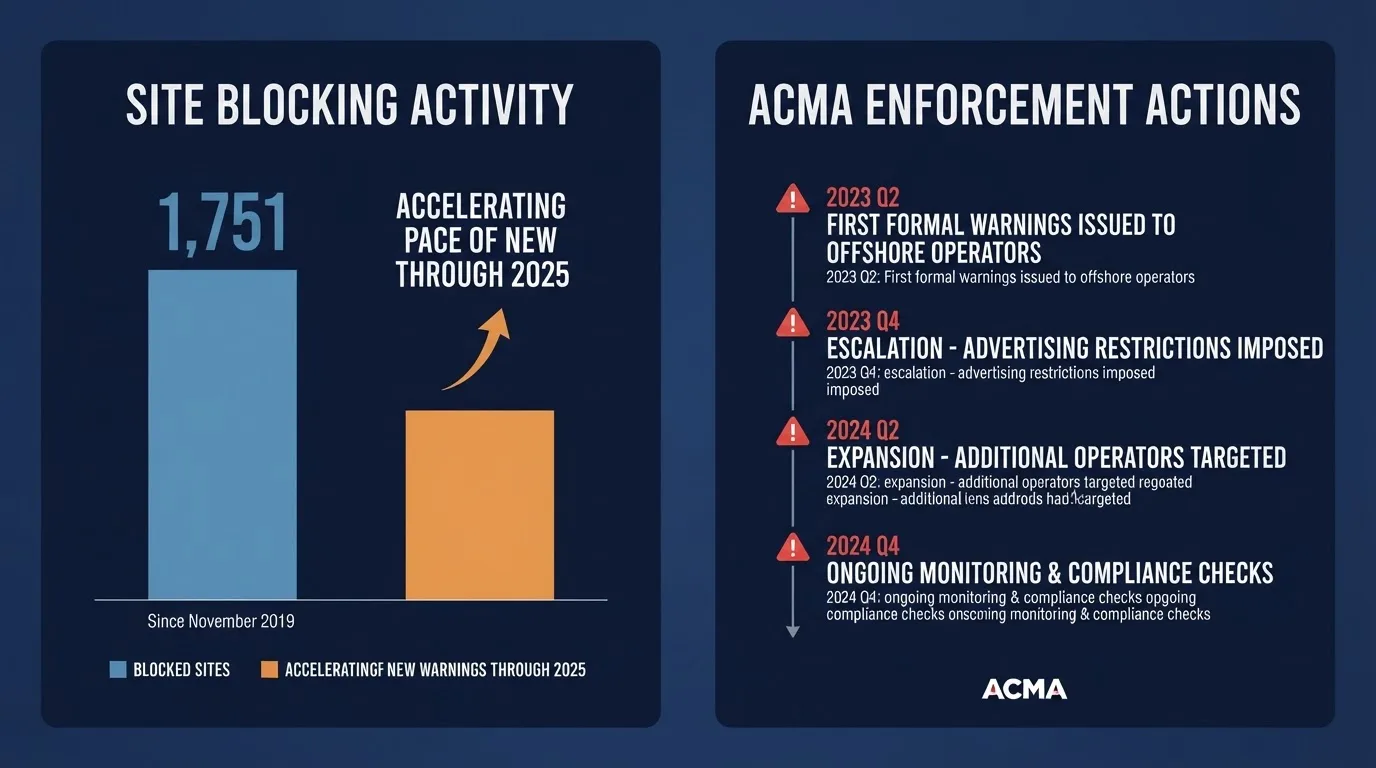
The ACMA’s tool of first resort is the formal warning — a published document naming the operator, the brand, and the section of the IGA breached. A second warning or a refusal to engage moves the matter toward civil action or an ISP block. The June 2026 blocking round, reported on 26 June 2026, asked ISPs to block twelve more sites: 7Signs, ChromaBet, Donbet, Duospin, Freshbet, Slots Gem, Jacks Club, Lucky Start, Pointsbetz, Spinrise, Vinyl Casino and Wildsino.
The cumulative effect, as of the same reporting, is that since the first blocking request in November 2019 a total of 1,751 illegal gambling and affiliate marketing websites have been blocked, and more than 230 unlicensed gambling services have left the Australian market since enforcement was strengthened in 2017. The blocking rate is the page’s own calculation, run in the section that follows.
The blocking rate since November 2019
The number of websites blocked between the first request in November 2019 and the June 2026 reporting sits at 1,751, across roughly six and a half years. That is an average of around 269 sites per year, or just over twenty-two per month, if the blocks were evenly distributed. They are not. The early rounds covered a backlog of long-standing sites; later rounds have been smaller and more targeted. A reader looking at the figure should hold it as a band — low hundreds per year as the steady-state, with occasional spikes tied to a single operator network — rather than as a flat monthly rate that the ACMA’s process does not actually run on. The cumulative total is the reliable number; the per-period rate is a working estimate.
The wider financial frame is that H2 Gambling Capital’s 2025 report estimates Australians lose about A$3.9 billion a year to illegal gambling sites, and that the share of gambling going through legal channels fell from 74% in 2021 to 64%. The block-and-leave figures and the financial scale figures come from different sources and they tell different parts of the same story: enforcement is reducing supply, and supply reduction is not yet reducing loss to the extent a reader might assume from the headlines.
Responsible gaming on a tablet, with no Australian licence to lean on
The BetStop National Self-Exclusion Register, live since August 2023, binds Australian-licensed online and phone wagering services. An offshore casino is not connected to it. A player who has registered with BetStop and then opens a tablet browser to an offshore casino site is, in the register’s terms, an Australian consumer acting outside the register’s reach. The register is real, the casino is real, and the two do not meet.
What is still available, because it lives at the bank level rather than the casino level, is a gambling transaction block. ANZ’s block, activated in the ANZ app, refuses authorisation of gambling transactions made through a digital wallet such as Apple Pay on an eligible card. Westpac’s gambling block works at the card level on the merchant category code “Betting/Casino Gambling”, refusing authorisation on eligible personal credit and debit cards. Commonwealth Bank’s gambling lock, applied via the CommBank app, automatically blocks most gambling transactions on the eligible cards — with the same caveat the other banks publish, that not every gambling transaction will be blocked and some non-gambling transactions may be blocked in error. Removing ANZ’s block requires a 48-hour waiting period, which is a small friction designed to discourage an impulsive reversal.
The four banks’ tools do the work an offshore casino’s own responsible-gaming page does not. They sit on the funding side, so they catch the transaction before it reaches the casino. They cover Apple Pay and Google Pay on a credit card because the block tracks the underlying instrument. They are imperfect — none of the four banks claims a complete block — but they are the most reliable Australian-resident control available to a person who is determined to fund an offshore casino account from an Australian bank.
The National Gambling Helpline 1800 858 858 is free, 24/7 and offers chat at Gambling Help Online. For a player who is concerned about their own play, those are the right first call. They sit ahead of any operator’s self-exclusion toggle, because the operator in question is not bound by Australian consumer law.
A practical responsible-gaming framing for tablet play, then, is layered. Set the bank block first, before the casino account is funded. Set a session timer on the tablet, not the casino, because the casino’s own timer is something the player can disable from inside the session. Decide in advance what the deposit ceiling is for the week, and have the bank block fail-closed if that ceiling is exceeded. None of these are substitutes for not opening the casino at all, which is the option the IGA’s own structure leaves available.
Payments, payout speed and the instrument that matters
An iPad casino site’s deposit page is where the substantive difference between a desktop and a tablet session tends to land. The cards, the e-wallets, the crypto options and the bank-transfer field are all the same HTML form, but the form is being read on a smaller screen with autofill doing more of the work and the player doing less of the looking.
Cards, credit versus debit, and the 2024 prohibition
The Interactive Gambling Act 2001 as amended in 2023 prohibits licensed online wagering services from accepting credit cards or credit-related products. That prohibition came into force on 11 June 2024. Penalties for licensed operators who take a credit card payment reach A$247,500 per offence. The prohibition does not, on its terms, bind an offshore casino — the offshore casino is outside the Australian licence frame — but it binds the Australian bank. The bank sees a credit card transaction coded to a gambling MCC, and the bank-side block fires.

What that means for the player is that a credit card, including a credit-funded Apple Pay transaction, will fail at the bank level rather than at the casino’s cashier. A debit card or a debit-funded wallet is the route that clears the bank block. Visa, Mastercard and eftpos are the three networks the Reserve Bank of Australia’s July 2025 review proposes to bring inside a surcharge-removal regime. American Express sits outside the proposed scope: it operates as a three-party scheme rather than Visa or Mastercard’s four-party network, which is the structural reason the RBA left it alone. The transaction will still be subject to the merchant’s own processing surcharge, because Amex rates are typically higher.
Apple Pay, Google Pay and the bank-side filter
By the end of 2025, Apple Pay, Google Pay and Samsung Pay collectively accounted for around 45% of all card payments in Australia by number. That share is large enough that a casino deposit page that does not show a wallet button is the exception, and a tablet is where the wallet button does the most work.
What a wallet does not change is the underlying instrument. A wallet presents a tokenised card number to the merchant; the merchant sees a card transaction; the bank sees the MCC. If the card is a credit card, the bank’s gambling block rejects the transaction whether the wallet was used or not. The RBA review’s commentary, and ANZ’s own block page, both make this point: the block applies to gambling transactions made through a digital wallet on an eligible card, not just to the physical card. Apple Pay itself does not charge a consumer fee for in-store, online or in-app use, so any surcharge on a casino deposit paid through Apple Pay is the merchant’s card-processing fee rather than Apple’s. Transaction limits and PIN requirements for Apple Pay purchases are set by the card issuer or merchant, not by Apple — Apple sets the platform, the issuer sets the floor.
PayID, Osko and the receipt that shows the recipient’s name
PayID-based instant transfers are available at over 100 Australian financial institutions, and more than 25 million PayID identifiers had been registered on Australia’s New Payments Platform as of April 2025. The platform itself became accessible to the public on 13 February 2018 and is owned by New Payments Platform Australia Ltd, a non-profit whose thirteen shareholders include the Reserve Bank of Australia and the major banks. In 2021 the ACCC authorised the merger of NPP Australia with BPAY and eftpos into a single company, Australian Payments Plus. AP+ runs the platform under contractual reliability rules that cap monthly outages at no more than two minutes.
For the player, what PayID gives is twofold. The transfer arrives in under a minute, 24/7 including weekends, whether the destination is a BSB and account number or a PayID. And before the transfer is sent, the customer sees the name of the account holder. AP+ warns that being asked to transfer money to a PayID on an illegal gambling site almost certainly means a scam site. That warning sits on top of the same IGA frame: a PayID transfer to an offshore casino is a transfer the casino’s bank can later identify, and the casino’s bank is itself outside the Australian rules.
Osko is the instant-transfer product running on top of the New Payments Platform. The same minute-or-less timing applies, and the same account-holder-name display applies. From the casino’s perspective, a PayID or Osko deposit looks like a normal bank transfer that happens to be instant; from the player’s perspective, the recipient-name check is the one safeguard an offshore cashier does not hide.
BPAY, the bill-payment mechanism, and what it is not
BPAY has operated in Australia since 1997 and is available in the online banking of over 140 banks and financial institutions, with over 95,000 businesses offering it as a payment method. The payer enters a Biller Code and a Customer Reference Number (CRN); the funds clear against the bill rather than as a direct transfer. BPAY was launched on 18 November 1997 and is owned equally, via the parent company Cardlink Services Limited, by Australia’s four major banks. It is run today by Australian Payments Plus, alongside PayID and Osko.
BPAY is built for bills, not for one-off casino deposits. A casino that takes BPAY is unusual; a casino that uses BPAY as a deposit rail is, in practice, asking the customer to treat the deposit as a bill payment. That is workable at the bank level — the funds clear, the bank’s MCC check still fires — but it is not what BPAY was designed for, and the customer should read the biller terms before relying on it.
Crypto, Bitcoin and the offshore cashier’s preferred rail
A bitcoin-funded iPad casino works the same way as a card-funded one at the wallet level: the deposit is a transfer to a casino-controlled address, the casino credits the balance once the transaction confirms, and the withdrawal is the reverse. What bitcoin changes is the bank-side filtering. There is no card transaction for the bank to see, no PayID name to check against the casino’s claimed operator, and no merchant category code to fire the gambling block on. The AUSTRAC threshold-transaction-report rule, which requires reporting of transfers of A$10,000 or more, applies to physical cash only; ordinary electronic bank transfers are not subject to that per-transaction reporting, regardless of the amount sent. Crypto sits in a separate reporting frame, which is why the offshore casino’s deposit page often shows Bitcoin and a card option side by side: the bank card fails the gambling block, the Bitcoin deposit does not.
That is not a recommendation of one rail over another. It is an account of why the choice is on the page.
The mobile layer: browser, app, and what Apple actually allows
The phrase “iPad casino” almost always means a website, not an app. Apple restricts real-money casino apps from its store. A tablet user who downloads an app from the App Store will find the casino lobby is the social-casino or free-play version, with real-money play either absent or routed back through a browser tab. An offshore casino that wants to be on the tablet will hand the player a URL and let Safari or Chrome take it from there.
A browser-based casino site on an iPad is, functionally, the same product as on a desktop: the same RNG, the same RTP, the same bonus terms. The casino’s own marketing will tell the player the tablet experience is “optimised”, and at the level of touch targets and responsive layout it usually is. What the marketing will not say is that the bonus terms, the wagering multiple, the maximum cashout cap, and the withdrawal queue are all the same machinery on the same backend. A spin button that is easier to press with a thumb is still a spin button the casino is charging its edge on.
The exception worth knowing is the case where a casino packages a native iOS app as a Progressive Web App that installs from the browser rather than the App Store. That workaround exists, the games run inside the same browser engine the PWA wraps, and the install lives outside Apple’s review process. From a consumer-protection standpoint it changes nothing: the casino is still offshore, the licence is still Curaçao or Anjouan, and the IGA still applies.
Comparison of ACMA-warned brands
| Brand | ACMA action and date | Operator named by the ACMA | Subject support |
|---|---|---|---|
| RocketPlay | Formal warning, March 2026 (Pulsup Ltd); earlier Dama N.V., May 2022 | Pulsup Ltd (Rocketplay); earlier Dama N.V. | listings-only |
| Level Up Casino | Formal warning, May 2022 | Dama N.V. | listings-only |
| Woo Casino | Formal warning, March 2025 | Dama N.V. | — |
| Spirit Casino | Formal warning, May 2025 | Dama N.V. | — |
| National Casino | Formal warning, July 2025 | Consolutetish S.R.L. | listings-only |
| Bizzo Casino | Formal warning, July 2025 (Consolutetish S.R.L.); earlier 2022 (TechSolutions) | Consolutetish S.R.L.; earlier TechSolutions (CY) Group Limited and TechSolutions Group N.V. | listings-only |
| Ignition Casino | Formal warning, July 2025 | Bamboo Media | — |
| Instant Casino | Formal warning, February 2025 | EOD Code SRL | listings-only |
| Jackbit | Formal warning, April 2026 | Ryker B.V. | — |
| Casino Intense | Formal warning, April 2025 | Sterplay Holding Ltd | listings-only |
| Sky Crown | Formal warning, September 2022 | Hollycorn N.V. | — |
Every row is the same shape: a brand offered online casino games or pokies to Australian customers, the ACMA published a formal warning naming the operator entity, and the operator’s response — where one is recorded — varies. Dama N.V. has appeared more than once; in May 2022 over Bambet, Dazard, Level Up, Rocketplay, Wild Tornado and Cobra Casinos, then again in March 2025 over Woo Casino and in May 2025 over Spirit Casino. Consolutetish S.R.L. is the entity named in the July 2025 warnings over National Casino and Bizzo Casino, where Bizzo Casino had already been the subject of a 2022 warning to TechSolutions (CY) Group Limited and TechSolutions Group N.V. — a second formal warning tied to the same brand across different operator entities.
RocketPlay
Pulsup Ltd was issued a formal warning by the ACMA over RocketPlay in March 2026. The brand had earlier appeared in a May 2022 warning to Dama N.V. alongside five other Dama-operated brands. Subject coverage in the public listings is thin: Gambling Insider treats it as a standard offshore casino entry rather than as a special case, and the page does not pass that off as more than listings. The reading: a brand that has survived an operator change, returned to the Australian market, and been warned again. For a player weighing whether to open an account at all, the second warning is the more important of the two.
Level Up Casino
The Dama N.V. May 2022 warning named Level Up alongside Bambet, Dazard, Rocketplay, Wild Tornado and Cobra Casinos. Level Up’s casino product line is pokies and table games, with the same offshore cashier and the same browser-first delivery that the rest of the Dama portfolio runs. Subject coverage is listings-only (Westpac’s gambling block page lists the casino MCC under which a Level Up deposit would fall). The conclusion is structural rather than brand-specific: it is the same Dama portfolio, the same offshore frame, the same consumer-protection gap.
Woo Casino
Woo Casino carried a Dama N.V. warning in March 2025. The brand has no specific subject coverage beyond the ACMA action itself, which means there is no third-party listing on the page to compare the warning against. That absence is information: the ACMA’s warning is the only verified material fact about the brand’s status in Australia, and the page records it as that.
Spirit Casino
Spirit Casino carried a Dama N.V. warning in May 2025, two months after the Woo Casino warning. The two warnings, taken together, suggest a portfolio that the ACMA has been working through systematically rather than a one-off referral. There is no third-party subject coverage to compare against. The reading is the same shape as Woo Casino’s: the warning is the fact, and the absence of further public material is itself the picture.
National Casino
National Casino carried a Consolutetish S.R.L. warning in July 2025. The brand has third-party subject coverage from the ACMA’s own register, AUSTRAC’s reporting rules, and BetStop — three Australian-side sources that confirm the brand is in scope for Australian consumer-protection discussions rather than outside them. The AUSTRAC and BetStop references are to the regulator frameworks themselves, not to National Casino-specific actions; the ACMA warning is the brand-specific action.
Bizzo Casino
Bizzo Casino carried a Consolutetish S.R.L. warning in July 2025, having already been the subject of a 2022 warning to TechSolutions (CY) Group Limited and TechSolutions Group N.V. A brand that has been warned twice under two different operator entities is the cleanest case on the page for the argument that ACMA warnings track the operator shell as much as the brand, and that a new entity does not amount to a fresh start. Gambling Insider lists the brand, and the warning chain is the substantively interesting fact.
Ignition Casino
Ignition Casino carried a Bamboo Media warning in July 2025. There is no third-party subject coverage to add to the ACMA action. The page records the warning as the single verified fact about the brand’s Australian-facing status.
Instant Casino
Instant Casino carried an EOD Code SRL warning in February 2025. Third-party subject coverage includes EcoPayz’s payment-method listings and PayID’s own scam-warning page — the PayID reference being to the recipient-name check that fires when a transfer is attempted to a brand of this kind. A payment-method and a payment-network warning attaching to the same brand is the kind of evidence base the page is meant to surface.
Jackbit
Jackbit carried a Ryker B.V. warning in April 2026. No third-party subject coverage beyond the ACMA action. The warning is the verified fact.
Casino Intense
Casino Intense carried a Sterplay Holding Ltd warning in April 2025. Third-party subject coverage from AUSTRAC’s reporting rules, BetStop’s register scope, and Gambling Insider’s listings. The AUSTRAC and BetStop references are again framework-level rather than brand-specific; the warning is the brand-specific action.
Sky Crown
Sky Crown carried a Hollycorn N.V. warning in September 2022 — the earliest of the eleven entries on this page and the one that establishes the time range the register covers. No third-party subject coverage beyond the ACMA action. The 2022 date matters because the brand has been on the register for long enough that any current Australian-facing activity is, in the ACMA’s terms, a continuation rather than a new entry.
iPad casinos in Australia in 2026 — More on this topic at casino deposit.
What the warning list does not tell a reader
The eleven brands above are the ACMA’s published actions. They are not the only offshore casino brands an Australian player can reach on an iPad. They are the ones the ACMA has put on the public record. A brand that does not appear on the list is not, by virtue of that absence, lawful; the IGA’s prohibition is on the supply, not on the regulator’s notice. The list is evidence of enforcement, not a whitelist of safe options.
A reader who wants to compare the brands on a different axis — payout speed, game library, bonus size — should know that the only sources for those comparisons are the brands’ own affiliate marketing pages, and that those pages are written to drive sign-ups rather than to inform.
The bonus layer, and what it really costs
A no-deposit bonus on an iPad casino is the same shape as a no-deposit bonus anywhere else: a small credit the casino hands the player in return for opening an account, with wagering requirements and a maximum-cashout cap attached. The “no deposit” framing is the marketing word, because the player is in fact depositing time, attention, and the wagering turnover required to convert the bonus credit into withdrawable cash.
The arithmetic below is therefore stated as an example with stated assumptions, not as a specific brand’s published terms.
A no-deposit bonus of, say, A$20 with a 40-times wagering multiple requires A$800 of turnover before any winnings become withdrawable. On a pokie played at A$1 per spin, that is 800 spins. At a five-second interval per spin, 800 spins is 4,000 seconds, or roughly 66 minutes of continuous play. The expected loss on that turnover, at a typical online pokie RTP of 96%, is A$800 × 4% = A$32. The player is paying A$32 in expected loss to clear an A$20 bonus — a net expected cost of A$12. The bonus’s headline value is not its real value; its real value is the gap between the headline and the expected loss. That gap is negative for almost every player.
A maximum cashout cap — the kind the affiliate page typically lists as, say, 10-times the bonus — means the player can withdraw at most A$200 from the A$20 bonus, even if the wagering is cleared and the balance sits higher. The cap is the second mechanism that turns the headline into a smaller real number.
For a player evaluating any no-deposit offer on an iPad casino, the three numbers to ask for are the wagering multiple, the maximum cashout cap, and the eligible games. Without those three, the headline number is not a number the player can act on. The ACMA’s register does not carry them, because they are not the regulator’s concern; the regulator’s concern is whether the casino is offering prohibited interactive gambling services to Australians at all.
What an Australian player actually controls, layer by layer
The control stack for an Australian resident playing on an iPad at an offshore casino is, from outside in, the bank, the wallet, the casino’s own tools, the platform’s own tools, and the player’s own session habits. Each layer does something different, and each is imperfect in its own way.
The bank is the strongest layer. A gambling transaction block on an eligible ANZ, Westpac or CommBank card refuses authorisation at the merchant category code, and ANZ’s block extends to digital-wallet transactions on the same card. Removal of ANZ’s block requires a 48-hour waiting period. The bank-side block fires before the casino sees the transaction, which means the deposit never lands.
The wallet is a thinner layer. Apple Pay and Google Pay present a tokenised card to the casino; the bank still sees the underlying instrument. If the underlying card is a debit card on an account with a gambling block, the block fires. If the underlying card is a credit card, the IGA 2024 prohibition on credit-funded wagering and the bank’s own block both apply. If the underlying card is an unrestricted debit card, the deposit clears.
The casino’s own tools are the layer the casino advertises and the layer the casino controls. Deposit limits, session timers, time-out toggles and self-exclusion switches are all operated by the casino, on the casino’s own backend, with the casino’s own power to override them. The casino’s own terms page is also the layer that defines the wagering multiple and the cashout cap on a bonus.
The platform layer is the iPad’s own. Screen-time limits, app-level time restrictions, and content filters sit in iOS itself. They do not know that a casino is a casino, because the casino is a browser tab; but a screen-time limit on Safari or Chrome will throttle the session, and a content filter can be configured to block known gambling domains at the device level.
The player’s own habits are the least reliable layer. A session timer set inside the casino can be disabled from inside the session. A deposit ceiling set in advance can be raised at the cashier. A “this is the last time” resolve can be revised at 11pm. The reliable version of the player’s own habits is to set the limit before the session starts, on a tool the player does not control — the bank block, the iPad screen-time limit, the spouse’s view of the bank statement.
What a reader should take from this
The market is what the ACMA’s register says it is. Eleven formal warnings over the named brands, plus the 1,751 blocked websites since November 2019, plus the A$3.9 billion estimated annual loss to illegal sites. The legal frame is what the IGA says it is: prohibition on the supply, no Australian licence for online casino games, no Australian consumer protection for an offshore account. The tablet is what the hardware allows: a browser-based product, a touchscreen interface, a session that fits in the cracks of a day.
What the page is not is a ranking. The eleven brands are not ranked on payout speed, bonus generosity, or game count, because those numbers come from affiliate pages rather than from the ACMA’s register and the page does not pass affiliate numbers off as verified facts. The brands are listed in the order the register places them, and the page records the ACMA’s own action against each.
The honest closing position is that no offshore iPad casino is a safe option for an Australian resident, because the consumer-protection frame that would make “safe” meaningful is the Australian licence frame, and the licence does not exist. The bank block is the strongest available control; BetStop and the National Gambling Helpline are the Australian-side supports; the casino’s own tools are the weakest layer and should not be relied on as the primary safeguard.
The IGA is the law. The bank block is the wall. The casino is the gap between the two.
Frequently asked questions
Is it legal to play at an online casino on an iPad in Australia?
No. The Interactive Gambling Act 2001 prohibits the supply of online casino games, online pokies and in-play betting to a person physically in Australia. The individual player is not prosecuted, but the site is operating outside Australian law, holds no Australian licence, and offers no Australian consumer protection. The IGA does not distinguish between an iPad and a desktop — the prohibited service is the same in both cases.
Why do most iPad casino sites run through a browser instead of a dedicated app?
Apple restricts real-money casino apps from its App Store. An app offered by an offshore casino is typically a Progressive Web App installed from a browser tab, which wraps the same browser-rendered product rather than a separately distributed binary. The games, the cashier, the bonus terms and the withdrawal queue are all the same machinery on the same backend. The browser route is not a technical limitation; it is a consequence of the App Store’s content rules.
Does a bitcoin-funded iPad casino work any differently from a card-funded one?
At the wallet level, the two deposit rails behave differently. A card deposit is filtered by the bank’s merchant category code; a Bitcoin deposit is not, because no Australian bank sees the transaction in the same form. The casino credits the balance on confirmation either way, and the wagering turnover is the same. The substantive difference is which layer of the player’s own control stack sees the deposit — the bank, or only the casino’s own cashier.
What conditions usually apply before an iPad casino no-deposit bonus can be withdrawn?
A no-deposit bonus is converted to withdrawable cash only after the player has wagered the bonus amount by the casino’s stated multiple — commonly 30 to 50 times — on eligible games, and the resulting balance is usually subject to a maximum cashout cap. A typical A$20 bonus at a 40-times multiple requires A$800 of turnover, which at A$1 per spin is 800 spins and roughly an hour of continuous play. The expected loss on that turnover at a 96% RTP is A$32, against an A$20 bonus credit. The bonus’s real value to the player is the gap, and the gap is negative for almost every player.
Are the games on an iPad casino site identical to the desktop version?
At the game-engine level, yes — the same HTML5 build, the same RNG, the same RTP, the same volatility profile. What changes between a desktop and an iPad is the input model — touch targets replace mouse precision, session length is shorter and more frequent, and the cashier is rendered smaller with autofill doing more of the work. The marketing line that the tablet is “optimised” is true at the layout level and silent on the consumer-protection level, which is the level the IGA operates on.
What should someone check before entering payment details into an iPad casino site?
Three checks. First, whether the casino holds any Australian licence — none of the offshore brands on this page do, because none can. Second, whether the bank-side gambling block is in place on the card the deposit would run through — ANZ, Westpac and CommBank all offer one, and ANZ’s extends to digital wallets on the eligible card. Third, whether a PayID transfer is being requested to an account-name that does not match the casino’s claimed operator — AP+ warns that an account-name mismatch on a gambling PayID almost certainly indicates a scam site. None of the three checks turns an offshore casino into a lawful one; they reduce the surface area for loss.