
What an international casino can and cannot offer someone sitting in Australia
 Available in US
Anyone reading this from Australia is already past the part of the search where the offer looks straightforward. Online casino games, online pokies and in-play betting cannot be licensed for Australian customers anywhere in the country. The Interactive Gambling Act 2001, tightened by the Interactive Gambling Amendment Act 2017, makes that prohibition clear, and the Australian Communications and Media Authority has spent every year since enforcing it. What an “international casino” delivers, in practice, is access from Australia to a site the ACMA has identified as offering a prohibited interactive gambling service. The page that follows works from that premise rather than around it: what the law says, what the ACMA has actually done, which operators the regulator has named, what protections do and do not apply, and what a player in Australia can lawfully use instead.
Current as of 24 September 2026 and cross-checked against the ACMA’s formal-warning register and the Reserve Bank of Australia’s public materials on payment rails.
Table of Contents
- The cost a player pays before any bonus is even calculated
- Wellbeing tools Australians can actually use around offshore sites
- The brands the ACMA has acted against: a comparison, not a ranking
- What each of those brands actually offers, in plain terms
- The legal landscape: how the prohibition is enforced
- What the blocking rate actually tells a reader
- What the offshore site actually offers that an Australian-licensed one does not
- The lawful alternatives the search actually supports
- Frequently asked questions
The cost a player pays before any bonus is even calculated
The cost a reader pays for an offshore casino is paid in protections that look like a list of rights and end up being nothing of the kind. An Australian-licensed online wagering service is bound by Australian consumer law, an Australian dispute resolution route and the National Self-Exclusion Register. An offshore casino is bound by the licence it chose, which is never an Australian one because none exists, and by the law of the jurisdiction that issued it. That is the entire framework. A player who loses access to a balance, who has a withdrawal refused or who finds a bonus term they cannot meet has, in practical terms, nowhere to escalate the complaint that costs the operator anything. The first sentence of every review site that ranks these brands is “fully licensed and regulated”; the last is the affiliate disclosure. The middle is the offer.

That is why the angle of this page is cost rather than shortlist. A shortlist gives a reader somewhere to click. A cost analysis gives a reader something to weigh before the click. The figures and dates below come from the ACMA’s own publications, from the regulator’s blocking actions and from the Australian Payments Plus materials on PayID and Osko. Where a brand name appears, it appears because the regulator named it. Where a brand does not appear, it is because the regulator has not, in the period this page covers, published a formal warning against it. That is a different ranking principle from “best for Australian players”, and it is the only honest one available.
Why the offshore route costs the things onshore guarantees
The Australian-licensed route costs the player something concrete: a credit-card ban that excludes linked digital wallets from gambling transactions, a deposit that goes through PayID or BPAY rather than a cryptocurrency wallet, and a self-exclusion register that actually stops a banned player from logging back in. Those constraints exist because parliament decided that online gambling needed them. The offshore route removes every one of those constraints and, with them, every one of the safeguards they supported. A player who can deposit with a credit card through an offshore site is also a player who cannot complain to the ACMA when the same site refuses to pay out.
The asymmetry is the cost. It does not show up in the marketing, which is built to look like a feature set; it shows up at the moment a balance becomes hard to withdraw. The rest of this page walks through where each part of that cost is paid.
Wellbeing tools Australians can actually use around offshore sites
The harms an offshore casino poses are not hypothetical, and the response an Australian reader can mount is mostly onshore. BetStop, the National Self-Exclusion Register, went live in August 2023 and binds every Australian-licensed online and phone wagering service. It does not bind an offshore casino, because the offshore casino has no Australian licence to bind. A player who excludes themselves through BetStop and then opens an account at one of the brands the ACMA has named below will find that the exclusion does not follow them.
That gap is the part of the cost the marketing never addresses. A self-exclusion register is only as strong as the operators it covers. The onshore route is, on this single point, the route with the working tool; the offshore route offers the player an act of will and nothing else.
Bank-level gambling blocks that work even at an offshore cashier
The practical answer sits one layer down, at the bank. Australia’s major banks now let customers turn on a card-level gambling block that operates at the merchant category code “Betting/Casino Gambling” — the same code an offshore casino’s payment processor carries. Commonwealth Bank’s gambling lock, applied through the CommBank app, blocks most gambling transactions on the eligible card, with the bank’s own caveat that not every gambling transaction will be stopped. Westpac’s gambling block works the same way at card level: authorisation is refused on transactions registered under that merchant category code. ANZ’s gambling transaction block, also activated in the ANZ app, blocks gambling transactions on an eligible card and explicitly extends the block to digital wallets such as Apple Pay on that card, not just the physical card itself. Removing ANZ’s block once turned on requires a 48-hour waiting period, and the bank’s own page warns that some non-gambling transactions may also be blocked in error.
The mechanism is not perfect — a bank card block is a transaction filter, not a self-exclusion register, and a player who moves to a different bank or a different card will have moved past it. But it is the only Australian-deployed safeguard that reaches the offshore cashier at all. The ACMA’s enforcement record and the banks’ card-level blocks are doing two different kinds of work at two different layers of the stack.
Helplines that answer regardless of which site a player used
The National Gambling Helpline, 1800 858 858, is free, operates 24/7, and is reachable by online chat through Gambling Help Online. It does not require the player to name the site they were using, and it does not require an Australian-licensed account. For a reader already past the part of the decision where a helpline changes anything, the helpline still exists; the cost of asking is zero and the cost of not asking is the cost the rest of this page is built around.
The brands the ACMA has acted against: a comparison, not a ranking
The table that follows is not a Top 10 in the affiliate-marketing sense. Each row is a brand the ACMA has named in a formal warning, with the date and the operator the regulator named at that time. The columns are the smallest set that makes the regulator’s record readable at a glance; a column that adds a comparative judgement about the brand would invent a fact the page has no source for, and the page is built not to do that.
| Brand | ACMA action and date | Operator named by the ACMA | Subject support |
|---|---|---|---|
| RocketPlay | Formal warning, March 2026; earlier Dama N.V. warning, May 2022 | Pulsup Ltd (RocketPlay) | listings-only (Gambling Insider) |
| Level Up Casino | Formal warning, May 2022 | Dama N.V. | listings-only (Westpac) |
| Woo Casino | Formal warning, March 2025 | Dama N.V. | — |
| Spirit Casino | Formal warning, May 2025 | Dama N.V. | — |
| National Casino | Formal warning, July 2025 | Consolutetish S.R.L. | listings-only (acma.gov.au, austrac.gov.au, betstop.gov.au) |
| Bizzo Casino | Formal warning, July 2025; earlier TechSolutions warning, 2022 | Consolutetish S.R.L. | listings-only (Gambling Insider) |
| Ignition Casino | Formal warning, July 2025 | Bamboo Media | — |
| Instant Casino | Formal warning, February 2025 | EOD Code SRL | listings-only (EcoPayz, PayID) |
| Jackbit | Formal warning, April 2026 | Ryker B.V. | — |
| Casino Intense | Formal warning, April 2025 | Sterplay Holding Ltd | listings-only (austrac.gov.au, betstop.gov.au, Gambling Insider) |
| Sky Crown | Formal warning, September 2022 | Hollycorn N.V. | — |
Two things to read in that table. The first is the operator name in the third column — that is the entity the regulator named, and it changes for some brands across time. Bizzo Casino was warned as TechSolutions in 2022 and as Consolutetish S.R.L. in 2025; RocketPlay was warned as Dama N.V. in 2022 and as Pulsup Ltd in 2026. The brand on the website is not necessarily the company the regulator corresponded with, and the regulator corresponded with whoever was operating the site at the address the warning covered. The second is the fourth column. Subject support is not a payment-method endorsement; it is the set of listings the research drew on, named for transparency. An em dash means no such listing was carried by the inputs, not that the brand operates without any subject support at all.
The comparison the table cannot make
The prose beside the table carries what the columns cannot. Dama N.V. is the operator named most often across the table — four of the eleven brands carry a Dama N.V. formal warning, and a fifth (RocketPlay) carries an earlier Dama N.V. warning alongside its current Pulsup Ltd warning. The cluster of Dama N.V. brands includes Level Up Casino, Woo Casino and Spirit Casino; it is the most-enforced operator in the regulator’s record for this set. Consolutetish S.R.L. is the second cluster, named in two of the eleven brand rows for the July 2025 warning round that also caught Bamboo Media. The remaining five brands sit across five different operators, each named once. The regulator’s record therefore reads, in the period covered by research, as one operator with a portfolio of brand names, a second operator with two, and a long tail of single warnings — which is itself a fact about how the offshore casino market is structured in Australia, and not one the table’s columns are built to show.
What each of those brands actually offers, in plain terms
RocketPlay — the brand the ACMA warned twice under two operators
RocketPlay’s formal-warning record runs across two operators and four years. Dama N.V. was named in May 2022 covering six brands at once; Pulsup Ltd was named in March 2026 specifically over RocketPlay. The brand’s commercial offering is not part of what this page covers — no bonus terms are transcribed, because the only sources for them are affiliate marketing pages, and a reader who acts on an affiliate-page bonus term at a brand the ACMA has named twice is acting on a marketing document at a brand the regulator has acted against. The verdict on RocketPlay is the verdict on its regulator record: the same brand name, two different operators, four years apart, and the regulator has returned to it twice. That is not what a brand looks like when an enforcement action has shifted its behaviour.
Level Up Casino — one of the original Dama N.V. six
Level Up Casino was named in the May 2022 Dama N.V. warning round that covered six brands at once: Bambet, Dazard, Level Up, Rocketplay, Wild Tornado and Cobra Casinos. It is the earliest Dama N.V. action in the regulator’s record on this set. The brand sits inside the cluster of Dama N.V. names the regulator has returned to repeatedly across 2022, 2025 and 2026, and that cluster is what makes the Dama N.V. name the single most prominent operator in the page’s source material. A reader who arrived at Level Up Casino through an affiliate link has arrived at a brand the regulator warned in the first of four Dama N.V. warnings the table records.
Woo Casino — Dama N.V.’s 2025 entry
Woo Casino was named in a Dama N.V. formal warning issued in March 2025. The operator is the same Dama N.V. that the regulator had already warned in May 2022; the brand is a different one. That distinction matters because it tells a reader what the regulator’s behaviour looks like at an operator that has been warned before: the regulator returns to the operator and names a new brand rather than treating the original warning as a closure. Woo Casino’s verdict is therefore not “an offshore casino with a warning” — it is a brand under an operator the regulator has now named at least four times across four years.
Spirit Casino — the second Dama N.V. warning of 2025
Spirit Casino was named in the Dama N.V. formal warning issued in May 2025, two months after Woo Casino. The pair forms the 2025 half of the regulator’s Dama N.V. record; the 2022 half is the original six-brand warning, and the 2026 entry is the RocketPlay warning against Pulsup Ltd specifically. A reader who treats these as separate incidents is missing the operator-level pattern, and the operator-level pattern is what the regulator’s record is built to surface.
National Casino — Consolutetish S.R.L.’s 2025 entry
National Casino was named in the July 2025 formal warning issued to Consolutetish S.R.L. The same warning round also caught Bizzo Casino (under Consolutetish S.R.L.) and Ignition Casino (under Bamboo Media). National Casino’s verdict is the same as Bizzo Casino’s at the operator level: Consolutetish S.R.L. is the entity the regulator corresponded with, and that entity is named across two brands in the same warning round. The brand-level entry for National Casino is, in this case, the operator-level entry in a thinner form.
Bizzo Casino — two operators, two warnings, four years apart
Bizzo Casino carries two formal warnings. The first, in 2022, was issued against TechSolutions (CY) Group Limited and TechSolutions Group N.V. The second, in July 2025, was issued against Consolutetish S.R.L. — a different operator entity at the same brand. That sequence is the clearest illustration on this page of how the offshore market reorganises around enforcement: the brand persists, the operator changes, and the regulator names whoever is operating it at the time of the warning. A reader who is weighing the brand against an earlier review that mentioned the TechSolutions name is reading a brand the regulator has now warned twice under two different operators.
Ignition Casino — the Bamboo Media entry
Ignition Casino was named in the July 2025 formal warning to Bamboo Media, in the same warning round that caught Consolutetish S.R.L.’s National Casino and Bizzo Casino. Bamboo Media is named once across the regulator’s record for this set, which makes Ignition Casino’s verdict the kind the table’s fourth column reflects — no listings entry in the research inputs, because the brand was carried into the page only on the regulator’s evidence.
Instant Casino — the EOD Code SRL warning of February 2025
Instant Casino was named in the February 2025 formal warning issued to EOD Code SRL. It is the earliest 2025 warning on this page and the only one with a single brand attached, since the Woo Casino and Spirit Casino warnings are two months later and both Dama N.V. The brand sits in the regulator’s record as a single-operator, single-brand event.
Jackbit — the April 2026 Ryker B.V. warning
Jackbit was named in the April 2026 formal warning issued to Ryker B.V. The same warning round also caught CasinOK. Jackbit is one of two brands named in this round, and Ryker B.V. is named once on this page — the kind of single-appearance operator entry that the regulator’s record is full of, and which a reader might treat as a less serious warning by virtue of its lower profile. That reading would be wrong: a single formal warning from the ACMA is the same regulatory action whether the operator is a portfolio of ten brands or a single brand at a single address.
Casino Intense — the Sterplay Holding Ltd entry
Casino Intense was named in the April 2025 formal warning issued to Sterplay Holding Ltd. It is the only brand on this page linked to that operator, which places it in the long tail of single-appearance operator warnings the regulator has issued. The brand’s verdict is the brand’s regulator record: one formal warning, one named operator, no follow-up entries in the period the page covers.
Sky Crown — the Hollycorn N.V. warning of September 2022
Sky Crown was named in the September 2022 formal warning issued to Hollycorn N.V. The same warning round also caught Blue Leo. Sky Crown is the earliest entry on the page and the only brand tied to Hollycorn N.V. in the regulator’s record for this set. A reader comparing it to a 2025 warning would see a difference in date and not much else — a formal warning from the ACMA is the same regulatory action regardless of which year it was issued, and the page treats it that way.
The legal landscape: how the prohibition is enforced
The Interactive Gambling Act 2001, as amended by the Interactive Gambling Amendment Act 2017, makes it an offence to provide online casino games, online pokies or in-play betting to a person physically in Australia. No state or territory issues licences for online casino games; the only online wagering licences Australia issues are for racing and sports betting placed before the event, and these are issued in practice by the Northern Territory Racing and Wagering Commission. The NTRWC regulates 52 online bookmakers including Sportsbet, Bet365 and Ladbrokes, and operates with no full-time staff and a monthly meeting in Darwin.
The individual player is not the target of the IGA; the Act targets the provider. The offshore casino has no Australian consumer protection regime behind it, no Australian complaints body the player can escalate to, and no Australian dispute resolution route. A player who has a balance they cannot withdraw is, in practice, outside any system that can compel a payout. The site’s licence — Curaçao, Anjouan, whatever footer it carries — is the only legal frame in play.
What the ACMA has actually done
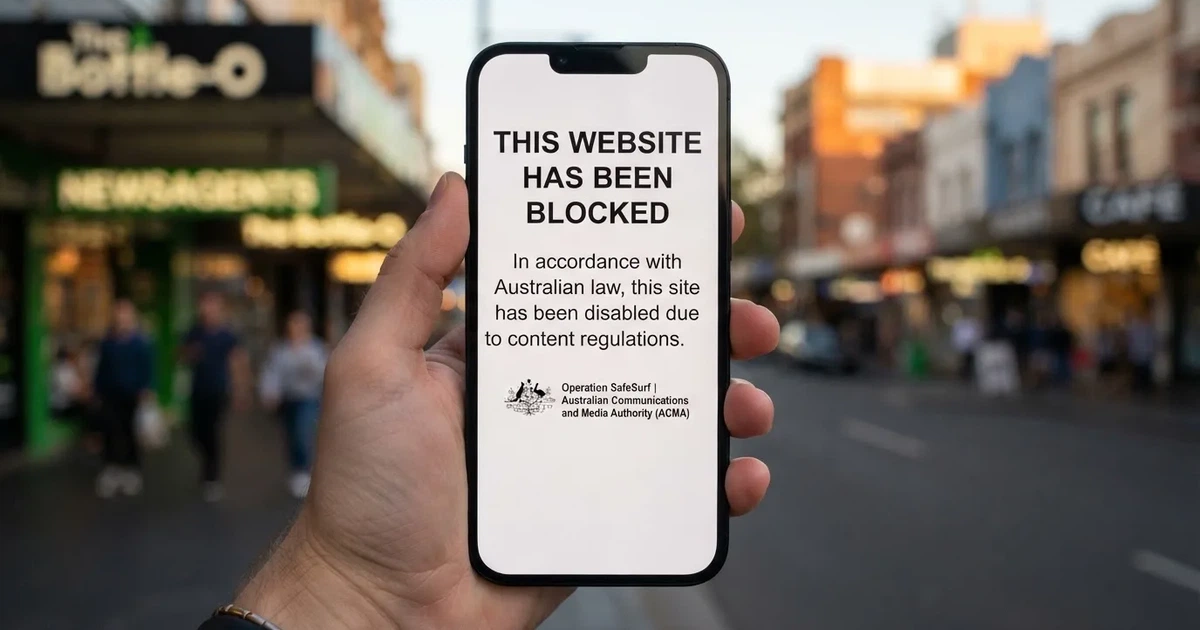
The ACMA’s enforcement record since November 2019 is the page’s primary source. As of June 2026, the regulator had asked Australian internet service providers to block 1,751 illegal gambling and affiliate marketing websites since the first blocking request, and more than 230 unlicensed gambling services had left the Australian market since enforcement was strengthened in 2017. The June 2026 blocking round alone covered 12 sites: 7Signs, ChromaBet, Donbet, Duospin, Freshbet, Slots Gem, Jacks Club, Lucky Start, Pointsbetz, Spinrise, Vinyl Casino and Wildsino.
What the ACMA has not done is also part of the record. The regulator has not blocked every offshore casino — it cannot, the operators rotate domains — and the rate at which it has blocked is the rate at which it has identified, corresponded with and pursued each operator through a formal warning to a blocking request. That rate is the page’s calculation, in the next section.
The reform that has passed and the reform that is still ahead
The Interactive Gambling Amendment (Gambling Reform) Bill 2026 passed Parliament on 19 August 2026. Its advertising and inducement measures commence on 1 January 2027 — law with a start date, not yet in force on a page read in the current year. A reader looking for the date the new advertising rules begin will find it in 2027; a reader looking for the date parliament passed them will find August 2026.
The payment side of the prohibition
Credit cards, credit-related products and digital currency have been banned as payment for Australian-licensed online wagering since 11 June 2024, with penalties of up to A$247,500 for operators who breach the rule. Legal deposit routes for licensed wagering are debit card, bank transfer, PayID/Osko and BPAY. The same restriction constrains gambling use of linked digital wallets like Apple Pay on Australian-licensed services. A site asking an Australian customer for a credit card or a cryptocurrency deposit is operating outside the Australian rules, and the page reads that request as a marker of which side of the prohibition the site sits on.
The tax position
Gambling winnings of a recreational player are not assessable income under section 6-5 of the Income Tax Assessment Act 1997, and losses are not deductible, unless the person carries on a business of gambling. The position is the model only — a player with a question about their own situation should check with the ATO, since the position depends on facts the page does not have.
What the blocking rate actually tells a reader
The blocking rate is the arithmetic the ACMA’s record supports. The first blocking request was made in November 2019. As of June 2026, the regulator had directed Australian ISPs to block 1,751 illegal gambling and affiliate marketing websites across that period. From November 2019 to June 2026 is roughly 79 months. The arithmetic is 1,751 divided by 79, which gives an average of around 22 sites blocked per month over the period.
Stated as a band rather than a single figure: the ACMA has been blocking illegal gambling and affiliate marketing sites at a pace that has averaged between roughly 20 and 25 sites per month since November 2019, on the conditions that the count covers both operator sites and affiliate marketing pages, that the count is the cumulative running total reported in June 2026, and that the period runs from the first blocking request in November 2019 to that report date.
The condition matters because the count covers both operator sites and affiliate marketing pages, and the mix has shifted over time. A reader who treats the figure as “22 offshore casinos blocked every month” is reading a different number than the regulator reported. The point of the band is that the regulator’s enforcement has run continuously and at a steady monthly pace, not that any single month’s blocking count sits on a precise line.
What the offshore site actually offers that an Australian-licensed one does not
Three things, and each one is also what the offshore site does not offer.
The offshore site accepts a credit card. The Australian-licensed wagering service does not, and has not since 11 June 2024. A player who is in the market for a credit-card deposit is, by definition, in the market for an offshore site — and is, by the same definition, outside the Australian consumer protection regime.
The offshore site takes payment in cryptocurrency. The Australian-licensed service does not. The same logic follows: a player who is depositing in crypto is depositing outside the Australian rules.
The offshore site offers online casino games and online pokies, the product the IGA prohibits for Australian customers. The Australian-licensed service does not offer that product at all, because no Australian licence covers it. The thing the offshore site “offers” is, structurally, the thing the law prohibits.
What the offshore site does not offer, in exchange, is the layer underneath. No BetStop self-exclusion. No ACMA complaint route. No Australian Consumer Law. No Australian dispute resolution. No AUSTRAC-monitored transaction reporting above the cash threshold — AUSTRAC’s threshold-transaction-report rule applies only to physical cash above A$10,000, and ordinary electronic bank transfers are not subject to that per-transaction reporting requirement, regardless of the amount sent. A reader comparing offers is comparing one side that has the legal frame and one that does not, and the side that does not is the side the regulator has been blocking since 2019.
The lawful alternatives the search actually supports
Lawful alternatives summary
| Alternative | Regulator | Scope |
|---|---|---|
| Land-based casinos | State/Territory regulators | Table games, pokies |
| Licensed pokies venues | State/Territory regulators | Poker machines |
| Online wagering | Northern Territory | Races, sports betting |
| Lotteries & Keno | State/Territory regulators | Retail, online channels |
The honest shortlist, for a reader in Australia, is not a list of offshore casinos. It is the list of what is licensable.
Licensed land-based casinos operate in every Australian state and territory and offer table games and pokies under state-level casino licences. Licensed pokies venues — pubs and clubs with gaming machines — operate under state and territory gaming regulations and offer poker machines only, no online play. Licensed online wagering on races and sport is available through the 52 Northern Territory-licensed bookmakers and a small number of state-licensed operators. Lotteries and keno are licensed by state and territory regulators and operate through retail and online channels. None of these offers an online casino game, because no Australian licence covers one. That is the answer to the search the page is built around.
How a reader can verify the offer they have been sent
A reader who has been sent a bonus offer by an offshore casino can check the brand against the ACMA’s formal-warning register at acma.gov.au. A brand that appears there has been the subject of a regulatory action; a brand that does not appear has not, in the period this page covers. The check takes a minute and costs nothing. The result is the reader’s own.
Frequently asked questions
What does “international casino” mean as distinct from an Australian-licensed one?
An international casino is an offshore operator that offers online casino games to customers in multiple jurisdictions, including Australia. An Australian-licensed casino does not exist as a product category: no Australian state or territory issues a licence for online casino games, online pokies or in-play betting, so the term has no onshore referent. The Australian-licensed online product is wagering on races and sport, which is licensed by the Northern Territory among others.
Can an international online casino legally accept players located in Australia?
No. The Interactive Gambling Act 2001, as amended in 2017, makes it an offence to provide online casino games or online pokies to a person physically in Australia. The individual player is not the target of the law, but the operator that accepts the player is. The ACMA enforces the prohibition through formal warnings and blocking requests to Australian ISPs, and the regulator has issued 1,751 such blocking requests between November 2019 and June 2026.
Does an overseas gambling licence carry any weight for an Australian player?
It carries the legal frame of the jurisdiction that issued it — typically Curaçao, Anjouan or Malta — and nothing else. It does not bring Australian Consumer Law into play, does not give the player a route to an Australian complaints body and does not connect the site to BetStop. A player who treats an overseas licence as equivalent to an Australian one is treating two different legal frames as one. They are not.
What protections, if any, apply to an Australian using an international casino site?
Three. First, the offshore casino’s own licence, in the jurisdiction that issued it, which a player would have to enforce in that jurisdiction. Second, the bank-level card blocks offered by Commonwealth Bank, Westpac and ANZ, which refuse authorisation at merchant category code “Betting/Casino Gambling” and, in ANZ’s case, extend to digital wallets on the same card. Third, the National Gambling Helpline on 1800 858 858, which is free and 24/7. What does not apply is BetStop self-exclusion, the ACMA complaint route and Australian Consumer Law.
Are international land-based casino resorts different from the international online sites people search for?
Yes, in the way that matters. International land-based casino resorts are physical venues in jurisdictions outside Australia and operate under those jurisdictions’ gaming licences; an Australian who travels to one is in a different legal environment. The international online sites people search for are websites offering online casino games to Australians, which the Interactive Gambling Act 2001 prohibits. The two products share a marketing vocabulary and not much else.
Who can an Australian contact if an international casino site will not pay out?
Practically, the bank that issued the card used for the deposit — to dispute the transaction through the card scheme’s chargeback process — and the National Gambling Helpline on 1800 858 858 for support with what comes next. Legally, the player is in the position of having to enforce any claim in the jurisdiction that issued the offshore casino’s licence, which is why the cost analysis on this page is built around the protections an Australian-licensed route provides rather than around an offshore enforcement route.
Written by the editors at Casino Deposit Info.