Best Aussie Online Casino 2026: The Honest Comparison
 Available in US
Data current as of 23 September 2026, verified against the Australian Communications and Media Authority’s published register of formal warnings and blocking actions.

The phrase “best Aussie online casino” sounds like a buyer’s guide. It isn’t. Under the Interactive Gambling Act 2001, no online casino — no pokies site, no table-games site, no live-dealer site — can be licensed anywhere in Australia to serve Australians. Every site a person in Australia can actually sign up to is offshore, unlicensed under Australian law, and on a list the ACMA is actively working through. The honest comparison, then, is not “which is best to play at” but “what does the landscape actually look like, what has the regulator done about it, and what does a person lose by being there at all.” That is what this page sets out.
Table of Contents
- What Counts as a New Aussie Casino Online
- How This Comparison Sets Up the Field
- The Legal Frame for Online Casino in Australia
- Who the ACMA Can Actually Reach
- What the Blocking Numbers Actually Look Like
- Help Available When Play Stops Being Fun
- Payments at Offshore Casino Sites: What the Rails Actually Look Like
- What Bonuses at Offshore Casinos Actually Cost
- Mobile Play: What the Casino’s Mobile Site Actually Does
- The Operators the ACMA Has Acted Against
- Comparison: What the ACMA’s Actions Look Like Across the Field
- The Pattern Behind the Names
- How a Reader Should Read the Field
- What a Punter Cannot Recover from an Offshore Casino
- The Wider Market Context
- A Final Word on What This Comparison Was For
- Frequently Asked Questions
What Counts as a New Aussie Casino Online
A “new” Aussie online casino is a marketing label, not a legal category. It means a newer offshore site — usually launched in the past year or two, often by an operator already running sister brands — that targets Australian players with AUD accounts, PayID-friendly banking and bonus terms tuned to the local market. None of that is new under Australian law. The law has not moved; what has moved is the brand.

What changes, when a new site opens, is mostly the surface. A new licence in Curaçao or Anjouan on the back end, a new domain, the same game providers the operator already used on older brands. Dama N.V., for example, has cycled through dozens of skins — Rocketplay, Level Up, Woo, Spirit — and the ACMA’s formal-warning register shows them turning up in different combinations across different months. From the regulator’s side, “new” is a relaunch, not an opening. From the player’s side, it is the same offer repackaged with a different URL.
That matters when a person reads “best new Australian online casino” as a recommendation. The newness has no regulatory meaning. The same operator can run a “new” site six months after the ACMA warned the last one, with the same game library, the same cashier, the same payment rails, and the same absence of Australian consumer protection. A site that markets itself as fresh is not, in any sense that matters to a punter, a fresh option.
How This Comparison Sets Up the Field
A fair comparison, in a market with no licensed local product, has to weigh what actually differs between offshore sites. Game library and software providers are largely shared — most of these sites run the same Pragmatic Play, Evolution, NetEnt and Play’n Go catalogue, so “what games are on offer” tells a reader very little. The differences that matter are:

- Operating company and history. Whether the operator behind the brand has been the subject of an ACMA formal warning before, and how recently.
- Banking rails. Whether the cashier is built around PayID and Osko, around cards, around crypto, or some mix.
- Bonus structure. What the headline offer actually requires — its wagering multiple, its time limit, any max-cashout cap.
- Withdrawal friction. Whether the site pays out at all, how long it takes, and what the complaints trail looks like when it does not.
This page compares on the first of those, because that is what the ACMA register actually lets a comparison rest on. The other three are matters of marketing copy, and the comparison below makes clear which operators the regulator has acted against, in what order, and which parent companies appear more than once.
The Legal Frame for Online Casino in Australia
The Interactive Gambling Act 2001, tightened by the Interactive Gambling Amendment Act 2017, makes it a civil penalty offence to supply an online casino game, an online pokie, or in-play betting to a person physically in Australia. “Online casino game” is the technical term the Act uses for the products the sites on this page offer — slots, blackjack, roulette, baccarat, live dealer tables, crash games, anything played against the house for money over the internet. The provider is the target of the law, not the player. The player does not get prosecuted. The provider gets fined, formally warned, and eventually blocked.
What is licensable, under Australian law, is wagering on sports and races placed before the event, lotteries, and keno. In practice, most online bookmakers — Sportsbet, Bet365, Ladbrokes — are licensed in the Northern Territory through the Northern Territory Racing and Wagering Commission, a body that meets once a month in Darwin and has no full-time staff. The Commission’s job is sports and racing bookmakers, not casinos. There is no equivalent commission for casinos because no casino licence exists to grant.
The Interactive Gambling Amendment (Gambling Reform) Bill 2026 passed Parliament on 19 August 2026. Its advertising and inducement measures do not commence until 1 January 2027, so on a 2026 page the bill is law with a future start date — enacted but not in force. It does not legalise online casino; it tightens the rules around licensed wagering.
The minimum age to use a licensed wagering service is 18. Offshore sites enforce their own age checks, with no Australian consistency.
Who the ACMA Can Actually Reach
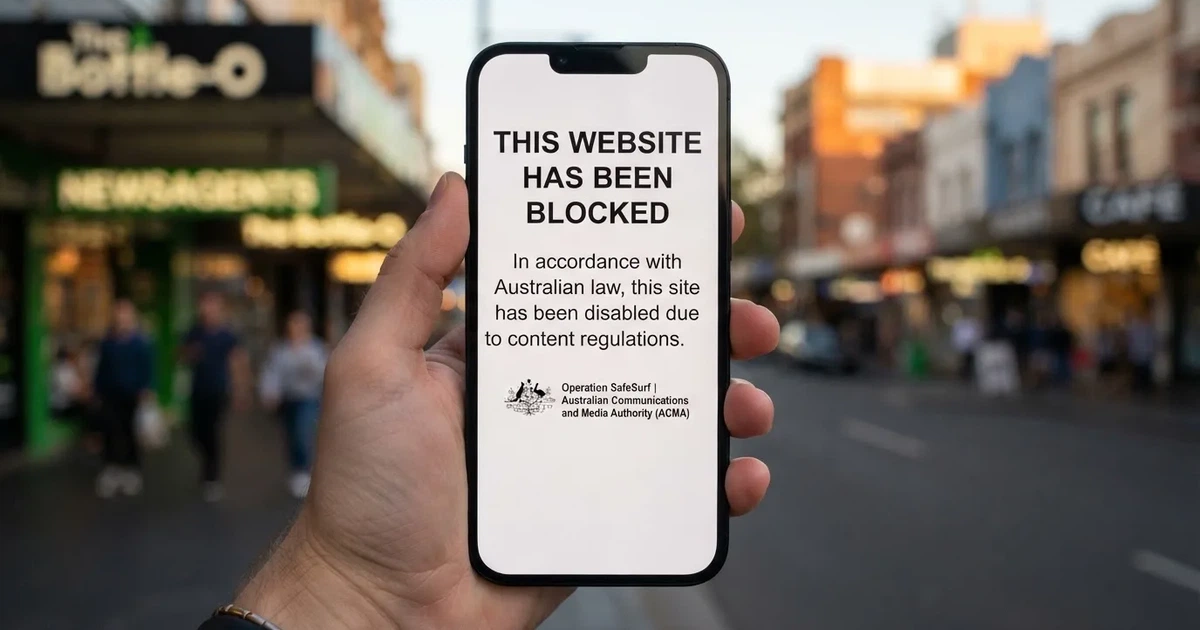
The ACMA’s enforcement toolkit has three layers. The first is the formal warning: a public document naming the operator, the brand and the prohibited service, served under the Interactive Gambling Act, published on the ACMA website, and aimed at an operator that is reachable through some Australian business nexus — a local marketing arm, a payment intermediary, a hosting relationship. The second is the formal infringement notice, which carries a financial penalty. The third is the blocking direction, where the ACMA asks Australian internet service providers to make the offending domain unreachable for Australian customers, often within days.
None of these tools reaches the player. There is no ATO follow-up for the punter, no Centrelink penalty, no criminal record. The cost of using one falls entirely on the provider, which is the point of the design.
What the ACMA cannot do is reach a player who has already paid into an offshore site. If a balance is sitting on a domain that has just been blocked, there is no complaints body the player can take it to. There is no Australian consumer protection that follows the money. The site is in Curaçao or Anjouan or Costa Rica; the casino’s own terms govern; and the operator’s licence to do anything about a refused withdrawal is the same licence the player never had. That absence is what the regulator’s actions are ultimately protecting Australians from.
What the Blocking Numbers Actually Look Like
The blocking direction is the ACMA’s bluntest tool, and the numbers are the cleanest measure of how busy it has been. As of June 2026, the ACMA had asked Australian ISPs to block 1,751 illegal gambling and affiliate marketing websites since the first blocking request went out in November 2019. The June 2026 round alone added twelve more names: 7Signs, ChromaBet, Donbet, Duospin, Freshbet, Slots Gem, Jacks Club, Lucky Start, Pointsbetz.com, Spinrise, Vinyl Casino and Wildsino.
Working the arithmetic: 1,751 sites over roughly seven and a half years, from November 2019 to June 2026, is an average of around 230 sites per year, or roughly four to five per working week. The pace is not steady — some weeks the ACMA moves on a batch of ten; some months nothing public — but as a band, a few dozen per month is the order of magnitude a reader can hold in mind. That is the regulator’s working tempo, and it is what any single offshore site faces as the cost of continuing to take Australian customers.
The wider market figures are heavier. H2 Gambling Capital’s 2026 estimates put Australian losses to illegal gambling sites at around A$3.9 billion per year, and the share of gambling going through legal Australian channels has slipped from 74% in 2021 to 64% in 2025. The illegal share is rising. The blocking round is the regulator’s response, but it is not yet a response that has bent the curve.
Help Available When Play Stops Being Fun
Two services sit underneath the rest of this page, and a reader who has read this far should know they exist before reading any further.
Gambling Help Online runs a national 24/7 chat and counselling service at gamblinghelponline.org.au, free and confidential, run by the Australian government through the Department of Social Services. The National Gambling Helpline — 1800 858 858 — is the phone number, the same counsellors, the same hours. Web chat, phone, and email are all routed through the same intake.
BetStop, the National Self-Exclusion Register, has been live since August 2023. A person who registers is excluded from every Australian-licensed online and phone wagering service for a chosen period, from three months up to a lifetime. Operators are required to honour the registration, close marketing communications, and not reopen accounts during the exclusion. BetStop is the strongest single tool the regulator has put into the hands of a punter who has decided to stop.
What BetStop is not, and what matters for the rest of this page, is a tool that reaches offshore casino sites. An Australian-licensed bookmaker cannot accept a BetStop-registered customer. An offshore casino has no obligation to check BetStop, no integration with the register, and no penalty for letting an excluded person keep playing. A punter using BetStop is closing off the legal half of the Australian market; the illegal half is something else.
The third help available is the bank’s own gambling block. ANZ, Commonwealth Bank and Westpac all let a cardholder turn on a gambling transaction block through the banking app. ANZ’s block stops gambling transactions on the physical card and through linked digital wallets such as Apple Pay. Commonwealth Bank’s block, set up in the CommBank app, blocks most gambling transactions on eligible cards, with the bank itself noting it cannot guarantee every gambling-related purchase will be stopped. Westpac’s block works at the card level against the merchant category code for betting and casino gambling on eligible personal credit and debit cards. Removing ANZ’s block requires a 48-hour cooling-off period once it has been turned on. None of these blocks reaches an offshore casino through every payment route — crypto, for instance, sits outside the card networks entirely — but they remove a chunk of the easy paths, and that is usually enough to slow a streak of impulse play.
Payments at Offshore Casino Sites: What the Rails Actually Look Like
The payment side of an offshore casino is built around three rails: card, instant bank transfer, and crypto. Each has a different relationship to the Australian rules.
Cards — Visa and Mastercard debit cards are accepted by most offshore casinos. Australian banks process them through the international card networks, where the merchant sits as a “card-not-present” gambling transaction. Under the 2024 amendments to the Interactive Gambling Act, Australian-licensed wagering services cannot accept credit card payments; that rule applies to the licensed side only, so an offshore casino is not bound by it. What a punter will notice is the bank’s own gambling block — Westpac, ANZ and Commonwealth Bank all have them — which can refuse the transaction at the card level. American Express cards sit on a three-party scheme that runs its own network, and Amex transactions were explicitly left outside the Reserve Bank of Australia’s proposed surcharge ban in the July 2026 review; on the gambling side, the same merchant category blocking logic applies as for Visa and Mastercard. Apple Pay and Google Pay, sitting on top of the underlying cards, are caught by the same bank-level gambling blocks where the bank extends its block to digital-wallet transactions, as ANZ does.
PayID and Osko are the Australian instant-transfer rails. A transfer through Osko arrives at the receiving account in under a minute, 24/7 including weekends, addressed to either a BSB-and-account-number or a PayID. Over 100 Australian financial institutions offer PayID, and more than 25 million PayID identifiers had been registered on the New Payments Platform as of April 2026. What makes PayID visible to a punter is that, before the transfer is sent, the screen shows the name of the account holder. AP+ warns that being asked to send money to a PayID held against an illegal gambling site almost certainly means the destination is a scam. Whether the destination is a scam or simply a payment processor for an offshore casino, the rail does not change; the warning sits at the point of confirmation.
Crypto is the rail an offshore casino leans on hardest when the bank rails start closing. Bitcoin, Ethereum, USDT and a handful of altcoins are accepted at most of the brands listed below. AUSTRAC’s threshold-transaction-report rule — the requirement to report transfers of A$10,000 or more — applies only to physical cash, not to ordinary electronic bank transfers; crypto transfers are tracked by AUSTRAC through the digital currency exchange register rather than per-transaction thresholds. The practical effect for a punter is that a crypto deposit does not hit a bank-block, and a crypto withdrawal is the rail an offshore casino uses when it does not want to touch a bank.
BPAY is the Australian bill-payment rail, owned jointly by the four major banks and run by Australian Payments Plus. It is built for paying bills — Biller Code and Customer Reference Number on the invoice — and is not the rail an offshore casino is set up to receive on. A licensed Australian bookmaker takes BPAY for the legal half of the market. An offshore casino does not. A punter asked to “pay via BPAY” on an offshore site is being routed to a payment processor, not to the casino itself, and that is the rail most worth questioning.
The offshore cashier, then, looks different from a licensed Australian bookmaker’s in two structural senses: it leans on crypto rather than BPAY, and it does not stop credit-card transactions at the source. The blocking work, if it is to happen, happens later, on the bank’s side, not at the point of payment.
What Bonuses at Offshore Casinos Actually Cost
The headline offer at an offshore casino is almost always a deposit match plus a bundle of free spins. A “100% up to A$500 + 200 free spins” reads as a free A$500. It is not free. It is a marketing construct with three numbers attached, and the arithmetic is what determines whether it is worth claiming.
The first number is the wagering multiple. It is the number of times the bonus amount (and sometimes the deposit amount too) must be wagered before any of the bonus balance can be withdrawn. A 40x bonus multiple on a A$500 bonus means A$20,000 of qualifying wagers before withdrawal. At an average slot RTP of around 96%, the house edge on those wagers is 4%, so the expected loss across the wagering requirement is roughly A$800 — a number the reader can hold against the headline A$500.
The second number is the max-cashout cap. Many bonus terms state that winnings from the bonus balance are capped — often at 5x to 10x the bonus amount. A punter who hits a big win during wagering and finds the cap means they can only withdraw A$2,500 on a A$500 bonus is reading a bonus term that was on the page when they signed up, but not in the headline. The cap is where most bonus value evaporates.
The third number is the time limit. Bonus terms commonly give 7 to 30 days to clear the wagering requirement. If the punter does not clear it in that window, the bonus balance and any winnings tied to it are removed. A punter who plays casually, in short sessions, against a 7-day window can find a balance wiped out for a reason that has nothing to do with how well they played.
The “free spins” piece of the headline runs through the same arithmetic with smaller numbers. Spins are typically set at the minimum stake (often A$0.10 to A$0.20) and the winnings from each spin are themselves bonus money, subject to the same wagering multiple and the same cap. A 200 free spins bundle at A$0.20 per spin is A$40 of spin value at the entry point, before any wagering is applied, before any RTP variance, before the cap kicks in.
A punter who reads the headline and not the terms is the punter the bonus is built for. The arithmetic above is what the headline conceals, and it is why “free” in an offshore casino’s marketing is rarely free in the punter’s wallet.
Mobile Play: What the Casino’s Mobile Site Actually Does
Every offshore casino listed below has a mobile-friendly site, and most have stopped building native apps. The reason is regulatory: Apple and Google have tightened their policies around real-money gambling apps, and an offshore operator without an Australian licence cannot pass either store’s review. What a punter gets instead is a Progressive Web App — a mobile site that adds itself to the home screen, sends push notifications if the punter allows it, and runs in full-screen mode without the browser chrome. It looks and feels like an app. It is not one. It is the casino’s website, packaged.
That matters for two reasons. The first is that updates and bug fixes are pushed by the casino, not by an app store, so there is no review process a punter can rely on to catch a dodgy build. The second is that any ban or removal happens at the browser or ISP level, not at the app store level. An app store can take an app down in a way that reaches every device at once. A blocked domain only reaches devices on participating Australian ISPs, and only until the punter finds a workaround.
A punter who wants to play on a phone is fine on the casino’s mobile site. A punter who thinks they are downloading an Australian-regulated app is reading the wrong page.
The Operators the ACMA Has Acted Against
The brands below are the operators the ACMA has named in formal warnings published on its website. The page lists them because the ACMA has acted against them — not because they are recommended. Every one of them is, in the language of the regulator, a prohibited interactive gambling service as far as Australian customers are concerned. The descriptions that follow are written to be useful to a reader who has arrived at one of them already, not to direct anyone there.
The order is the order the ACMA published the warnings in. Dates are as they appear in the ACMA’s register.
RocketPlay: Warned Twice Under Different Owners
RocketPlay has been the subject of two formal warnings under different operators. The ACMA warned Dama N.V. over Rocketplay in May 2022, then in March 2026 warned Pulsup Ltd over Rocketplay.com.au. The brand is still running. The corporate entity behind the URL is the only thing that has changed.
That pattern is the reason the brand appears first. RocketPlay is the textbook case of the warning cycle: a regulator acts, the brand is quietly transferred to a different operator in a different jurisdiction, the site reopens under a new company name, and the ACMA starts again. A punter who signs up to RocketPlay today is signing up to a brand that has been warned about twice, under different parents, in four years.
For a reader looking for the safest offshore option by the metric of “least regulator attention”, RocketPlay is the wrong place to start.
Level Up Casino: One of Dama N.V.’s Original Warnings
The May 2022 warning over Dama N.V. covered six brands at once: Bambet, Dazard, Level Up, Rocketplay, Wild Tornado and Cobra Casinos. Level Up is one of those six. Three of the six have been renamed or quietly dropped since 2022. Level Up is still running.
A punter who saw Level Up named in 2022 and assumes it has since cleaned up its offer is reading the regulator’s register wrong. The ACMA’s warnings are not lifted; they are not appealable in the way a court order is. The warning stays on the register, and a brand that was warned in 2022 is, on the register, the same brand in 2026.
Woo Casino: A Second Warning to the Same Operator
The March 2026 warning to Dama N.V. was a separate action over Woo Casino specifically. By 2026 Woo had been on the ACMA’s list for a second time as part of the broader Dama N.V. action, in addition to its place on the May 2022 list as one of the six brands in that earlier warning.
A reader trying to find a brand that has never been warned about is not going to find one on this page. The page is the list of brands that have been.
Spirit Casino: A Sister Brand, Same Operator
The May 2026 warning to Dama N.V. also covered Spirit Casino. The pattern is the same as Woo: same operator, different brand name, same regulatory problem.
The operator behind Spirit and Woo is Dama N.V., a Curaçao-licensed company that has cycled through dozens of brands over the past several years. Each new brand gets its own marketing, its own welcome package, its own theme. The underlying company is the same.
National Casino: A Warning in 2026
The July 2026 warning over National Casino went to Consolutetish S.R.L. National Casino had not appeared on the register before that warning, which makes it one of the few brands on this list with a single formal action rather than a chain.
The relevant question for a reader is whether one warning is meaningfully different from several. The answer is no. The ACMA warns first and blocks later. A brand with a single warning is a brand that has been on the regulator’s radar long enough to be named once; it is not a brand that has been cleared.
Bizzo Casino: A Repeat Warning Across Two Owners
Bizzo Casino was first the subject of a 2022 formal warning to TechSolutions (CY) Group Limited and TechSolutions Group N.V. The July 2026 warning over Bizzo went to Consolutetish S.R.L., a different operating entity. The brand has been transferred between operators the same way RocketPlay has, and the ACMA has now acted against it twice.
The Bizzo and RocketPlay cases are the clearest examples on this list of the “warning, transfer, reopen” pattern. The brand keeps the marketing; the corporate entity behind the URL changes; the regulator’s action resets to zero against the new entity and starts again. For a reader, the relevant fact is that the brand itself has been the subject of regulator action more than once, regardless of which company is currently on the other side of the URL.
Ignition Casino: A Warning to a Different Operator Class
The July 2026 warning over Ignition Casino went to Bamboo Media. Ignition is one of the better-known offshore brands in the Australian market; the warning is the first time the brand has appeared on the ACMA’s register.
The Ignition case is also a useful illustration of what the ACMA names. The warning is to the operator (Bamboo Media), not to the domain alone; the ACMA is acting against a corporate entity that has an Australian nexus, which is the only way the warning mechanism works.
Instant Casino: An Early 2026 Warning
The February 2026 warning to EOD Code SRL over Instant Casino was one of the regulator’s earlier 2026 actions. EOD Code SRL was the named operator. Instant Casino has not appeared on the register before or since.
What the warning tells a reader is that Instant Casino was, in February 2026, on the ACMA’s working list. What it does not tell a reader is anything about the current state of the brand — whether the warning has been complied with, whether the operator has changed, whether the site is still taking Australian customers. The ACMA’s register does not record compliance; it records action.
Jackbit: A Recent Warning to Ryker B.V.
The April 2026 warning to Ryker B.V. covered both Jackbit and CasinOK. Jackbit is one of the more visible crypto-led offshore brands in the Australian market, and the warning is the first against the brand.
The Jackbit and CasinOK case is also a reminder that the ACMA names operators that share an entity, not just brands. A punter looking at one of the two brands should know that the other was named in the same action.
Casino Intense: A Warning to Sterplay Holding Ltd
The April 2026 warning to Sterplay Holding Ltd over Casino Intense was a single-brand action. Casino Intense has not been named before or since on the ACMA’s register.
Sky Crown: An Earlier Warning Still on the Register
The warning to Hollycorn N.V. over Sky Crown and Blue Leo was published in September 2022. The warning is one of the older items still on the register, and Sky Crown is the only brand on this page with a warning of that age against the same operator.
A warning from 2022 is, on the ACMA’s own register, still current. The regulator does not “expire” formal warnings; they remain on the published list until the regulator chooses to update it. A reader who assumes a 2022 warning is no longer relevant is reading the regulator’s list as if it had a statute of limitations, and it does not.
Comparison: What the ACMA’s Actions Look Like Across the Field
The table below sets out the brand, the ACMA action, the operator named by the ACMA, and any subject-area support the research turned up for that brand. Subject support is what listing sites reported about the brand; it is not the page’s own endorsement.
| Brand | ACMA action and date | Operator named by the ACMA | Subject support |
|---|---|---|---|
| RocketPlay | Formal warning, May 2022; further warning, March 2026 | Dama N.V. (2022); Pulsup Ltd (2026) | Listings only |
| Level Up Casino | Formal warning, May 2022 | Dama N.V. | Listings only |
| Woo Casino | Formal warning, March 2026 | Dama N.V. | — |
| Spirit Casino | Formal warning, May 2026 | Dama N.V. | — |
| National Casino | Formal warning, July 2026 | Consolutetish S.R.L. | Listings only |
| Bizzo Casino | Formal warning, 2022; further warning, July 2026 | TechSolutions (2022); Consolutetish S.R.L. (2026) | Listings only |
| Ignition Casino | Formal warning, July 2026 | Bamboo Media | — |
| Instant Casino | Formal warning, February 2026 | EOD Code SRL | Listings only |
| Jackbit | Formal warning, April 2026 | Ryker B.V. | — |
| Casino Intense | Formal warning, April 2026 | Sterplay Holding Ltd | Listings only |
| Sky Crown | Formal warning, September 2022 | Hollycorn N.V. | — |
The column on subject support is what the page can document from outside the brand. Most rows carry no documented subject-area support beyond the ACMA’s own register; that absence is the honest answer. A reader who wants more on any one of them needs to look at the operator behind the URL — Dama N.V., Consolutetish S.R.L., Bamboo Media, and the others named above — because that is the entity the regulator has acted against.
The Pattern Behind the Names
Read across the table, two patterns stand out. The first is operator repetition. Dama N.V. appears on the table four times, Consolutetish S.R.L. twice, and the rest of the brands each have one operator action. A regulator working through a market tends to act against the operator first, not the brand, because the operator is the entity that controls multiple brands. A punter reading the table should weigh operator repetition more heavily than brand repetition — a brand that has been warned once under one operator is the same kind of problem as a brand warned once under another, but a brand that has been warned under two operators is the same operator problem wearing two names.
The second pattern is the 2022-to-2026 arc. The earliest warning on the register (Sky Crown, September 2022) is still relevant in 2026. The most recent warnings (RocketPlay in March 2026, Jackbit in April 2026) sit on the same register. The regulator is not finishing a job; it is maintaining a tempo. A reader who joins the offshore market today is joining a market that has been on the ACMA’s working list for years, and that will be on it again next month.
The blocking rate, calculated across the period the ACMA has been publishing blocking actions, is the working arithmetic behind that tempo. From November 2019, when the first blocking request went out, to June 2026, the regulator asked ISPs to block 1,751 illegal gambling and affiliate marketing websites. That is roughly 230 sites blocked per year over the period, or, as a band that reflects the regulator’s actual working pattern, somewhere between 150 and 300 sites per year depending on how the year falls. A punter thinking about joining a brand today is a punter thinking about joining a market where the regulator’s blocking tempo is several sites per week.
How a Reader Should Read the Field
Three honest reads are possible off the table. The first is the “don’t go there at all” read: the regulator’s register is the strongest single signal Australia has, and every brand on it has failed that signal. A punter who treats the register as a do-not-play list has not missed a nuanced read; they have read the page straight.
The second is the “if you are going to go anyway, pick by what the register tells you” read: a single warning under a single operator is one data point; a brand that has been warned twice under two operators is two data points against the same brand. The page’s table lays out that distinction cleanly, and a punter using the page to inform a decision is using it well.
The third is the “I am a recreational player who has decided to play anyway” read. That punter is going to play. The page’s job, for that punter, is to make sure the decision is informed — BetStop, the bank’s gambling block, Gambling Help Online’s number (1800 858 858) and the helpline’s web chat should be on the phone before the casino’s URL is. The offshore casino does not give the punter any of those protections; the Australian system does. The order matters.
What a Punter Cannot Recover from an Offshore Casino
An offshore casino’s terms and conditions are the only contract a punter has with the operator. Australian consumer law does not apply; the Australian Financial Complaints Authority does not have jurisdiction; the ACMA’s enforcement is against the operator, not the balance. A punter with a stuck withdrawal is not a consumer with a complaint; they are a customer of an overseas company governed by that company’s own rules.
The mechanisms that protect an Australian punter using a licensed wagering service — complaints pathways, account closure on BetStop registration, dispute resolution, the obligation on the operator to honour withdrawals — are not present at the offshore casino. The terms the punter clicked “I agree” to at signup are the terms that govern, and most offshore terms include clauses that let the operator void winnings, refuse withdrawals, and close accounts at their discretion.
A punter who has decided to use an offshore casino has decided to use a service where the only recourse when something goes wrong is the operator itself. That is the trade the punter is making, and the ACMA’s register is the trade the regulator is documenting.
The Wider Market Context
The illegal gambling market in Australia is not small. H2 Gambling Capital’s 2026 estimate puts annual losses at around A$3.9 billion. The legal market’s share has slipped from 74% in 2021 to 64% in 2025, a ten-point fall in four years that the regulator’s blocking round has so far been unable to reverse.
That ten-point fall is the background against which the rest of this page sits. The licensed bookmakers — Sportsbet, Bet365, Ladbrokes — take bets on sports and racing only, not on casino games or pokies. The punter who wants to play a pokie online has, today, only the offshore option. The Interactive Gambling Amendment (Gambling Reform) Bill 2026, passed on 19 August 2026 and commencing on 1 January 2027, tightens the rules around licensed wagering’s advertising and inducements. It does not open a legal path for online casino games. The legal half of the Australian market for online casino play is, in 2026, still empty.
A Final Word on What This Comparison Was For
This page was not built to recommend an operator. The ACMA’s register is the page’s main source, and the register is built to name operators, not to compare them. Where the page has compared, it has compared on what the register actually records: the operator behind the brand, the date of the warning, and the pattern of repetition across operator names. A reader who wants more than that — payout speed, game count, bonus headline, sign-up offer — is asking the page for a comparison it cannot honestly make, because the only sources for those numbers are affiliate marketing pages, and this page does not run on those sources.
What the page has done is set out the field as the regulator sees it, mark the brands the regulator has acted against, and document the wider context in which those actions sit. For a punter deciding whether to play at an offshore casino at all, that context is the relevant comparison. For a punter who has already decided, the names, dates and operators above are the relevant data. For a punter who has decided to stop, Gambling Help Online (1800 858 858), BetStop, and the bank’s own gambling block are the relevant next step.
Frequently Asked Questions
Is there a licensed online casino based in Australia that Australians can legally join?
No. The Interactive Gambling Act 2001 prohibits online casino games and online pokies from being supplied to anyone in Australia, and no state or territory issues a licence for them. What is licensed in Australia is wagering on sports and racing before the event, lotteries and keno — typically through operators licensed in the Northern Territory. There is no licensed Australian online casino to join.
What does “best” mean when every option being compared is an offshore, unlicensed site?
In the strict sense, “best” applies to a comparison that does not exist. The honest comparison is between offshore sites the regulator has acted against and offshore sites the regulator has not yet acted against, on grounds like how recently the operator was warned, whether the same operator appears under multiple brand names, and whether the brand has cycled through multiple corporate owners. None of those criteria produces a “best” in the buyer’s-guide sense.
How does the ACMA decide which offshore casino sites to warn about or block?
The ACMA works through formal warnings first, then formal infringement notices, then blocking directions to Australian internet service providers. The criteria are tied to whether the service is a prohibited interactive gambling service being supplied to Australians, whether the operator has an Australian nexus the ACMA can reach, and whether a blocking action will be effective. As of June 2026, 1,751 illegal gambling and affiliate marketing websites had been blocked since the first blocking request in November 2019.
Can an offshore casino site legally register an Australian-style web address and call itself Aussie?
There is no prohibition on an offshore operator choosing a domain that reads as Australian, running AUD as an account currency, or marketing to Australian customers with Australian themes. Calling itself “Aussie” is a marketing choice, not a regulatory one. The .com.au domain is restricted to businesses with an Australian presence, but most offshore operators use .com, and the ACMA’s actions are taken against the operator regardless of the domain extension.
What legal, licensed alternative exists for someone wanting a casino night in Australia?
Australia’s licensed land-based casinos operate in every state and territory under state-level casino licensing regimes — Crown Melbourne, Crown Perth, The Star Sydney, The Star Gold Coast, Casino Canberra and the Lasseters Hotel Casino in the Northern Territory. These are licensed venues, age-verified at the door, with responsible gambling obligations attached to the licence. They are not online services and they are not what this page compares, but they are the legal Australian casino experience for anyone who wants one.
Published by the Casino Deposit Info team.