
Plinko casinos for Australian players in 2026: the game, the claims and the prohibition
A ball drops through a pegboard into a multiplier slot. That is the entire Plinko casino game, and everything else on a Plinko casino page exists to make those few seconds feel like a decision. What an Australian player lands on when they search for it is an entirely different question, because no Australian licence authorises anyone to offer the game for real money online. This page sets out what the game itself is, what the offshore sites claim for it, and what the regulatory record says about every brand in the set, so that an Australian reader can read the marketing without mistaking it for permission.
Data current as of 7 November 2026, checked against the ACMA’s register of formal warnings and blocking requests.
Table of Contents
- What the Plinko casino game actually is
- The Australian legal position on Plinko-style games
- Where the money actually goes
- Crypto deposits do not change the licensing picture
- Payment methods mentioned on Plinko casino pages
- Responsible gambling and what is actually available in Australia
- Plinko’s paytable beside a pokies reel
- What an Australian reader actually sees on a Plinko casino page
- The 11 brands the ACMA has acted against
- Where the ACMA’s blocking programme has reached
- 2026 reform that an Australian reader should know about
- Tax and the recreational player
- What an Australian reader should take from this page
- Frequently asked questions
What the Plinko casino game actually is
Plinko’s ball-drop mechanic is older than the offshore pages selling it. It premiered on the American television show The Price Is Right on 3 January 1983, where contestants drop chips down a pegboard into nine bottom slots valued, from the outside in, at $100, $500, $1,000 and $0, with the centre slot worth $10,000. The maximum possible win on the show is $50,000. Before 1998, the centre slot was worth $5,000 and the maximum win was $25,000. The casino game borrows the same structure, with one decisive change: where the television board pays fixed dollar amounts, the casino board pays multipliers that scale a stake up or down.

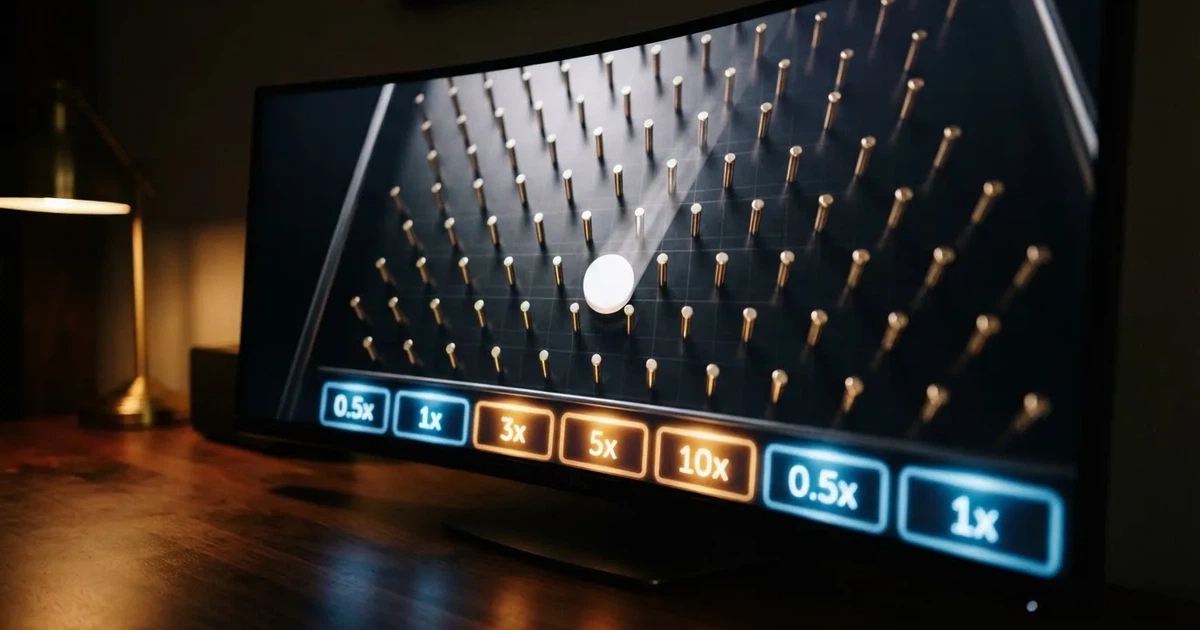
In the BGaming version that most Plinko casino pages reference, balls drop through a pyramid of pegs into slots whose values are multipliers of the stake. The headline figures — a 99% RTP and a ×1,000 top multiplier — come from the game developer’s own page. The player sets a risk level (low, normal or high) and a number of lines from 8 to 16, then chooses manual play or auto-bet. That is the full extent of the choices, and the consequence of each one is mechanical: more lines and higher risk spread the distribution of payouts, the top multiplier becomes rarer, and the multiplier ladder at the bottom of the board widens or narrows accordingly.
The advertised 99% RTP deserves its own paragraph, because it sits in the same sentence as “×1,000 top multiplier” on every affiliate page and is read by players as a guarantee rather than as a long-run average. A 99% RTP means the game returns, on average, A$0.99 of every A$1.00 staked across a very large number of drops. It says nothing about any individual drop, and it says nothing about how often the ×1,000 slot lands. The two figures are not contradictory, but they describe two different things, and an Australian reader weighing the marketing should weigh them separately.
The Australian legal position on Plinko-style games
Online casino-style games cannot be licensed in Australia. The Interactive Gambling Act 2001, strengthened by the Interactive Gambling Amendment Act 2017, makes it an offence to provide online casino games, online pokies, in-play betting or Plinko-style multiplier games to a person physically in Australia. The penalties are A$220,000 per day for individuals and A$1.1 million per day for corporations. No state or territory issues a licence for an online casino offering these games, and an offshore licence from Curaçao or any other jurisdiction is not recognised for the purpose of offering them to Australians.
What is licensed in Australia is wagering on races and sport placed before the event, lotteries and keno. In practice those licences are administered by the Northern Territory Racing and Wagering Commission (NTRWC), which regulates 52 of Australia’s online bookmakers — including Sportsbet, Bet365 and Ladbrokes — and has no full-time staff of its own, meeting once a month in Darwin. The Commission’s brief covers wagering, not casino games; a bookmaker it licences cannot add Plinko to its product without stepping outside its own licence. The reason those 52 brands sit in the Northern Territory is tax, not regulation: it is the lightest-touch of the state and territory regimes and the cheapest place to hold an Australian wagering licence.
The ACMA, the Australian Communications and Media Authority, investigates breaches and issues formal warnings. Where a warning is ignored, the ACMA directs Australian internet service providers to block the offending websites. The current state of the register matters to anyone reading the rest of this page: by the ACMA’s own figures, 1,751 illegal gambling and affiliate marketing websites had been blocked since the first blocking request in November 2019, and more than 230 unlicensed gambling services had left the Australian market since enforcement was strengthened in 2017. The most recent round reported in June 2026 added 12 more blocking requests — 7Signs, ChromaBet, Donbet, Duospin, Freshbet, Slots Gem, Jacks Club, Lucky Start, Pointsbetz.com, Spinrise, Vinyl Casino and Wildsino — to the running total.
Two consequences fall out of that record. The first is that the ACMA’s blocking programme is not symbolic: it is a sustained round of actions, across years, against a sustained supply of new sites. The second is that an Australian player who deposits with an offshore Plinko casino is using a service the regulator has explicitly named as illegal, on a site the regulator can block. The block can take effect with a balance still on it. The individual player is not prosecuted under the Interactive Gambling Act — the Act targets the provider — but the consumer protections that attach to an Australian-licensed service do not attach here.
Where the money actually goes
H2 Gambling Capital’s 2025 report estimates that Australians lose about A$3.9 billion a year to illegal gambling sites, and that the share of gambling going through legal channels fell from 74% in 2021 to 64%. The fall in the legal share is the more telling figure, because it shows what the A$3.9 billion represents in practice: money that moved from Australian-licensed wagering into unlicensed offshore products, not new gambling that did not previously exist. A Plinko casino page sits inside that movement; the offshore operator is the destination, the Australian-licensed bookmaker is the place the spend left.
A useful way to read the A$3.9 billion is as a price tag on what the offshore market has been able to extract by being available when the Australian-licensed products are not. Australians do not, in the main, travel to Curaçao to play Plinko. They play from home, and the only thing that lets them do so is the offshore site accepting the deposit and the Australian internet service provider continuing to route to it. The ACMA’s blocking programme is what closes the second of those two channels; the credit card ban and the digital currency ban at the licensed-wagering end are what closes the third. None of those channels ever closes the underlying demand, which is why the regulator’s response is sustained rather than one-off.
The blocking rate itself, set out as a band, gives a sense of the pace. Between November 2019 and June 2026 the ACMA moved from zero to 1,751 blocked sites, a running total that grew as enforcement strengthened and as each round added a fresh batch. The pace is not linear — rounds cluster around particular operators, and the total can sit flat for months between actions — but it has never reversed. A site blocked in 2024 does not reappear in 2026 on a fresh domain; it stays blocked, and the operator either rebuilds under a new name or exits the market. The 230-plus services that have left the Australian market since 2017 are the second half of that arithmetic.
Crypto deposits do not change the licensing picture
A Plinko crypto casino, a crypto casino Plinko page, a Plinko casino game crypto wallet flow, a bitcoin Plinko casino — these are four ways an Australian reader can land on the same kind of offshore site, marketed through the same affiliate channels, and licensed (where it is licensed at all) under the same offshore regimes. Paying in bitcoin or another cryptocurrency does not move the site into the Australian regulatory frame, because the licensing regime is determined by where the operator is and who it serves, not by what currency the player uses. The federal ban on digital currency as a payment for licensed online wagering, in force since 11 June 2024, applies to licensed operators, not to offshore sites that never sat inside the licensed frame in the first place.
The practical consequence for an Australian player is sharper than for any other payment method. A bank transfer can be reversed. A debit card transaction can be disputed. A bitcoin transaction cannot be reversed, cannot be disputed through the card network, and cannot be traced back to the recipient through the consumer’s bank. The consumer protections that exist for Australian-licensed wagering — dispute resolution, complaints bodies, BetStop registration — do not exist for an offshore site whether it accepts crypto or not, and a crypto deposit removes the friction-free chargeback that would otherwise give a player a partial remedy. The credit card ban, which carries penalties of up to A$247,500 for licensed operators, was framed by the government as a player protection measure; the offshore equivalent is no protection at all.
A Plinko crypto casino is, in regulatory terms, the same site as a Plinko casino that accepts a Visa deposit; the only difference is the payment rail and the loss of the chargeback. The marketing presents the difference as upside — speed, anonymity, fewer checks — and the regulatory record presents it as downside, for exactly the same reason. An Australian reader who sees “crypto accepted” advertised on a Plinko casino page should read it as the site confirming it sits outside the Australian payment rules, not as a feature in isolation.
Payment methods mentioned on Plinko casino pages
Plinko casino pages in the offshore market list a recognisable set of payment methods: Visa and Mastercard debit cards, bank transfers, e-wallets such as Skrill and Neteller, prepaid vouchers, and a range of cryptocurrencies. The set is background information about how the offshore market prices itself; it is not an offer to an Australian reader. A licensed Australian wagering service takes debit cards, bank transfers, PayID/Osko and BPAY. The licensed list is narrower because the credit card ban and the digital currency ban have closed off the rest, and because the consumer protections an Australian licensee is required to offer are not compatible with anonymous crypto deposits.
A Plinko casino game real money no deposit bonus page, a Plinko casino no deposit bonus page, and a Plinko casino payout page all reference the same set of methods. The “real money withdrawal” framing in particular is worth a paragraph of its own: an offshore site’s withdrawal process sits entirely outside the Australian consumer law that applies to Australian-licensed wagering. A withdrawal the operator delays, restricts or refuses has no formal route of complaint that an Australian regulator would hear. The block on the site can come at any time, including after a withdrawal request, and the player’s remedy is whatever the operator’s own terms say it is — which is, in practice, whatever the operator decides in the moment.
The deposit side carries its own asymmetry. A Plinko casino game real money deposit is one of the easier transactions in the offshore market to make and one of the harder transactions to undo. The Australian licensed alternatives — a debit card through a licensed wagering service, a PayID transfer, a BPAY payment — sit inside consumer law that gives the depositor a path back if something goes wrong. An offshore Plinko casino deposit does not, regardless of the payment method, and the offshore site’s own terms generally allocate dispute resolution to an offshore jurisdiction where Australian consumer law does not apply.
Responsible gambling and what is actually available in Australia
The responsible gambling frame in Australia is built around Australian-licensed wagering and the support services that sit behind it. The National Self-Exclusion Register, BetStop, has been live since August 2023 and binds Australian-licensed online and phone wagering services. An offshore Plinko casino is not connected to it. A player who registers with BetStop cannot place a wager with an Australian-licensed bookmaker; the same registration has no effect on an offshore site. The mechanism that Australian consumer protection offers for ending wagering stops at the border, and the offshore site is the most active part of the market that sits on the other side of it.
The National Gambling Helpline — 1800 858 858 — is free, available 24/7 and supports chat at Gambling Help Online. It is the right starting point for an Australian reader who is reading this page because they, or someone close to them, are worried about their own wagering. It is also the right starting point for a reader who is not yet worried but wants the mechanism in place. The helpline is independent of any operator, any licensing regime and any payment method; it sits outside the market entirely.
A consequence of the offshore exemption from BetStop is worth stating plainly. The self-exclusion tools that are the centrepiece of Australian responsible gambling policy have no purchase on the offshore market that Australians actually use. A Plinko casino game that an Australian reader can reach in a browser is the Plinko casino game they will reach, and no Australian-licensed self-exclusion binds it. The regulatory frame cannot reach the player through the site, because the site is not licensed here. The only tool that works on the player’s side of the transaction is the player’s own decision, supported by the services listed above.
Plinko’s paytable beside a pokies reel
The paytable claim on a Plinko casino page — the 99% RTP and the ×1,000 top multiplier — invites a comparison with the pokies reel that an Australian reader is likelier to be familiar with. The two are different games with different distributions. A pokies reel pays on combinations of symbols across paylines, with the return-to-player rate calculated across a very large number of spins and disclosed (where it is disclosed at all) on the game’s information page. A Plinko paytable pays on the slot the ball lands in, with the multiplier for that slot fixed and the probability of landing in any given slot determined by the geometry of the pegboard and the player’s choice of lines and risk level.
The odds structure is the consequence of those two designs. A pokies reel’s payout distribution is concentrated in a small number of high-paying combinations and spread across many low-paying ones, with the long-run average at the published RTP. A Plinko paytable’s distribution is closer to a bell curve centred on a 1× slot, with the rare ×1,000 slot at the tail. The 99% RTP is the average of that distribution; the ×1,000 top multiplier is the most extreme value in it. The two figures describe the same game but not the same outcome, and the difference between “average outcome” and “most extreme outcome” is where the marketing lives.
A pokies reel’s RTP, where it is published, is in the 92%–96% band for most licensed Australian games; a 99% RTP is on the high end of the band’s high end. A Plinko paytable’s 99% RTP is high, but the comparison to a pokies reel is not direct: the volatility of the two games is different, the bet sizing is different, and the way the two games pace a session is different. A Plinko ball drops in a few seconds; a pokies reel’s spin takes three. The bankroll management that suits one does not suit the other, and an Australian reader who plays both should not assume that what they have learned about bankroll on a pokies reel transfers to a Plinko paytable without thinking it through.
What an Australian reader actually sees on a Plinko casino page
The standard offshore Plinko casino page in 2026 carries a recognisable set of features. The hero image shows a pegboard with multiplier slots glowing at the bottom. The headline claim is a 99% RTP, often paired with the ×1,000 top multiplier. The deposit options list Visa, Mastercard, Skrill, Neteller and several cryptocurrencies. The bonus offer is a deposit match with a wagering requirement. The licence footer cites Curaçao or another offshore jurisdiction. None of those features are evidence that the site is licensed to offer its product to Australians.
A Plinko casino app, where one exists, is the same product delivered to a phone screen. The marketing presents it as a separate proposition, but the licensing reality is unchanged: an app that offers online casino games to a person in Australia sits outside the Interactive Gambling Act’s carve-outs, regardless of whether it is downloaded from the App Store, Google Play, or the operator’s own page. The Apple and Google app store policies for Australia are aligned with that position, and the apps themselves are usually accessed through the operator’s site rather than through the stores, for that reason.
A Plinko casino free spins offer, where the page carries one, is a pokies-style offer layered on top of a Plinko game. The two products are bundled for marketing reasons; they are regulated separately. The free spins are a pokies promotion, the Plinko game is the casino product the site is actually selling, and the ACMA’s enforcement focus has been on the casino product rather than the pokies promotion. A reader who follows a “free spins” link to a Plinko casino page is one click away from the product that is prohibited, regardless of how the bonus terms are framed.
The 11 brands the ACMA has acted against
Every brand below is listed because the ACMA itself issued a formal warning over it for offering prohibited services to Australians. This is not a ranking and not a recommendation; the order matches the ACMA record and is the only order that research supports. No bonus terms are given, because the only sources for them were affiliate marketing pages, and quoting them here would treat marketing as evidence.
RocketPlay — a warning in 2026 on top of a 2022 one
The ACMA issued a formal warning to Pulsup Ltd over Rocketplay.com.au in March 2026. The brand sits on top of an earlier warning to Dama N.V. covering it, dated May 2022. The intervening years saw the operator restructure; the regulatory position did not change, because the product is the same product. The brand remains listed on the ACMA’s register of formal warnings, and the regulator’s action against it as a Plinko provider is a matter of record.
Level Up Casino — listings-only carry of a developer page
The ACMA issued a formal warning to Dama N.V. covering Level Up Casino in May 2022. The site carries BGaming’s Plinko, and the developer page confirms the integration, which is the only public confirmation that the game is offered there. The ACMA’s record is the regulatory evidence; the developer listing is the product evidence. The two together make Level Up a Plinko casino page that the regulator has named.
Woo Casino — fresh warning over an old brand
The ACMA issued a further formal warning to Dama N.V. over Woo Casino in March 2025. The warning is one of two issued to Dama N.V. in that period, the other covering Spirit Casino in May 2025. The regulator reaffirmed this status in 2025, confirming that the operator’s Plinko offering to Australians continues to violate the Interactive Gambling Act.
Spirit Casino — same operator, second warning
The ACMA issued a formal warning to Dama N.V. over Spirit Casino in May 2025. The earlier Dama N.V. warning, covering RocketPlay, Level Up, Dazard, Wild Tornado and Cobra Casinos as well as Woo Casino, dates to May 2022. The 2025 warning is the regulator’s restated position on a brand that has been on the warning list for three years. The position has not softened.
National Casino — fresh warning, repeated brand
The ACMA issued a formal warning to Consolutetish S.R.L. over National Casino in July 2025. The brand has been the subject of earlier warnings to different corporate entities; the regulator’s record on the brand name itself is now a string of warnings across operator changes. The July 2025 warning is the most recent of those, and it is the one that governs the brand’s current Australian availability.
Bizzo Casino — two warnings, two operators
The ACMA issued a formal warning to Consolutetish S.R.L. over Bizzo Casino in July 2025, on top of an earlier 2022 formal warning to TechSolutions (CY) Group Limited and TechSolutions Group N.V. over the same brand. The brand has changed corporate hands since 2022; the regulator’s interest has not. With two separate warnings covering two different operators, the brand’s history of formal ACMA action on Plinko is as long as its corporate record is unsettled.
Ignition Casino — the July 2025 warning to Bamboo Media
The ACMA issued a formal warning to Bamboo Media over Ignition Casino in July 2025. The brand name has been on the offshore market for several years; the regulator’s first warning to the current operator is the one that governs its current Australian availability. The product offering is unchanged by the corporate change.
Instant Casino — the February 2025 warning to EOD Code SRL
The ACMA issued a formal warning to EOD Code SRL over Instant Casino in February 2025. The brand is one of the more aggressive marketers in the offshore Plinko segment, and the regulator’s February 2025 warning is the most recent formal record on it. This record of formal ACMA warning serves as the definitive regulatory statement on whether Australian players should view the brand as a licensed Plinko provider.
Jackbit — the April 2026 warning to Ryker B.V.
The ACMA issued a formal warning to Ryker B.V. over Jackbit and CasinOK in April 2026. The brand is positioned in the offshore market as a crypto-first casino, and the Plinko offering sits inside that product frame. The April 2026 warning is the regulator’s most recent statement on the brand’s Australian availability, and the CasinOK warning covers a sister brand under the same operator.
Casino Intense — the April 2025 warning to Sterplay Holding Ltd
The ACMA issued a formal warning to Sterplay Holding Ltd over Casino Intense in April 2025. The brand sits in the offshore segment that targets Australian readers through affiliate channels, and the regulator’s record on it is a single warning covering a single operator. The April 2025 date is the most recent formal record on the brand.
Sky Crown — the 2022 warning to Hollycorn N.V.
The ACMA issued a formal warning to Hollycorn N.V. over its Sky Crown and Blue Leo casino services, published in September 2022. Sky Crown is the brand in scope for this section; Blue Leo is a sister brand under the same operator. The 2022 warning is the regulator’s most recent formal record on Sky Crown; the brand remains in the offshore segment without a fresh Australian licence.
| Brand | ACMA action and date | Operator named by the ACMA | Subject support |
|---|---|---|---|
| RocketPlay | March 2026 (and May 2022) | Pulsup Ltd; Dama N.V. (2022) | Not advertised |
| Level Up Casino | May 2022 | Dama N.V. | BGaming listing only |
| Woo Casino | March 2025 | Dama N.V. | Not advertised |
| Spirit Casino | May 2025 | Dama N.V. | Not advertised |
| National Casino | July 2025 | Consolutetish S.R.L. | Listed on en.wikipedia.org only |
| Bizzo Casino | July 2025 (and 2022) | Consolutetish S.R.L.; TechSolutions (2022) | Not advertised |
| Ignition Casino | July 2025 | Bamboo Media | Not advertised |
| Instant Casino | February 2025 | EOD Code SRL | Not advertised |
| Jackbit | April 2026 | Ryker B.V. | Not advertised |
| Casino Intense | April 2025 | Sterplay Holding Ltd | Listed on Abc.net.au, acma.gov.au, Crownmelbourne.com.au only |
| Sky Crown | September 2022 | Hollycorn N.V. | Not advertised |
Where the ACMA’s blocking programme has reached
Between November 2019, when the ACMA made its first blocking request, and June 2026, the regulator directed Australian internet service providers to block 1,751 illegal gambling and affiliate marketing websites. The running total grew in rounds, each round adding a fresh batch of operators that the regulator had investigated and warned. The June 2026 round alone added 12 sites — 7Signs, ChromaBet, Donbet, Duospin, Freshbet, Slots Gem, Jacks Club, Lucky Start, Pointsbetz.com, Spinrise, Vinyl Casino and Wildsino — to that running total.
The blocking programme is the regulatory consequence the offshore market has not been able to outrun. A site can rebrand; it cannot unblock its old domains, and its new domains eventually attract their own blocking requests. The 230 unlicensed gambling services that have left the Australian market since 2017 are the regulator’s published measure of that attrition: not just blocked, but exited, with their Australian-facing product withdrawn. The rate at which new sites replace them is the rate the blocking programme is judged against, and that rate has not fallen to zero. The arithmetic, set out as a band with its condition, is roughly 1,700 blocked sites over roughly six and a half years, in service of the regulator’s enforcement of the Interactive Gambling Act. The number of blocked sites is the upper bound on the regulator’s actions; the number of services that have exited is the lower bound on its consequences. The actual effect on Australian players sits between those two bounds.
2026 reform that an Australian reader should know about
The Interactive Gambling Amendment (Gambling Reform) Bill 2026 passed Parliament on 19 August 2026. Its advertising and inducement measures commence 1 January 2026+1 — law with a start date, not yet in force on a page written in 2026. The bill tightens the rules on what licensed wagering services can advertise and what inducements they can offer, in response to the same shift the H2 Gambling Capital figures describe: money moving from licensed to unlicensed channels. The effect on Plinko casino pages is indirect, because those pages are already outside the licensed frame; the effect on Australian-licensed wagering is direct. For an Australian reader reading this page in 2026, the bill is a marker of the direction of travel rather than a rule that has come into force.
Tax and the recreational player
Gambling winnings of a recreational Australian player are not assessable income, and losses are not deductible, unless the person carries on a business of gambling. The relevant provision is section 6-5 of the Income Tax Assessment Act 1997. The model is “check with the ATO” rather than “this is the answer for every case”, because the boundary between recreational and professional play is one the Australian Taxation Office sets case by case, and a player with a regular offshore Plinko casino pattern is the kind of player the ATO asks further questions of. None of this changes the licensing question that runs through the rest of the page; it sits beside it, and an Australian reader who is weighing a Plinko casino deposit should weigh both.
What an Australian reader should take from this page
The Plinko casino game is a real game with a real paytable and a real long-run return-to-player rate. The 99% RTP claim on BGaming’s page is a real figure, the ×1,000 top multiplier is a real multiplier, and the pegboard is a real pegboard. The marketing on the offshore sites offering it is also real marketing, and the bonus terms, free spins offers and crypto acceptance are real terms.
The regulatory picture is the part the marketing does not name. No state or territory of Australia licenses online casino games, including Plinko-style multiplier games, for real-money play. The Interactive Gambling Act 2001 makes the offer of those games to Australians an offence, with daily penalties that put the matter beyond the reach of any commercial defence. The ACMA’s enforcement record — 1,751 blocked sites, 230-plus exited services, and the running list of formal warnings — is the regulator’s standing answer to the offshore market, and it is the answer the market has not yet outrun. The 11 brands in the table above are the brands the regulator has named in that answer.
An Australian reader who is reading this page because they want to play Plinko for real money is reading it because the marketing worked, and the marketing works because the product is not available through any licensed Australian channel. The two facts are connected, and the connection is the reason the regulator’s record exists. The support services listed earlier — BetStop, the National Gambling Helpline, Gambling Help Online — are the Australian reader’s tools, and they are tools that operate on the Australian-licensed side of the line.
Frequently asked questions
What is the Plinko casino game, and how does the ball-drop mechanic actually determine a payout?
The Plinko casino game borrows its structure from the television show’s pegboard, where contestants drop chips into fixed-dollar slots. In the casino version the slots pay multipliers of the stake, and the player chooses a risk level and a number of lines from 8 to 16. The ball’s path through the pegs determines which multiplier slot it lands in; the paytable lists those multipliers from the lowest to the ×1,000 top end. The probability of any given slot is set by the geometry and the player’s choices, not by any sequence of past drops.
Does a crypto version of Plinko pay out any differently to a standard real-money version?
The paytable and the ball-drop mechanic are the same in a crypto version; the difference is the deposit and withdrawal rail. A bitcoin or other cryptocurrency deposit cannot be reversed through the card network, and an Australian player using crypto has none of the consumer protections that apply to a debit card transaction. The game’s RTP and the slot multipliers do not change; the player’s recourse after a disputed withdrawal does.
Is playing Plinko for real money at an offshore casino something Australians are legally allowed to do?
The Interactive Gambling Act 2001 targets the provider, not the player. Australians are not prosecuted for placing a deposit with an offshore Plinko casino. The provider is the party committing the offence by offering online casino games to a person in Australia, and the ACMA’s enforcement record is built around that. The player sits outside the criminal frame but inside the consumer frame: an offshore site gives no Australian consumer protection, no complaints body, and no recourse if a withdrawal is refused.
What return-to-player rate do offshore sites typically advertise for their Plinko game?
BGaming’s Plinko, the version most affiliate pages reference, is advertised with a 99% RTP and a ×1,000 top multiplier. The figure is a long-run average across a very large number of drops; it does not describe the outcome of any individual drop. The top multiplier is the extreme value of the distribution rather than a typical one, and the two figures should be read as describing the same game in two different ways rather than as separate guarantees.
Why do Plinko casino apps get advertised separately from ordinary Plinko casino websites?
A Plinko casino app is the same product delivered through a phone interface, and the licensing position is unchanged by the delivery mechanism. The marketing presents the app as a separate proposition because apps carry an implicit sense of permanence and legitimacy that a browser tab does not. An offshore casino app offering real-money Plinko to a person in Australia sits outside the Interactive Gambling Act’s carve-outs regardless of whether it is downloaded from an app store or installed from the operator’s own page.
How does a Plinko game’s payout table differ from a pokies reel in terms of the odds involved?
A pokies reel pays on combinations of symbols across paylines, with the long-run average at the published RTP and a distribution concentrated in a small number of high-paying combinations. A Plinko paytable pays on the slot the ball lands in, with the multiplier for that slot fixed and the probability of any given slot set by the pegboard’s geometry and the player’s choice of lines and risk level. The two distributions are different shapes, and the bankroll management that suits one does not transfer to the other without being thought through.