
Modern video slots in Australia: the format, the law, and the offshore brands the regulator keeps naming
A “video slot” sounds like a category. It is — but the category hides a gap that matters more than the name suggests. Modern video slots are five reels, dozens of paylines, animated bonus rounds and free-spin features. They are also the format that offshore casino sites advertise hardest to Australian players, even though offering online casino games to anyone in Australia has been a civil offence since 2001 and a criminal one since 2017. The honest starting point for this page is that the offshore version is unlawful, and the lawful version is the electronic gaming machine you find in a pub, club or land-based casino. From there, the rest is mechanics, consequences and a list of the brands the regulator has named over the past four years.
7 November 2026 — figures and ACMA enforcement actions verified against the Australian Communications and Media Authority register and the igamingbusiness.com report on the 26 June 2026 blocking round.
Table of Contents
- What a video slot actually is, and what changes from the classic three-reel machine
- The legal frame: why the offshore version is unlawful in Australia
- The licensed option: what an Australian punter can actually play
- How the ACMA has been acting against the offshore version
- What “free spins” and “bonus rounds” mean on an offshore offer
- Mobile play: browser versus app
- Game mechanics: paylines, volatility and the figures that move
- House edge: where the slot sits among the table games
- How an offshore video slot brand gets named
- Player protection and where to get help
- What this page is not for
- Frequently asked questions
What a video slot actually is, and what changes from the classic three-reel machine
The first automatic slot machine, built by Charles Fey in San Francisco in the late 19th century, ran three reels with five symbols — horseshoes, diamonds, spades, hearts and the Liberty Bell — and three bells in a row paid ten nickels. It was mechanical, deterministic and short on combinations: roughly one thousand possible outcomes across the whole machine.

Modern video slots are a different object. They use five or more reels, fifty or more symbols per reel, and an odds profile on the top combination that can reach three hundred million to one. The mechanical reel has been replaced by a random number generator. The coin hopper is gone — Bally’s “Money Honey” of 1963 did away with the need for an attendant to pay out by hand, and the first true video slot, developed by Fortune Coin Co. in 1976, removed the physical reel as well. What a video slot keeps from the original is the line structure: matching symbols on designated paylines, paid out by the machine without a dealer.
The difference shows up in three places a player feels. The reels move faster, so the time per spin is shorter. The number of paylines is higher, often fixed at twenty to fifty rather than the three of a one-armed bandit. And bonus features — free-spin rounds, pick-a-prize screens, cascading reels — are part of the base game rather than a rare event. A modern video slot is closer to a small video game with a money stake attached than to the slot of fifty years ago. It is also the format that every offshore casino site markets hardest, and the format the Interactive Gambling Act makes hardest for Australians to access lawfully.
The legal frame: why the offshore version is unlawful in Australia
The Interactive Gambling Act 2001, strengthened by the Interactive Gambling Amendment Act 2017, makes it an offence for a provider to supply online casino games, online pokies or in-play betting to a person in Australia. State and territory regulators do not licence online casino products. What is licensed is wagering on races and sport placed before the event, lotteries and keno. Wagering is licensed in practice by the Northern Territory Racing and Wagering Commission, which regulates fifty-two of Australia’s online bookmakers — Sportsbet, Bet365, Ladbrokes among them — and meets once a month in Darwin with no full-time staff.
The penalty sits on the provider, not the player. The individual punter is not prosecuted. The provider faces civil action, formal warnings and the possibility that Australian internet service providers will be ordered to block the site at the network level. An offshore casino also gives no Australian consumer protection. There is no complaints body in Australia with jurisdiction over a Curaçao-registered operator, no Australian recourse if a withdrawal is refused, and no guarantee that a balance is recoverable if the site is blocked. The site can vanish overnight and the money with it.
Minimum age is 18. Credit cards, credit-related products and digital currency have been banned as payment for licensed online wagering since 11 June 2024, with penalties of up to A$247,500 for operators who break the rule. The legal deposit routes for licensed wagering are debit card, bank transfer, PayID/Osko and BPAY. A site that asks an Australian player for a credit card or a crypto deposit is operating outside the Australian rules. The Interactive Gambling Amendment (Gambling Reform) Bill 2026 passed Parliament on 19 August 2026; its advertising and inducement measures commence on 1 January 2027 — law with a start date, not yet in force on a 2026 page.
Gambling winnings of a recreational player are not assessable income in Australia and losses are not deductible, except where the ATO treats the activity as a business. The ATO decides that one case by case. The honest framing is “check with the ATO if the activity is more than recreational”.
The licensed option: what an Australian punter can actually play
Australian venues operate pokies, which is the local name for slot-style machines. New South Wales alone had 87,298 pokies-style machines outside casinos in June 2023, against 26,380 in Victoria across 2021–22, 21,122 in Queensland in October 2023, 11,672 in South Australia in September 2023 and 3,587 in the ACT in November 2023. By 2010 Australia was running an estimated 97,103 gaming machines outside casinos — a per-capita density roughly five times that of the United States. The state-level number that stands out is NSW: it was the first to legalise slot machines, in 1956, and it still carries more machines than the next four jurisdictions combined.
NSW legalised slot machines in 1956. The first licensed electronic gaming machines that resemble the modern video slot appeared in Australian clubs in the 1990s. The ones on a venue floor today are governed by state-level regulators — Liquor & Gaming NSW in New South Wales, the Victorian Gambling and Casino Control Commission (VGCCC) in Victoria, the Office of Liquor and Gaming Regulation in Queensland — and they cover a paytable range, a return-to-player floor, and a maximum stake per spin that varies by jurisdiction. The machines themselves are not all identical: states set different minimum return-to-player percentages, different maximum stake tiers, and different mandatory break periods, and a serious comparison sits in the state regulator’s own machine register rather than in any one venue’s marketing.
The licensed video slot machine and the offshore video slot are the same format. The lawful one is in a venue, with a printed return-to-player figure and a state-level complaints body behind it. The offshore one is on a screen, with no return-to-player figure the regulator has verified and no Australian complaints body behind it. The format is identical; the frame around it is not.
Operator Enforcement Summary
| Brand | ACMA action and date | Operator named by the ACMA | Subject support |
|---|---|---|---|
| RocketPlay | formal warning, March 2026 | Pulsup Ltd | No data |
| Level Up Casino | formal warning, May 2022 | Dama N.V. | Listings only |
| Woo Casino | formal warning, March 2025 | Dama N.V. | No data |
| Spirit Casino | formal warning, May 2025 | Dama N.V. | No data |
| National Casino | formal warning, July 2025 | Consolutetish S.R.L. | Listings only |
| Bizzo Casino | formal warning, July 2025 | Consolutetish S.R.L. | No data |
| Ignition Casino | formal warning, July 2025 | Bamboo Media | No data |
| Instant Casino | formal warning, February 2025 | EOD Code SRL | No data |
| Jackbit | formal warning, April 2026 | Ryker B.V. | No data |
| Casino Intense | formal warning, April 2025 | Sterplay Holding Ltd | Listings only |
| Sky Crown | formal warning, September 2022 | Hollycorn N.V. | No data |
How the ACMA has been acting against the offshore version
The Australian Communications and Media Authority investigates complaints, issues formal warnings and asks Australian internet service providers to block sites operating in breach of the Interactive Gambling Act. According to the ACMA’s own figure as reported in June 2026, 1,751 illegal gambling and affiliate marketing websites had been blocked since the first blocking request was made in November 2019. More than 230 unlicensed gambling services had left the Australian market since enforcement was strengthened in 2017.
The 26 June 2026 blocking round asked ISPs to block twelve more sites: 7Signs, ChromaBet, Donbet, Duospin, Freshbet, Slots Gem, Jacks Club, Lucky Start, Pointsbetz.com, Spinrise, Vinyl Casino and Wildsino. None of those names is on this page as a recommended brand. They are listed as the ACMA listed them — sites the regulator acted against in a single round, and a small sample of the 1,751 the regulator has reached since 2019.
The ACMA’s other main lever is the formal warning — a published notice naming the operator behind the brand and the date the warning was issued. The published warnings over the past four years reach more than a dozen operators and dozens of brands. Some, like Dama N.V., have been warned more than once: the May 2022 warning covered Bambet, Dazard, Level Up, Rocketplay, Wild Tornado and Cobra Casinos; the March 2025 warning added Woo Casino; the May 2025 warning added Spirit Casino. Pulsup Ltd was warned in March 2026 over Rocketplay.com.au — the same brand the Dama N.V. warning had named four years earlier, now under different ownership. Consolutetish S.R.L. was warned in July 2025 over National Casino and Bizzo Casino; Bizzo had already been the subject of a 2022 warning to TechSolutions (CY) Group Limited and TechSolutions Group N.V. Bamboo Media was warned in July 2025 over Ignition Casino. EOD Code SRL was warned in February 2025 over Instant Casino. Ryker B.V. was warned in April 2026 over Jackbit and CasinOK. Sterplay Holding Ltd was warned in April 2025 over Casino Intense. Hollycorn N.V. was warned over Sky Crown and Blue Leo in September 2022.
The published warnings are not a ranking. They are what the regulator has put on the public record. Several of them are also attached to brands that later changed hands, were re-skinned and re-launched, or re-emerged under a new operator name. The pattern is itself the information: an offshore brand named once by the ACMA is likely to resurface under a new entity within a year or two.
Blocking rate since the first blocking request
The ACMA’s own figure is 1,751 illegal gambling and affiliate websites blocked since November 2019. June 2026 was the cutoff date in the source. The arithmetic is simple: from November 2019 to June 2026 is roughly eighty months. 1,751 sites over eighty months works out to an average of about twenty-two sites blocked per month, with the rate uneven across years as the ACMA has run rounds in clusters. That average carries no predictive weight — the ACMA’s blocking rounds are not on a fixed cadence, and a single month can carry thirty blocked sites or none. The useful framing is the band: somewhere between ten and forty sites blocked per month, with the cumulative total at roughly 1,751 by mid-2026, and the next round announced when the ACMA announces it.
What “free spins” and “bonus rounds” mean on an offshore offer
The shelf of marketing language around an offshore video slot runs heavy on free spins, bonus rounds, deposit matches and cashback. Most of the language is built around two ideas: free spins and bonus rounds.
A free-spin offer, in the form offshore sites use it, is a stated number of spins on a named slot at a fixed stake, awarded either on sign-up or on a qualifying deposit. The word “free” carries a condition: the winnings from the spins are usually credited as bonus money, not as cash, and bonus money carries a wagering requirement — a multiplier that says how many times the bonus must be staked before any of it can be withdrawn. A wagering requirement of forty times on A$10 of bonus winnings means A$400 of qualifying bets before withdrawal unlocks. Most offers cap the amount that can be withdrawn from bonus-derived winnings; many cap the slot on which the free spins can be used; almost all carry a maximum stake per spin during the wagering period, which limits how quickly the requirement can be cleared.
A bonus round is a feature inside the slot itself, not a marketing concession. Modern video slots trigger bonus rounds on specific symbol combinations — three scatter symbols might open a free-spin round inside the game, where the spins are paid for by the slot, not by the player, and the bonus round’s stake is set by the slot, not by the punter. The marketing language uses the same words for two different objects: a marketing free-spin offer is a concession; a bonus round is a feature of the game. A punter who reads “free spins” on a banner needs to know which one it is.
What is unusual about the offshore market in Australia is that none of those terms apply to a lawful offer, because no online casino is licensed in Australia. Every free-spin banner, every deposit-match headline and every cashback offer from an offshore site is offered by a brand that the regulator has either warned or blocked. The terms that apply to the offer are the offshore operator’s own terms, not Australian consumer law.
Mobile play: browser versus app
Modern video slots are built to run on a phone screen. Most providers write the slot in HTML5, which means the same game runs on a desktop browser, a mobile browser and a tablet browser from the same codebase. A video slot on a mobile browser is the same game as the desktop version: the paytable, the random number generator, the return-to-player figure and the bonus-round logic are identical. What changes is the screen real estate — bonus-round animations are compressed for portrait, paylines are easier to follow on a wider screen, and the spin button sits under the thumb rather than under the cursor.
The deeper distinction is between browser play and a dedicated app. An offshore casino that distributes a native iOS or Android app is asking the punter to side-load software from outside the App Store and the Play Store — Apple and Google do not carry real-money casino apps in the Australian market, and the apps are typically distributed as direct downloads from the operator. A browser-based mobile casino needs no download, but the operator still needs to be licensed in Australia to be lawful, and the same offshore brands that distribute apps are not licensed to operate in Australia. A mobile browser video slot and a desktop browser video slot are the same game. A mobile app video slot is the same game wrapped in a software distribution channel that does not exist in the App Store or the Play Store for Australian players. Both routes are unlawful for an offshore operator, and the format of the screen does not change the legal status of the offer.
Game mechanics: paylines, volatility and the figures that move
A modern video slot is built around three mechanical facts: the number of reels, the number of paylines and the volatility profile.
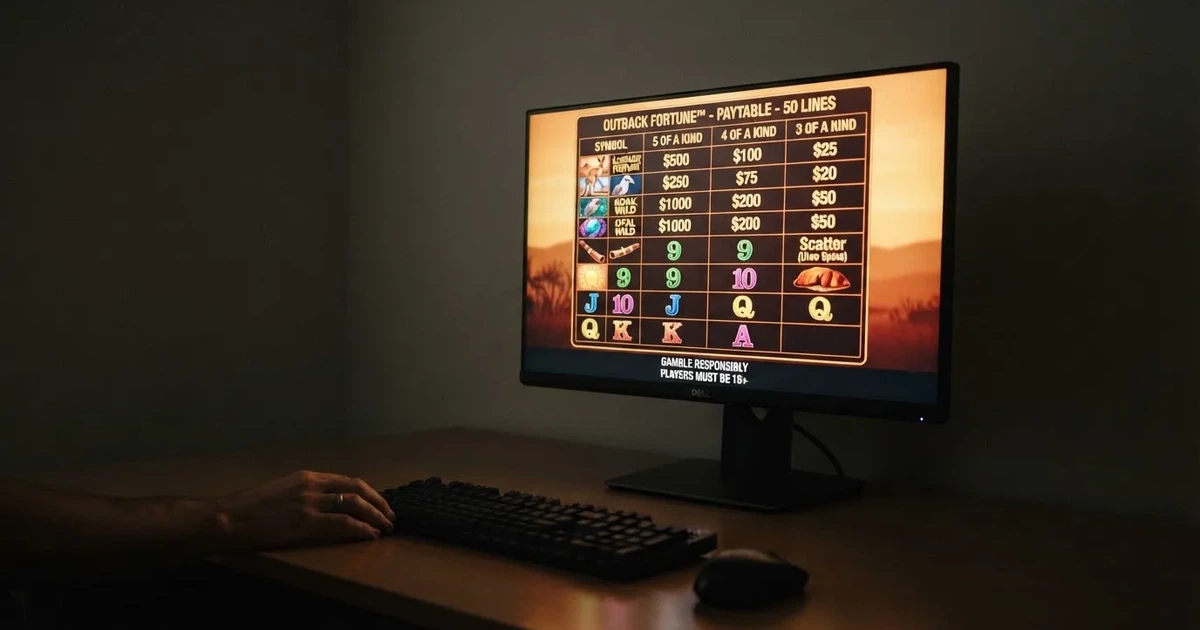
Reels and paylines. The classic machine had three reels and one payline. Modern video slots have five reels and between ten and fifty paylines, sometimes more. Some paylines are straight, some zigzag across the reel grid, and the paytable — the on-screen table that maps each symbol combination to a payout — sits as a tab inside the slot. Paylines are not all paid equally; a five-of-a-kind on the highest-paying symbol carries a different weight from a three-of-a-kind on the lowest. The paytable is the document a player reads before deciding what to stake. It is also the document the offshore operator has the most discretion over: the same slot can be deployed at different return-to-player figures across different markets, and only the licensed venues in Australia publish a return-to-player figure the regulator has verified.
Volatility. Volatility is the term for how unevenly the slot pays out. A low-volatility slot pays out small amounts often. A high-volatility slot pays out large amounts rarely. The same provider’s catalogue can carry low- and high-volatility titles, and the choice is a choice about what kind of session the punter is buying: a long session with frequent small wins, or a short session where most spins lose and one spin might pay out substantially. The volatility profile is set by the game designer and does not change between markets; it is a property of the slot.
Return-to-player. The return-to-player figure is the long-run percentage of stake that the slot returns to players in winnings. State regulators in Australia publish a minimum return-to-player figure for venue machines; offshore sites typically publish a target return-to-player of between 94% and 97%, with no Australian regulator verifying the figure. A 96% return-to-player figure means the slot retains A$4 of every A$100 staked, on average, over a large number of spins. The figure is statistical, not promised to any single session. It is also the figure the venue-based pokies market publishes and the offshore market usually does not verify.
The three numbers — reels, paylines and volatility — are set by the game designer. The fourth, the return-to-player, is set by the operator. The same slot can carry different return-to-player figures at different sites. A punter comparing two offshore offers for the same slot title is comparing two figures the operator chose.
House edge: where the slot sits among the table games
The house edge is the long-run percentage of stake that the casino retains. Slots sit at the higher end of the table. Baccarat, by contrast, has a house edge of 1.06% on the Banker bet, 1.24% on the Player bet and 14.36% on the Tie. Blackjack, played with optimal strategy, runs at about 0.28% under liberal Las Vegas Strip rules and about 0.43% under Atlantic City rules. Craps runs at 1.41% on Pass/Come and 1.36% on Don’t Pass/Don’t Come. State-level minimum payout percentages for slot machines in the United States vary: Nevada sets 75%, Mississippi 80%, New Jersey 83%. Australian state regulators publish their own minimums for venue machines, with figures that differ from jurisdiction to jurisdiction.
The reason for the contrast is the design of the game. Table games run on a small set of outcomes and a published rule book, which lets the house edge be calculated exactly. A modern video slot runs on a random number generator with hundreds of possible symbol combinations, and the published return-to-player is an average across an enormous number of spins. The slot retains more per stake, on average, than almost any table game on the floor. It also pays out more often, in smaller amounts, which is part of why the format dominates the venue floor in Australia: 87,298 machines outside casinos in NSW alone is not a small footprint.
Reading the offer: what a bonus actually costs
A stated “A$100 bonus with 40x wagering” means A$100 of bonus money that must be staked 40 times — A$4,000 of qualifying bets — before any of the bonus-derived winnings can be withdrawn. A stated “free spins on a named slot at A$0.20 per spin” means fifty or a hundred spins at that stake, with the winnings usually credited as bonus money and the same wagering requirement applying. The marketing version is “free”. The arithmetic version is “the winnings carry a turnover requirement that takes hours of play to clear”.
A useful rule of thumb: the expected loss during the wagering period is the required turnover multiplied by the house edge of the slot. A$4,000 of qualifying turnover on a 96% return-to-player slot implies an expected loss of A$160 during the clearance period, before any of the bonus is withdrawable. That expected loss is statistical: across many players, the average loss is A$160; for any single player, the actual loss is higher or lower depending on the slot’s volatility. The point is that “free” is not a price tag — it is a stake requirement, and the stake carries its own expected cost.
How an offshore video slot brand gets named
The names on this page are operators the ACMA itself has acted against, not a ranking or a shortlist. The table lists each one with the operator the ACMA named, the date the warning was issued, and what subject-specific information the ACMA’s own listings carry about it. The pattern across the eleven is consistent: every brand on the list is offered by an offshore operator, every one is unlawful to access from Australia, and the ACMA has put the warning on the public record.
| Brand | ACMA action and date | Operator named by the ACMA | Subject support |
|---|---|---|---|
| RocketPlay | formal warning, March 2026; earlier warning, May 2022 | Pulsup Ltd (Rocketplay.com.au); earlier Dama N.V. | no data |
| Level Up Casino | formal warning, May 2022 | Dama N.V. | Bgaming.com listings only |
| Woo Casino | formal warning, March 2025 | Dama N.V. | no data |
| Spirit Casino | formal warning, May 2025 | Dama N.V. | no data |
| National Casino | formal warning, July 2025 | Consolutetish S.R.L. | en.wikipedia.org listings only |
| Bizzo Casino | formal warning, July 2025; earlier warning, 2022 | Consolutetish S.R.L.; earlier TechSolutions (CY) Group Ltd and TechSolutions Group N.V. | no data |
| Ignition Casino | formal warning, July 2025 | Bamboo Media | no data |
| Instant Casino | formal warning, February 2025 | EOD Code SRL | no data |
| Jackbit | formal warning, April 2026 | Ryker B.V. | no data |
| Casino Intense | formal warning, April 2025 | Sterplay Holding Ltd | Abc.net.au, acma.gov.au, Crownmelbourne.com.au listings only |
| Sky Crown | formal warning, September 2022 | Hollycorn N.V. | no data |
What the table is not is a buyer’s guide. The subject support column records what the public listings report — a slot provider’s own catalogue mention, a Wikipedia entry, a regulator reference — and stops there. Where the listing is absent, the cell carries the no-data marker rather than a guess. The point of the table is that the regulator has acted against every brand on it, and the brand’s own pages carry no information the regulator has verified.
RocketPlay
The brand has been warned twice under different operators: Dama N.V. in May 2022, and Pulsup Ltd in March 2026 over Rocketplay.com.au. The same brand name has surfaced under different corporate parents within four years — a clear indicator of how the offshore market rebrands. The ACMA has no verified public support data for this brand. Australians who choose to play should consider that venue-based pokies operate with state-level oversight, unlike these offshore sites.
Level Up Casino
The ACMA’s May 2022 warning to Dama N.V. listed Level Up among six brands alongside Bambet, Dazard, Rocketplay, Wild Tornado and Cobra Casinos. Game-provider listings carry Level Up among Bgaming.com’s deployments, which is a marketing-side listing rather than a regulator’s verification. The lawful option is the same as it is for any offshore casino brand: a venue-based pokie in Australia.
Woo Casino
The Dama N.V. warning was extended in March 2025 to add Woo Casino to the list of brands under formal warning. Spirit Casino was added two months later in May 2025. The pattern across Dama N.V. brands is the ACMA returning to the same operator, finding new brands under the same ownership, and putting each one on the public warning list. No verified operational data exists for Woo Casino in ACMA records.
Spirit Casino
A second brand added to the Dama N.V. warning list in May 2025. ACMA records do not verify the slot catalogue or bonus terms of Spirit Casino. This site does not offer the protections afforded by Australian licensed venues, such as a state-level complaints body or verified return-to-player figures.
National Casino
The Consolutetish S.R.L. warning in July 2025 covered National Casino and Bizzo Casino. Wikipedia’s own entry on gambling in Australia mentions National Casino among offshore brands the regulator has acted against. The lawful Australian option is the same as for any offshore brand on the list. The frame is the operator warning rather than any subject-specific verification of the slot catalogue.
Bizzo Casino
A repeat warning: Consolutetish S.R.L. in July 2025, and TechSolutions (CY) Group Limited and TechSolutions Group N.V. in 2022, covering the same brand under different corporate parents. The re-warning pattern is itself the information: a brand that has been the subject of a regulator’s action, then re-emerges under new ownership within a few years, and is named again. The lawful Australian option remains the venue-based pokie.
Ignition Casino
The Bamboo Media warning in July 2025 added Ignition Casino to the list. ACMA records contain no verification of the casino’s bonus terms or slot catalogue. Players should be aware that these offshore sites lack the state-regulated complaints bodies that oversee Australian venue-based gaming.
Instant Casino
EOD Code SRL received the formal warning in February 2025. The ACMA provides no verified information on this site’s operations. Unlike venue-based gaming machines which are regulated by state commissions, this site falls outside the Australian consumer protection framework.
Jackbit
Ryker B.V. was warned in April 2026, covering Jackbit and CasinOK. The ACMA has published no operational verification for this brand. Jackbit sits in the most recent cluster of ACMA actions, alongside the 26 June 2026 blocking round. Australian players looking for regulated play typically find it in local venues, not offshore sites.
Casino Intense
Sterplay Holding Ltd was warned in April 2025. While external sources sometimes reference this brand, the ACMA’s formal warning constitutes the primary regulator finding. This brand lacks the verification and consumer protections built into Australia’s venue-based gaming landscape.
Sky Crown
Hollycorn N.V. was warned over Sky Crown and Blue Leo in September 2022. The regulator has provided no verified data on the site’s offerings. Operators like these remain outside the Australian framework, unlike local venues with their clear state-level compliance.
Player protection and where to get help
The licensed wagering market is bound to BetStop, the National Self-Exclusion Register, which went live in August 2023. The register lets a punter exclude themselves from every Australian-licensed online and phone wagering service in one step, and the exclusion applies across operators. It does not bind offshore casinos: an Australian who has self-excluded through BetStop can still reach an offshore site that the ACMA has warned about, because the offshore site is not connected to the register.
The national support line is 1800 858 858, free and 24/7, with online chat at Gambling Help Online. The line is funded by state and territory governments and is the route for a punter, or a punter’s family, who needs to talk through a problem. State-level counselling services — Gambler’s Help in Victoria, Gambling Help in NSW and the equivalents in Queensland, South Australia, Western Australia, Tasmania and the ACT — run the same kind of service with regional contact details.
A punter who plays a venue-based pokie in Australia is playing inside that protection frame: a state regulator, a printed return-to-player figure, a self-exclusion mechanism that binds the venue, and a national helpline that knows the jurisdiction. A punter who plays an offshore video slot is playing outside it: no Australian regulator with jurisdiction, no self-exclusion that binds the operator, and no complaints body that can compel a withdrawal. The format on the screen is the same; the frame around it is different, and the difference is the entire reason the ACMA’s enforcement effort exists.
What this page is not for
This page is not a recommendation to play any brand on the operator list. Every brand on that list is an offshore casino that the ACMA has warned about for offering unlawful online casino games to Australians. The lawful way to play a video slot in Australia is in a pub, club or land-based casino, on a state-regulated machine.
This page is also not a guide to claiming a bonus, a free-spin offer or any inducement from an offshore site. The arithmetic on what a bonus costs is in the mechanics section; the rule on inducements under the 2026 reform bill is that advertising measures commence 1 January 2027, not on a 2026 page. The framing is the consequence, not the route.
This page is also not a substitute for the ATO on the tax side, and not a substitute for Gambling Help Online on the support side. A punter whose activity has crossed from recreational into something else has a free national helpline at 1800 858 858 and an ATO ruling to look up.
Frequently asked questions
What makes a video slot different from a classic three-reel pokies machine?
A modern video slot uses five or more reels, fifty or more symbols per reel and a random number generator rather than a mechanical reel, with odds on the top combination that can reach three hundred million to one. The classic three-reel machine has about ten symbols per reel and roughly one thousand possible outcomes. Both formats are slot machines; both have a payline structure; the modern video slot adds bonus features, faster play and a higher-volatility payout profile.
Do video slots typically include bonus rounds that classic machines don’t have?
Yes. Modern video slots run free-spin rounds, pick-a-prize screens, cascading reels and other features as part of the base game. A classic three-reel machine runs a single spin-and-pay cycle. The bonus round in a video slot is a feature of the game itself, triggered by a specific symbol combination and paid for by the slot rather than by the player. The term is sometimes confused with a marketing free-spin offer, which is a different object.
Are video slots on a mobile browser the same game as the desktop version?
Yes, in paytable, random number generator, return-to-player figure and bonus-round logic. The same HTML5 codebase runs the slot on desktop, mobile and tablet browsers. What changes is the screen layout: a portrait mobile screen compresses the bonus-round animations, and the spin button sits under the thumb rather than under the cursor. The game is the same.
How many paylines does a typical modern video slot use?
Modern video slots commonly use between ten and fifty paylines, with some titles running higher. A classic three-reel machine had one payline. The paylines on a modern slot can run straight across the reels, in zigzags, or in patterns that depend on the slot’s design, and the paytable documents the line structure and the payout for each symbol combination on each line.
Why do video slots vary in volatility even within the same provider’s catalogue?
Volatility is the unevenness of the payout profile, and the provider sets it deliberately. A low-volatility slot pays out small amounts often and runs a long session with frequent small wins. A high-volatility slot pays out large amounts rarely and runs a short session where most spins lose and one might pay out substantially. The same provider’s catalogue carries low- and high-volatility titles because the choice is a choice about what kind of session the punter is buying.
Which Australian state has the most licensed gaming machines outside casinos?
New South Wales, with 87,298 pokies-style machines outside casinos as of June 2023, against 26,380 in Victoria across 2021–22, 21,122 in Queensland in October 2023, 11,672 in South Australia in September 2023 and 3,587 in the ACT in November 2023. NSW was the first Australian state to legalise slot machines, in 1956, and still carries more machines outside casinos than the next four jurisdictions combined.