
Reading the online pokies market in Australia without the marketing sheen
The page that follows is built around a single, awkward truth. Anyone in Australia typing best aussie pokies online australia 2026 into a search bar is asking for a ranked list of licensed local sites — and no such list exists, because the Interactive Gambling Act 2001 prohibits online pokies outright. The closest legal equivalent is a poker machine inside a licensed pub, club or casino, regulated state by state, and quite separate from the offshore sites whose names dominate search results.
The only honest starting point is to say so. The rest of the page explains what the offshore market looks like, why the Australian Communications and Media Authority has spent years acting against it, and how a reader comparing offers can read the specifications without inheriting the marketing.
Current as of 31 October 2026. Verified against ACMA formal warnings and blocking notices, plus state gaming regulator returns.
Table of Contents
- The shape of the online pokies question in Australia
- What Australian law actually says about online pokies
- What the ACMA has actually done, and to whom
- What responsible gambling support looks like from an Australian reader’s seat
- How payments and payout speed actually read
- What bonus credits and free spins are worth on a prohibited product
- What a paytable and a catalogue generally show
- How a fair comparison would actually weigh the operators
- Reading the individual operator record
- What the comparison table actually leaves out
- How to read a single offshore site’s claim without inheriting its marketing
- The arithmetic of how a session actually costs
- What the regulatory record means for a reader comparing offers today
- Frequently asked questions
The shape of the online pokies question in Australia
Online pokies are the online version of the electronic gaming machines Australians call pokies — the cabinet-style games that sit in pubs, clubs and casinos from Perth to Hobart. In every state and territory they are heavily regulated: a NSW venue outside a casino held 87,298 of them across 2,195 sites as of June 2023, with player losses of A$8.18 billion in the 2022-23 financial year. Queensland had 21,122 machines in 351 venues in October 2023; Victoria ran 26,380 machines outside Crown Casino in 488 venues under a 30,000-machine statewide cap. Australia holds about 3% of the world’s pub and club poker machines with 0.3% of the global population. By any measure, pokies are the country’s most-played form of legal gambling.

The online counterpart is a different question. Under the Interactive Gambling Act 2001, as tightened by the Interactive Gambling Amendment Act 2017, it is an offence to provide online casino games — online pokies included — to a person physically in Australia. No state or territory issues a licence for them. The legal Australian online wagering market runs to sports and race betting, lotteries and keno; the casino-style product is prohibited. Whatever an offshore site claims about “Aussie-friendly” branding, that branding is marketing, not a jurisdiction.
The landscape a search results page suggests is therefore a marketing artefact, not a regulated market. Reading it requires separating the two things the marketing collapses: the offshore product on offer, and the legal status of offering it to someone in Australia.
What Australian law actually says about online pokies
The Interactive Gambling Act 2001 is the federal frame. It prohibits the supply of “prohibited interactive gambling services” — online casino games, online pokies and in-play betting — to people in Australia. The 2017 amendments strengthened enforcement and expanded what counts as an inducement. The 2026 reform bill — the Interactive Gambling Amendment (Gambling Reform) Bill 2026 — passed Parliament on 19 August 2026; its advertising and inducement measures commence 1 January 2027, which means the law is enacted but not yet in force on a page read this year.

The individual player is not the target of prosecution. The IGA reaches the provider. That distinction matters for the practical reading of the rules: no Australian reader is going to be charged for opening an offshore account, but neither do they receive any of the protections an Australian licence would attach — no Australian complaints body, no recourse if a withdrawal is refused, no guarantee the site will still be reachable next week. The ACMA can direct Australian internet service providers to block the site, and it has done so 1,751 times since November 2019 — including twelve more sites in the round reported on 26 June 2026 alone.
What is licensable online is wagering — bets placed before an event on racing or sport — plus lotteries and keno. The Northern Territory Racing and Wagering Commission regulates 52 of Australia’s online bookmakers (Sportsbet, Bet365, Ladbrokes among them) for tax reasons, and the commission runs with no full-time staff, meeting once a month in Darwin. That is the regulated shape; everything outside it is offshore.
What the ACMA has actually done, and to whom
The ACMA’s enforcement has three visible instruments. It can issue formal warnings to operators; it can direct Australian ISPs to block sites; and it can refer matters for civil penalty proceedings. By June 2026 the cumulative count was 1,751 blocked illegal gambling and affiliate marketing websites, with more than 230 unlicensed services having left the Australian market since 2017.
The blocking rate is the arithmetic the rest of this page leans on. From the first blocking request in November 2019 to the 26 June 2026 round, 1,751 sites went on the list across roughly 79 months — an average of about 22 sites per month across the full period. The pace has been far from even. The single round reported on 26 June 2026 alone named twelve new targets: 7Signs, ChromaBet, Donbet, Duospin, Freshbet, Slots Gem, Jacks Club, Lucky Start, Pointsbetz, Spinrise, Vinyl Casino and Wildsino. That is twelve in one announcement against the long-run average of roughly twenty-two in a calendar month. Different rounds have run faster or slower, and the headline count is a cumulative running total rather than a steady drumbeat — but the order of magnitude is the right one to carry: somewhere between a dozen and several dozen new blocks per month across the period, with bursts well above that average when a particular network of sites draws regulator attention.
Formal warnings are a separate track. The ACMA names an operator and a brand, gives the date of the warning, and publishes the record. The pattern across the past four years tells its own story: Dama N.V. was warned in May 2022 covering six brands (Bambet, Dazard, Level Up, Rocketplay, Wild Tornado and Cobra Casinos), then again over Woo Casino in March 2025 and Spirit Casino in May 2025. Bizzo Casino was warned through TechSolutions in 2022 and again through Consolutetish S.R.L. in July 2025. Bamboo Media was warned over Ignition Casino in July 2025; EOD Code SRL over Instant Casino in February 2025; Sterplay Holding Ltd over Casino Intense in April 2025; Hollycorn N.V. over Sky Crown and Blue Leo in September 2022; Ryker B.V. over Jackbit and CasinOK in April 2026; Pulsup Ltd over Rocketplay in March 2026.
The repeated warning — same operator, different brand, a year or two later — is the regulator’s acknowledgement that a warning letter is rarely the end of the matter. The same corporate group rebrands or repackages and the cycle restarts. A reader looking at an offshore site’s licence claim should look past the licence badge and ask whether the operating company behind the brand has been named in an ACMA warning before.
What responsible gambling support looks like from an Australian reader’s seat
If a question about online pokies play starts to feel heavier than a recreational question, the Australian support routes are open, free, and confidential. Gambling Help Online runs the national chat service; the National Gambling Helpline on 1800 858 858 is free and operates twenty-four hours a day. Both services are independent of any operator, onshore or off.
BetStop, the National Self-Exclusion Register, has been live since August 2023. It is the right tool for someone who wants a structural break from Australian-licensed wagering services. Its scope is the licensed segment: BetStop binds Australian-licensed online and phone wagering providers, and offshore casino sites are not connected to it. A self-exclusion through BetStop will not stop an offshore casino from accepting a deposit; it will stop the licensed bookmaker and lottery products the person can reach through Australian channels. For an offshore product the lever is payment-block at the bank and account-block at the site itself, with the regulator route limited to complaint and block request rather than exclusion register.
A reader comparing offers should read responsible-gambling framing the same way they read a bonus term: as a clause that describes what happens in the unfavourable case, not as a feature for everyday use. The house always has an edge. The protection is what stands between the player and the worst case, and on the licensed Australian side the protection has a regulator behind it. On the offshore side it does not.
How payments and payout speed actually read
A serious reading of an offshore site’s payments section has to start with what Australian law says about payments for licensed wagering — because the offshore site is not bound by any of it. Since 11 June 2024, credit cards, credit-related products and digital currency are banned as payment for licensed online wagering, with penalties of up to A$247,500 for the operator that breaks the rule. The legal deposit routes for a licensed Australian wagering service are debit card, bank transfer, PayID, Osko and BPAY.
That is the licensed frame. The offshore frame is different and entirely outside Australian reach. PayID — the fast settlement system connected to Australia’s New Payments Platform — is built for real-time transfers between Australian bank accounts and is the practical deposit method of choice for a reader who wants to fund an offshore account. PayID itself is a transfer mechanism, not a regulatory mechanism; it does not vet the receiving party, and a PayID deposit into an offshore casino is still a deposit into a site the ACMA may have warned, blocked or referred. The same applies to BPAY and ordinary bank transfer: they move the money, the regulator reaches the operator, the player carries the residual risk if the site vanishes.
Payout speed is the practical question that follows. An Australian debit-card refund through the NPP typically clears within minutes in normal conditions, subject to the receiving bank’s processing window. Withdrawals from an offshore site follow a longer chain — request, internal approval, transfer, receiving bank — and what the marketing page claims (“instant”, “same day”) is best read as the optimistic end of a range rather than a guarantee. The honest reading is: request to receipt is several business days at a normally functioning offshore operator, longer if anything in the chain is held.
Two practical consequences follow. The first is that the payment method is not a proxy for safety. A PayID deposit is convenient and fast, but the speed is the system’s, not the regulator’s. The second is that a balance sitting on an offshore site is a balance exposed to a block, an operator dispute or a withdrawal queue — the offshore operator has no obligation to the Australian consumer framework, and a blocked site cannot pay out what its Australian customers had on it.
What bonus credits and free spins are worth on a prohibited product
For online pokies play, the bonus and free-spin offer is something no Australian-licensed product may lawfully extend. The 2017 amendments to the Interactive Gambling Act specifically targeted inducements — bonus credits, free spins, sign-up offers — as part of what the regulator can act against. An offer landing in an Australian inbox or on an Australian-facing page is, on its face, part of the prohibited conduct. Reading it requires reading what would matter if it were a licensed offer.
Wagering requirements are the first thing to look at. A bonus advertised at A$1,000 with a 40x playthrough asks the player to wager A$40,000 before any of it converts to withdrawable cash. The marketing headline is the A$1,000; the actual price is the turnover. Free spins attached to a deposit are read the same way — winnings are bonus funds, the wagering multiple attaches to them, and a maximum-cashout cap is usually sitting in the terms. The arithmetic that exposes the cost is in the next section; the qualitative reading here is that an inducement on a prohibited product is the inducement the regulator is also acting against.
The 2026 reform bill tightens this further from 1 January 2027, with advertising and inducement measures taking effect then. A page read in 2026 sits in the gap between the prohibition already in force and the new measures not yet commenced. The honest reading is unchanged: any bonus credit, free spin or sign-up offer landing from an offshore casino onto an Australian reader’s screen is already part of the conduct the regulator prosecutes the operator for, and any dollar attached to it is at the offshore operator’s discretion, not under Australian consumer law.
What a paytable and a catalogue generally show
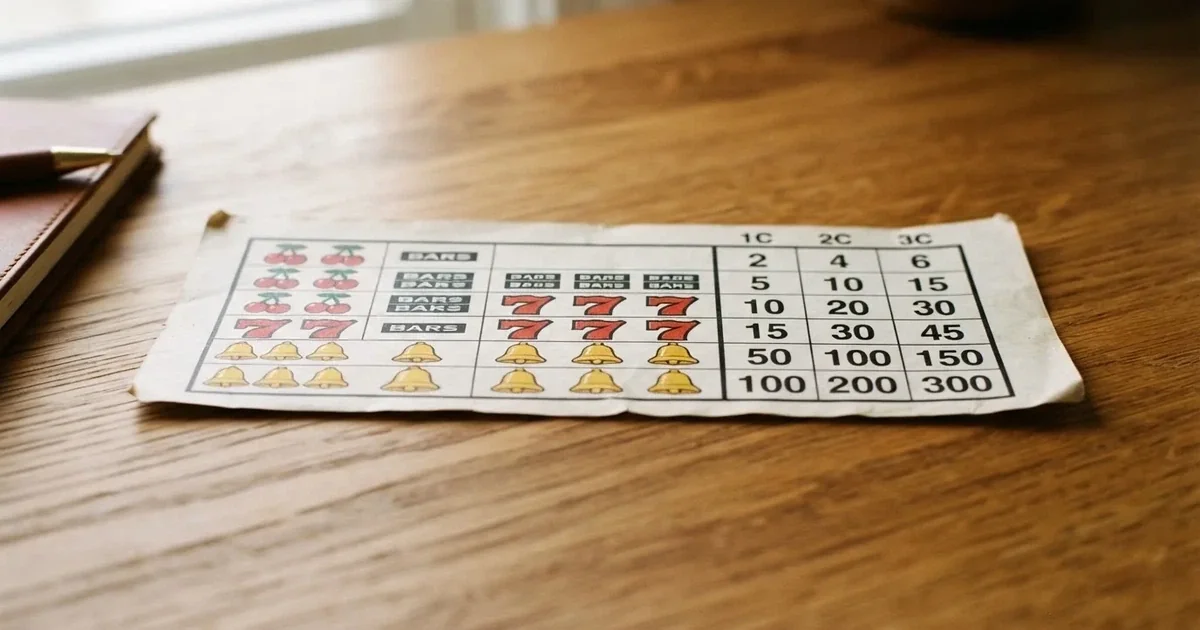
The paytable is the printed or on-screen reference chart for a pokie. It lists each symbol, the payout for landing three, four or five of a kind on a payline, and the rules around wilds, scatters and bonus features. A reader looking at a paytable for the first time is looking at the single document that tells them what the game pays out, in what combinations, and what triggers the feature round. It is the closest thing a pokie has to a contract.
A catalogue — the list of titles a site offers — is typically organised by provider, by theme or by feature type. A reader browsing a catalogue sees game variants (three-reel classics, five-reel video slots, jackpot titles with a pooled prize), volatility bands (low, medium, high — the rough rhythm of small frequent wins against larger rarer ones) and return-to-player figures (the theoretical percentage of wagered money a game returns to players over the long run, set by the game’s design). State-level licensed machines in Australia carry minimum RTP floors set by jurisdiction: 85% in NSW, the Northern Territory, Queensland and generally Victoria (87% at Crown Melbourne), 87% in the ACT and Tasmania, 87.5% in South Australia, and 90% in Western Australia. An offshore title’s RTP is whatever the developer set; the licence display on the offshore site is the developer’s or operator’s claim, not a regulator’s.
Two practical reading points. The first is that a higher RTP is not a higher chance of winning any individual spin — it is a long-run average across many spins, and a session of any length can sit well above or well below it. The second is that an offshore site’s catalogue is not auditable in the way a state-regulated machine’s paytable is: the file sits on the offshore operator’s servers, the regulator has no jurisdiction, and the player has no independent verification route. Reading a catalogue with that in mind changes what the reader takes from it.
How a fair comparison would actually weigh the operators
A fair comparison of online pokies offers in Australia cannot produce a shortlist of operators to visit, because none of them is licensed in Australia. The honest comparison is at one level removed — a comparison of how each offshore site has been treated by the regulator, what its operating company has been warned over, and what a reader should know before deciding to engage with it at all.
Eleven brands appear below. Each has been the subject of an ACMA formal warning. Each is presented for what the warning record shows, not as a recommendation. The role of the comparison is to make the warning record legible — to turn the regulator’s enforcement log into something a reader can read at a glance, and to flag the patterns that matter.
| Brand | ACMA action and date | Operator named by the ACMA | Subject support |
|---|---|---|---|
| RocketPlay | March 2026 (also May 2022 under a prior operator) | Pulsup Ltd (2026); Dama N.V. (2022) | — |
| Level Up Casino | May 2022 | Dama N.V. | listed by BGaming |
| Woo Casino | March 2025 | Dama N.V. | — |
| Spirit Casino | May 2025 | Dama N.V. | — |
| National Casino | July 2025 | Consolutetish S.R.L. | listed on en.wikipedia.org |
| Bizzo Casino | July 2025 (also 2022 under a prior operator) | Consolutetish S.R.L. (2025); TechSolutions (2022) | — |
| Ignition Casino | July 2025 | Bamboo Media | — |
| Instant Casino | February 2025 | EOD Code SRL | — |
| Jackbit | April 2026 | Ryker B.V. | — |
| Casino Intense | April 2025 | Sterplay Holding Ltd | listed by ABC, ACMA, Crown Melbourne |
| Sky Crown | September 2022 | Hollycorn N.V. | — |
The table’s structure is deliberate. The brand is what a reader sees on a search results page; the operator is the corporate entity the regulator names; the date is when the warning was published. Where a brand has been warned twice — once under one operator, once under another — both entries sit in the same cell. The subject-support column shows whether independent listings (developer pages, encyclopaedia entries, mainstream press) name the brand alongside Australian regulated material; an em dash means the inputs carry nothing the page can responsibly affirm.
The pattern in the operator column is the column that matters. Dama N.V. appears three times — Level Up Casino, Woo Casino and Spirit Casino — across four years. The same parent company, three brand names, three separate warnings. Hollycorn N.V. was warned over Sky Crown and Blue Leo together in 2022. Consolutetish S.R.L. was warned over National Casino and Bizzo Casino together in July 2025. Bizzo Casino additionally sits on a 2022 warning to TechSolutions. The pattern is unmistakable: a warning letter addressed to one corporate entity often covers several brands, and a brand rewarned under a new corporate name is the same product under a new wrapper.
The honest reading of that pattern is that the offshore market operates at the level of the corporate group rather than the brand. A reader who has looked at a brand’s homepage and decided it looks legitimate is, in many of these cases, looking at one entry in a portfolio the regulator has acted against. The “Subject support” column shows the independent signal that sits outside the regulator’s record: BGaming’s developer listings, an encyclopaedia entry, an ABC News mention. Where the column is empty, the page has nothing to attach to the brand outside the warning itself.
Reading the individual operator record
The eleven brands below are each presented for what the ACMA has published about them. The verdict at the end of each entry is the page’s own reading of the record, not a recommendation to use the site.
RocketPlay
The ACMA warned Pulsup Ltd over Rocketplay in March 2026. A separate warning — to Dama N.V. — covered Rocketplay in May 2022 alongside five other brands. The brand has moved through more than one operating company in four years; the warning record moves with it. The honest reading is that the operator behind the brand has changed, and the warning record is the longest consistent thread connecting the brand’s history.
Level Up Casino
Warned in May 2022 under Dama N.V. as part of the six-brand batch that also covered Bambet, Dazard, Rocketplay, Wild Tornado and Cobra Casinos. BGaming lists Level Up among the operators carrying its content, which is the only signal outside the regulator’s record the inputs carry. Four years on from the warning, the brand’s continued operation sits inside the pattern of long-running offshore brands that the regulator has named once and not revisited by name since.
Woo Casino
Dama N.V. was warned over Woo Casino in March 2025 — three years after the May 2022 batch that covered other Dama brands. The pattern of the same operator being warned over successive brands is the practical reading the warning record supports.
Spirit Casino
The May 2025 warning to Dama N.V. over Spirit Casino is the third Dama N.V. brand on this list, alongside Level Up Casino and Woo Casino. Three brands, one operator, warnings spread across 2022 and 2025 — the warning record itself is the clearest signal the page can carry.
National Casino
Consolutetish S.R.L. was warned over National Casino in July 2025 as part of a batch that also covered Bizzo Casino. An encyclopaedia entry mentions the brand, which is the only independent listing the inputs carry. The brand sits in a two-brand batch with a sister operator already warned in 2022 under a different corporate name.
Bizzo Casino
Warned twice. The first warning went to TechSolutions (CY) Group Limited and TechSolutions Group N.V. in 2022; the second, in July 2025, went to Consolutetish S.R.L. Two warnings, two corporate names, one brand. A reader looking at the brand’s current licence display should read the corporate history behind it.
Ignition Casino
Bamboo Media was warned over Ignition Casino in July 2025. The brand sits in the same batch of warnings as National Casino and Bizzo Casino under separate operators, but the regulator’s record for Ignition itself runs to one warning to date.
Instant Casino
EOD Code SRL was warned over Instant Casino in February 2025. The warning predates the July 2025 batch by five months, and the brand is the only EOD Code brand the warning names.
Jackbit
Ryker B.V. was warned over Jackbit and CasinOK together in April 2026. The two-brand warning is consistent with the pattern across the rest of the operator set: a single warning letter covering more than one brand under one operating company.
Casino Intense
Sterplay Holding Ltd was warned over Casino Intense in April 2025. Independent listings — ABC News coverage, ACMA publications and a Crown Melbourne reference in the inputs — name the brand alongside Australian regulated material, which is the strongest external signal in the table for any of the eleven brands.
Sky Crown
Hollycorn N.V. was warned over Sky Crown and Blue Leo together in September 2022. The earliest of the warnings on this list, and the brand whose warning record has had the longest time to develop. No further formal warning to the same operator over the same brand has been published in the period since, which is the only reading the inputs support.
What the comparison table actually leaves out
The table above carries four columns. It does not carry bonus terms, because the only sources for bonus terms on these brands were affiliate marketing pages, and writing them into the page would amount to repeating the marketing. It does not carry a payout speed column, because none of the inputs give a figure for any of the eleven brands, and an honest comparison cannot invent one. It does not carry a payment-method column, because the legal frame in §7 is what determines whether a method is even available to a licensed Australian wagering service, and the offshore sites are not bound by it. Each absence is itself information: the comparison is what the regulator’s record and the inputs together support, nothing more.
A reader who wants to fill any of those columns should treat their absence as the warning. Where a marketing site publishes a figure for any of these brands, the figure is the operator’s own claim and the inputs carry no independent verification of it.
How to read a single offshore site’s claim without inheriting its marketing
A short sequence works for most pages. First, the licence display: it sits on the operator’s own page, names a regulator in another jurisdiction, and the licence number is searchable on that regulator’s public register. If the regulator cannot be verified or the licence number does not resolve, the licence display is the marketing. Second, the operating company: the small-print footer or the terms page names the corporate entity. If that entity appears in the ACMA’s formal warning register, the warning is older than any current licence claim. Third, the payment methods: an offshore site offering credit card deposits or cryptocurrency to an Australian reader is operating outside the Australian frame entirely; the legal deposit routes for licensed Australian wagering are debit card, bank transfer, PayID, Osko and BPAY, and an offshore site accepting anything else is not aligning itself with the Australian rules. Fourth, the bonus terms: a large headline number attached to a high wagering multiple is a marketing number; the wagering multiple is the actual price. Fifth, the responsible-gambling page: an offshore page with no meaningful responsible-gambling framework is the most basic reading of what an unregulated product offers.
The arithmetic of how a session actually costs
The session arithmetic on a pokie is straightforward, and worth running once. Take a five-reel video slot at 96% RTP — meaning the machine returns 96 cents in winnings for every dollar wagered across a long run — and a stake of A$1 per spin. Each spin has an expected loss of 4 cents, the difference between the stake and the expected return. A session of 250 spins costs an expected A$10 in the aggregate, with a wide spread around that average for any single session. A session of 500 spins costs an expected A$20. The house edge is the constant; the session length is the variable.
The arithmetic exposes what a bonus offer actually does. A A$200 bonus with a 35x wagering requirement asks the player to wager A$7,000 before the bonus converts. At a 96% RTP and A$1 per spin, the expected loss across A$7,000 of wagering is A$280 — more than the headline bonus, before the player has staked a cent of their own money. The bonus pays the player back less, on average, than the wagering requirement costs. The marketing word is “bonus”; the underlying number is a negative expected value.
A A$500 bonus with a 40x playthrough runs to A$20,000 in required wagering. The expected loss is A$800. A A$1,000 bonus with a 50x playthrough runs to A$50,000 in wagering and an expected A$2,000 loss. The pattern is mechanical: the larger the headline, the larger the wagering requirement, and the larger the expected cost. No bonus on a prohibited product converts the player’s edge; it converts a portion of the wagering into bonus funds that the player cannot withdraw until the playthrough is met.
The honest gloss on the arithmetic is that a bonus is a way of increasing the volume the player wagers through the machine. The player’s expected loss per dollar wagered is unchanged; the total dollars wagered rises sharply with the playthrough; the total expected loss rises with it. A player who would not wager the bonus turnover at their own stake should not accept the bonus, because the bonus is asking them to.
What the regulatory record means for a reader comparing offers today
By June 2026 the ACMA had blocked 1,751 illegal gambling and affiliate marketing websites since November 2019. The blocking rate — roughly twenty-two sites per month across the full period, with bursts above that — is the regulator’s continuous answer to a market that has continued to find new entries to replace blocked ones. H2 Gambling Capital’s 2025 estimate puts Australian losses to illegal gambling sites at about A$3.9 billion a year; the share of gambling going through legal channels fell from 74% in 2021 to 64%.
The trend is the reader-relevant figure. A market in which the legal share is shrinking is a market in which the offshore offer is doing more of the work. The reader sitting in that market has less of the regulator’s protection in the average transaction than they did five years ago, and the regulator’s response — blocking, warning, civil penalty — has scaled to match. The honest reading is that the reader’s choice is between a small and shrinking licensed Australian market (wagering, lotteries, keno) and a larger offshore market that operates outside Australian consumer law and that the regulator continues to act against.
The rest of the page is the practical reading of that choice. The comparison above is the warning record a reader can read in one table. The arithmetic above is the cost of a session the reader can compute. The FAQ below covers the questions the inputs most clearly support.
Frequently asked questions
Does calling an online pokies site “Aussie” change where it is actually licensed?
No. The label is a marketing term. No state or territory in Australia issues a licence for online pokies, because the Interactive Gambling Act 2001 prohibits them. A site using “Aussie” in its branding is making a claim about its audience, not its regulator; the licence on its footer is the licence of another jurisdiction. The site’s actual status is the ACMA’s formal warning record, not its own branding.
Are the bonus credits and free spins on an “Aussie pokies” site legal to advertise here?
No. The 2017 amendments to the Interactive Gambling Act make inducements — including bonus credits and free spins offered to people in Australia — part of the prohibited conduct. An offer landing on an Australian-facing page is part of what the regulator is empowered to act against, and the Interactive Gambling Amendment (Gambling Reform) Bill 2026 tightens this further from 1 January 2027.
Is there a dedicated app for Aussie-branded online pokies that’s legal to install locally?
No. No app store legitimately distributes an online pokies product for Australian users, because the product itself is prohibited. Apps surfacing in search results under an “Aussie” label are typically web-app wrappers around the same offshore site; the legal status does not change with the installation method.
Do state gaming regulators recognise any “Aussie online pokies” brand as licensed?
No. State regulators — the NSW Liquor & Gaming authority, the Victorian Gambling and Casino Control Commission, the Queensland Office of Liquor and Gaming Regulation, the Tasmanian Liquor and Gaming Commission and the others — regulate land-based gaming machines, lotteries and wagering. None of them licenses online casino games or online pokies. An offshore site’s claim of Australian recognition is unsupported by any state regulator’s public register.
How does an Aussie-branded online pokies catalogue differ from a licensed pub’s machines?
A licensed pub or club pokie is regulated state by state, with a minimum return-to-player floor set by jurisdiction (85% in NSW, the Northern Territory, Queensland and generally Victoria, 87% at Crown Melbourne, 87% in the ACT and Tasmania, 87.5% in South Australia, and 90% in Western Australia), and with the regulator auditing the machine’s actual performance. An offshore catalogue’s RTP figures are the developer’s or operator’s claim, the games are hosted on the offshore operator’s own servers, and there is no independent audit the Australian reader can verify.
Can an Aussie-branded online pokies site accept a PayID deposit and still be unlicensed?
Yes. PayID is a transfer mechanism connected to Australia’s New Payments Platform; it moves money between Australian bank accounts quickly but does not vet the receiving party. An offshore casino can accept a PayID deposit without holding any Australian licence, because the system’s role is settlement, not regulation. The legal deposit routes for licensed Australian wagering are debit card, bank transfer, PayID, Osko and BPAY; credit cards, credit-related products and digital currency are banned for licensed wagering since 11 June 2024. An offshore site accepting any of those routes to an Australian reader is operating outside the Australian frame.