
Casino sites that accept Osko in Australia: the ACMA warnings, the blocked sites, and what a deposit actually settles into
The phrase “casino sites that accept Osko in Australia” reads like a payment-method comparison. It is not. Osko is a real, fast Australian bank transfer rail; offshore casino sites that advertise it to Australians are the subject the ACMA has spent seven years acting against. The page below works through what Osko is, why the matching of the two is prohibited, what the regulator has done about it, what an Australian player who lands on one of these sites actually ends up holding, and where the eleven operators most often named in this search sit in that picture.

Current as of 29 October 2026, verified against the ACMA’s formal-warning register and the Australian Communications and Media Authority’s blocking notices.
Table of Contents
- What Osko is, and why it ends up advertised next to offshore casinos
- The legality frame: why Osko cannot legally route an Australian casino deposit
- Responsible-gambling supports that an Osko deposit does not connect a player to
- Payments and payout speed: what the rail can and cannot do for the player
- The eleven operators most often named in this search, and what the ACMA has done about each
- The blocking rate: what the ACMA’s record shows
- What an Australian player is actually funding with an Osko deposit to one of these sites
- Where the limits sit: a note on the deposit-cap framing
- What the ACMA’s June 2026 round says about the current state of enforcement
- Frequently asked questions
What Osko is, and why it ends up advertised next to offshore casinos
Osko is the instant-transfer layer that runs on top of Australia’s New Payments Platform. Australian Payments Plus, the same body behind PayID and BPAY, owns the brand. When both the sending and receiving account are held at participating banks, an Osko payment arrives in under a minute, 24 hours a day, seven days a week, including weekends and public holidays. A payment goes through whether the recipient is identified by a BSB and account number or by a PayID. There is no separate sign-up: the Osko option sits inside the “Pay Anyone” section of a bank’s internet banking or app, and any transfer tagged with the Osko logo is processed through the fast rail.

The mechanism behind that minute is the Reserve Bank of Australia’s Fast Settlement Service, which settles individual NPP payments in close to real time around the clock. The NPP itself launched to the public on 13 February 2018, is owned by a non-profit company whose thirteen shareholders include the Reserve Bank and the major banks, and by 31 August 2025 had reached 128 million accounts and was facilitating around A$7 billion of payments a day. Participants in the platform are obliged to keep monthly outages to under two minutes, which is why the speed claim is the rail’s whole point. PayID, the addressing layer Osko uses when no BSB is involved, had passed 25 million registered identifiers by April 2025, and instant transfers against a PayID are available at over a hundred Australian financial institutions.
The first thing to settle is why this matters for a casino page at all. Osko is built for ordinary commerce between Australian accounts. Any deposit that an Australian player makes to an offshore casino has to be paid to a recipient account, and the recipient is, in practice, a payment processor sitting somewhere outside Australia. The Osko transfer itself is fast, but it is also fully traced: the receiving account is named, the description field can carry up to 280 characters when Osko is enabled on both sides, and a PayID transfer will display the name of the account holder before the payment is confirmed. Australian Payments Plus is explicit about this: being asked to send an Osko payment to a PayID on an illegal gambling site is, in the operator’s own language, “almost certainly” a scam site.
That detail is the heart of the page. The rail is real, the speed is real, the protection on the rail is real, and the receiving end is the part the regulator has spent years warning Australians about.
The legality frame: why Osko cannot legally route an Australian casino deposit
Online casino games and online pokies cannot be licensed for Australian customers. The Interactive Gambling Act 2001, strengthened by the Interactive Gambling Amendment Act 2017, makes it an offence to provide those services to a person physically in Australia; no state or territory issues a licence for them. What can be licensed is wagering on races and sporting events placed before the event, lotteries and keno — and in practice the licensing of those services is concentrated in the Northern Territory, where the Northern Territory Racing and Wagering Commission oversees 52 of Australia’s online bookmakers, including Sportsbet, Bet365 and Ladbrokes. The commission has no full-time staff and meets once a month in Darwin.
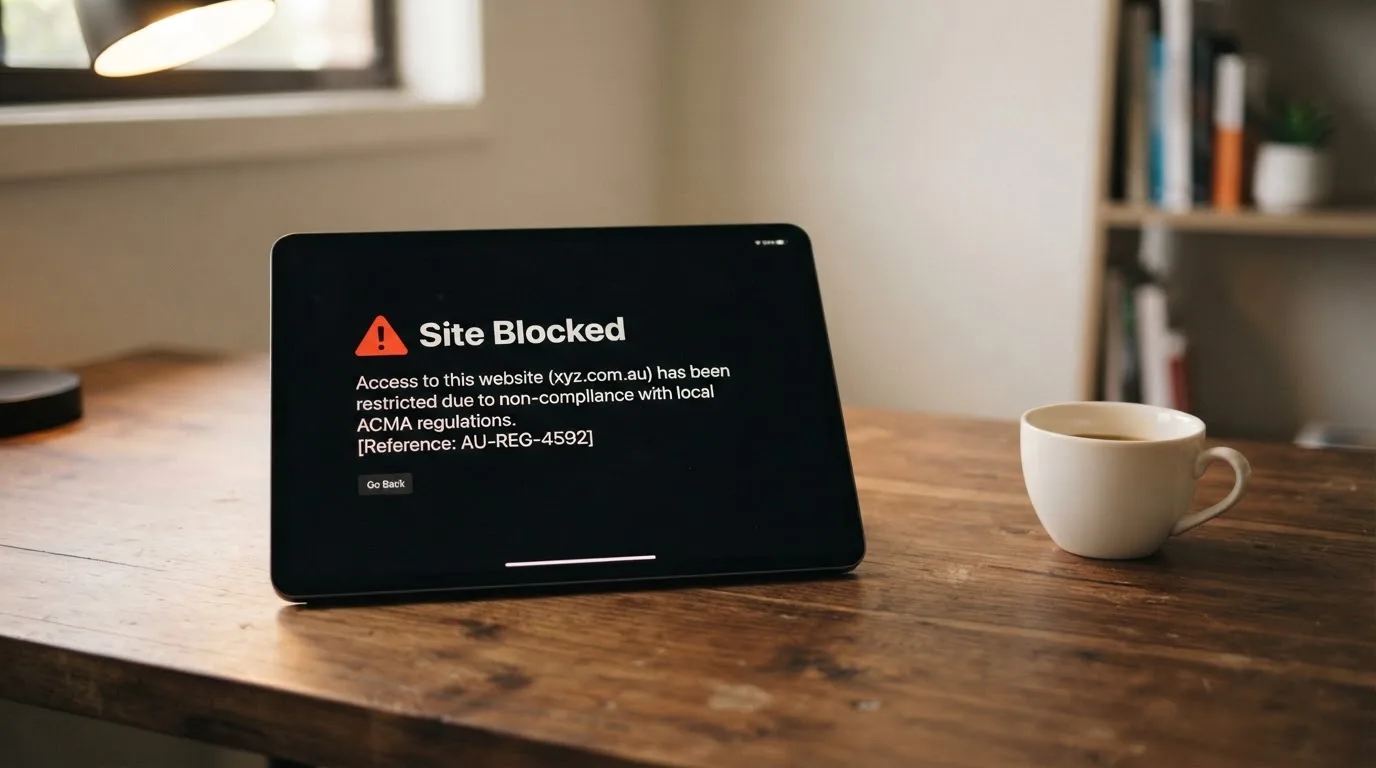
The ACMA — the Australian Communications and Media Authority — enforces the prohibition. It investigates, issues formal warnings, and can direct ISPs to block illegal services. By June 2026 the ACMA had asked Australian ISPs to block 1,751 illegal gambling and affiliate marketing websites since the first blocking request in November 2019, and more than 230 unlicensed gambling services had left the Australian market since enforcement was stepped up in 2017. A typical round, the one reported on 26 June 2026, named twelve more sites for blocking: 7Signs, ChromaBet, Donbet, Duospin, Freshbet, Slots Gem, Jacks Club, Lucky Start, Pointsbetz.com, Spinrise, Vinyl Casino and Wildsino.
H2 Gambling Capital’s 2025 report puts the cost at around A$3.9 billion a year lost to illegal offshore sites by Australians, and notes that the share of gambling going through legal channels fell from 74% in 2021 to 64%.
The Interactive Gambling Amendment Act 2017, reinforced in 2023, also bans credit cards and credit-related products as a payment method at any Australian-licensed online wagering service, with penalties of up to $247,500 for operators. Legal deposit routes for licensed wagering are debit card, bank transfer, PayID and Osko, and BPAY. A site that asks an Australian player to fund an account with a credit card or a cryptocurrency deposit is operating outside the Australian rules regardless of what licence it displays in its footer.
The same logic covers Osko. Osko itself is a permitted payment rail for licensed wagering, and is used that way by licensed Australian bookmakers. Osko as a deposit rail into an offshore casino is the rail being used for a prohibited service, and the offshore operator is the entity the Act targets, not the Australian player. The individual player is not prosecuted under the IGA. The site is. The site can be blocked with a balance on it, the Australian player has no complaints body and no recourse if a withdrawal is refused, and the deposit, fast as it was, ends up at a recipient account the ACMA has warned about.
A secondary frame sits behind this one. The Interactive Gambling Amendment (Gambling Reform) Bill 2026 passed Parliament on 19 August 2026; its advertising and inducement measures commence on 1 January 2027. That is law with a start date, not a regime in force today, and on a 2026 page it has to be read as a forward-looking measure rather than as a current rule.
Responsible-gambling supports that an Osko deposit does not connect a player to
An Osko deposit into an Australian-licensed wagering service plugs a player into the Australian responsible-gambling framework. An Osko deposit into an offshore casino does not.
BetStop, the National Self-Exclusion Register, has been live since August 2023. Its reach is precisely defined: it binds Australian-licensed online and phone wagering services. Self-exclusion through BetStop does not extend to an offshore casino, because the offshore casino is not connected to the register. A player who has excluded themselves with BetStop and then funds an offshore account through Osko is still funding an account that BetStop cannot touch.
The National Gambling Helpline is 1800 858 858, free, available 24/7, with web chat through Gambling Help Online. State and territory self-exclusion schemes cover land-based venues. None of these instruments cover an offshore casino, and the offshore casino has no Australian licence to lose by ignoring a player’s request to be excluded from its own product.
On the bank side, two Australian banks offer card-level gambling blocks that work with digital wallets. Westpac’s gambling block refuses authorisation of any transaction registered under the merchant category code “Betting/Casino Gambling” on an eligible personal credit or debit card. ANZ’s gambling transaction block, activated inside the ANZ app, extends the same treatment to a digital-wallet transaction such as Apple Pay made on an eligible card, not only the physical card. Once turned on at ANZ, removing the block requires a 48-hour waiting period. ANZ’s own disclosure warns that not every gambling transaction will be blocked and that some non-gambling transactions can be blocked in error.
The scope matters. A card-level block works at the merchant category code. An Osko transfer is not a card transaction; it is a direct bank-to-bank transfer. Card-level blocks do not, on their own, prevent an Osko deposit to a recipient account the customer has chosen. The decision to send the Osko payment, and the decision to send it to a given PayID or BSB, sits with the customer at the moment of confirmation. The rail will move the money.
Payments and payout speed: what the rail can and cannot do for the player
Osko is built for sending, not for receiving against an unknown correspondent. The deposit leg, where an Australian player sends Osko to an offshore casino’s payment processor, looks fast on the surface: under a minute from a confirmed Pay Anyone instruction to the recipient account. What the player has actually bought with that speed is a fast, traced transfer of their own money to an entity the ACMA has acted against. The deposit arrival at the casino side is not the same thing as the casino honouring the deposit as a playable balance, and a casino outside Australia is under no obligation to clear a withdrawal back through Osko at all.
On the withdrawal side, the picture is thinner. Osko is a push rail — it requires the sender to be authenticated at a participating Australian bank. A casino paying out to a player would, in principle, need to push a payment back through Osko to the player’s bank account. Whether a given operator offers that path, and how long its internal processing takes before the Osko push is initiated, is not information the ACMA publishes. The bank-side question is the second one. ANZ, Commonwealth, Westpac, NAB and the rest of the major banks apply their own transaction-monitoring rules; an inbound transfer from an unknown overseas originator may be slowed, held for review, or returned. AUSTRAC’s threshold-transaction-report rule, which requires reporting of transfers of A$10,000 or more, applies to physical cash only — ordinary electronic bank transfers are not subject to that per-transaction reporting, regardless of amount.
Two structural consequences follow. The first is that a player who wants to use Osko for what it is best at — a fast, named, traced transfer between Australian accounts — is using the wrong rail for an offshore casino, because the receiving end is offshore and the protection on the rail is the part that follows the recipient. The second is that a player who lands on an offshore site that advertises Osko is being shown a payment option the site may or may not actually offer on the withdrawal leg, in a market where the ACMA has warned the public that the operator is offering a prohibited service. The fast rail is real. The legal premise the site is built on is not.
The PayID-side warning deserves a separate line. Paying to a PayID shows the account holder’s name before the transfer is sent. If a player has reached a page that lists a PayID for a casino deposit, that name is the first thing worth reading carefully. A legitimate Australian bookmaker will name itself. An offshore casino will name a payment processor, often in a jurisdiction the player has no practical way to act in.
The eleven operators most often named in this search, and what the ACMA has done about each
The list below is not a ranking, and it is not a recommendation. Each brand appears here because the ACMA itself issued a formal warning to the company behind it for offering prohibited online casino games to people in Australia. The order reflects the date of the most recent ACMA action, earliest first. No brand on the list is licensed for online casino games in Australia, regardless of what licence the site displays. None can lawfully offer a real-money online casino product to a person in Australia, and an Osko deposit to any of them is being made to an entity the regulator has warned the public about.
| Brand | ACMA action and date | Operator named by the ACMA | Subject support |
|---|---|---|---|
| Sky Crown | Formal warning, September 2022 | Hollycorn N.V. | — |
| Level Up Casino | Formal warning, May 2022 | Dama N.V. | listings-only (Westpac) |
| Bizzo Casino | Formal warning, July 2025; earlier 2022 | Consolutetish S.R.L.; earlier TechSolutions | — |
| Casino Intense | Formal warning, April 2025 | Sterplay Holding Ltd | listings-only (AUSTRAC, itnews, NAB) |
| Instant Casino | Formal warning, February 2025 | EOD Code SRL | listings-only (ecoPayz, PayID) |
| Woo Casino | Formal warning, March 2025 | Dama N.V. | — |
| Spirit Casino | Formal warning, May 2025 | Dama N.V. | — |
| Ignition Casino | Formal warning, July 2025 | Bamboo Media | — |
| National Casino | Formal warning, July 2025 | Consolutetish S.R.L. | listings-only (AUSTRAC, Wikipedia) |
| Jackbit | Formal warning, April 2026 | Ryker B.V. | — |
| RocketPlay | Formal warning, March 2026; earlier May 2022 | Pulsup Ltd; earlier Dama N.V. | — |
Two patterns are worth reading off the table. The first is recurrence: Dama N.V. has appeared across three separate warnings for three distinct brands (Level Up in 2022, Woo in 2025, Spirit in 2025), and RocketPlay has surfaced twice under different operators, with the earlier Dama N.V. action and the more recent Pulsup Ltd action both on the ACMA’s record. The second is the gap between action and consequence: the warnings span 2022 to 2026, and the same operators have stayed reachable to Australian players across that whole period under new brand names. The blocking list in June 2026 captures the sites the ACMA has asked ISPs to remove; the formal-warning register captures the operators it has named; the two lists are not the same list.
The “Subject support” column above reflects what the operator’s own materials or third-party listings state about Osko. An em dash means the operator does not name Osko in the materials the research consulted. A “listings-only” tag means the Osko reference appears on a third-party listing page rather than in the operator’s own deposit menu, so any reader who lands on the site will need to check the cashier before assuming the rail is offered on the day.
Sky Crown
The ACMA’s formal warning to Hollycorn N.V., published in September 2022, named Sky Crown and Blue Leo as the two casino services the regulator was acting against. Sky Crown has no Australian authorisation for these games. The site displays a Curaçao sub-licence in its footer, the very document the ACMA’s warning cites as the predicate for the prohibition. No Osko support appears in the reviewed research materials; any Australian player reaching Sky Crown faces a payment processor that lacks Osko. A brand with a four-year-old regulator warning and no Australian licence is a brand to bypass.
Level Up Casino
Level Up was named in the same May 2022 warning to Dama N.V. that also covered Bambet, Dazard, Rocketplay, Wild Tornado and Cobra Casino. A Westpac merchant-category-code reference treats gambling transactions to Level Up’s category as a betting/casino gambling transaction — which is the same way the card-level gambling block at Westpac and ANZ treats any transaction to an online casino. Level Up’s status under Australian law has not changed since the 2022 warning. The brand is reachable from inside Australia only because the offshore operator continues to take Australian registrations, not because the regulator has cleared it. The reading of the brand is unchanged from Sky Crown’s: a 2022 formal warning, no Australian licence, and a card-rail block that will refuse authorisation on the way in.
Bizzo Casino
Bizzo’s history is the longest on the list. The ACMA issued a 2022 formal warning to TechSolutions (CY) Group Limited and TechSolutions Group N.V. covering the brand, and a July 2025 formal warning to Consolutetish S.R.L. for National Casino and Bizzo Casino. The same brand, on the ACMA’s record, has been warned under two different operating companies within three years. Research materials for this brand found no Osko support; players should verify the cashier options on the day. The recurrence pattern is clear: a brand cycling through operators while remaining on the ACMA’s warning register shows no improvement in compliance since the first warning.
Casino Intense
Sterplay Holding Ltd was the operator the ACMA named in the April 2025 warning covering Casino Intense. AUSTRAC, an industry-news outlet and NAB have all carried listings referring to Casino Intense’s payment routing; the operator’s own cashier page is not in the research record. Like all sites on this list, it lacks an Australian licence. The card-level gambling block at ANZ and Westpac will treat a transaction to Casino Intense as a betting/casino gambling transaction; an Osko transfer to the casino’s processor is not a card transaction and falls outside that block, as detailed in the legality section.
Instant Casino
EOD Code SRL was the operator named in the February 2025 warning over Instant Casino. A “listings-only” reference on ecoPayz and PayID pages records Osko as one of the rails mentioned for the brand in third-party listings; the operator’s own cashier is not in the research record, and an Australian player reaching the site should check the cashier on the day. Instant Casino is not licensed for online casino games in Australia. The reading of the brand is consistent with the rest of the list: the ACMA has acted, the operator is offshore, and the question for the reader is whether a fast Osko deposit to an unlicensed operator is a payment they want to be the subject of.
Woo Casino
The ACMA’s March 2025 warning to Dama N.V. covered Woo Casino. Research materials found no Osko support. Woo Casino is the same operator that earlier surfaced in the May 2022 warning for Level Up and four other Dama N.V. brands, fitting the recurrence pattern observed in the table. The brand’s status remains illegal in Australia.
Spirit Casino
The May 2025 warning to Dama N.V. covered Spirit Casino. Spirit is the third Dama N.V. brand on this list, after Level Up and Woo. The operating company has cycled through three brand names and three warnings across the ACMA’s record. Research materials found no specific Osko support for this site. Spirit Casino remains unlicensed for Australian gaming.
Ignition Casino
Bamboo Media was the operator the ACMA named in the July 2025 warning covering Ignition Casino. Research materials found no specific Osko support here. Ignition Casino operates without an Australian licence.
National Casino
The ACMA’s July 2025 warning covered Consolutetish S.R.L. for National Casino and Bizzo Casino. Listings in AUSTRAC and Wikipedia mention National Casino’s payment routing. It lacks an Australian licence for casino operations.
Jackbit
Ryker B.V. was the operator named in the April 2026 warning covering Jackbit and CasinOK. No Osko support is confirmed in research. As the most recent formal warning on this list, this brand is the one closest in time to a player reading this page today.
RocketPlay
RocketPlay is the brand on this list with the longest ACMA history. The May 2022 warning to Dama N.V. covered RocketPlay alongside Level Up and four other brands. The March 2026 warning to Pulsup Ltd covered Rocketplay.com.au. The same brand has been warned twice under two different operators within four years, and the second warning names an Australian-targeted domain. No Osko support is confirmed in research. The brand has moved between operators while remaining on the ACMA’s radar.
The blocking rate: what the ACMA’s record shows
The blocking list published on 26 June 2026 named 1,751 illegal gambling and affiliate marketing websites blocked since the first blocking request in November 2019. Working the arithmetic out from those two numbers, the ACMA has asked Australian ISPs to block an average of roughly 260 illegal sites per year across that period, and at the same time more than 230 unlicensed gambling services have left the Australian market entirely since enforcement was strengthened in 2017. The blocking figure is sites; the leaving-the-market figure is services; the two should not be added together as if they measured the same thing.
The blocking rate sits in a band rather than at one number, because the year-on-year pace has not been even. A single round reported on 26 June 2026 named twelve sites for blocking; other rounds in the same enforcement period named different counts, and the cumulative total has grown by an order of magnitude since 2019. The honest reading of the figure is that the ACMA’s enforcement tool — a formal warning, followed by an ISP blocking request, followed by the site’s voluntary exit — has been applied against roughly two hundred and fifty sites a year on average, with year-to-year variation driven by the rhythm of investigations rather than by a steady cadence.
The conditional form is the one that matters for a reader. The 260-sites-per-year band is what the ACMA’s published record shows as the average since the first blocking request in November 2019; it is not a forecast of what the ACMA will block in any given year ahead, and it is not a count of the warnings on this page. The eleven brands above are eleven formal warnings, not eleven blocked sites, and the overlap between the warning register and the blocking register is partial rather than total.
What an Australian player is actually funding with an Osko deposit to one of these sites
A licensed Australian wagering service, where Osko is one of the legal deposit rails, is required to identify the customer, hold the deposited funds in a regulated client account, and offer the responsible-gambling instruments the regulator mandates. An offshore casino offers none of that. The Osko deposit, fast and named as it is, lands in an account controlled by an operator the ACMA has named in a formal warning. There is no Australian complaints body, no BetStop coverage, no guarantee that the balance can be withdrawn, and a real chance that the site is blocked with funds still on it.
The cost of the rail’s speed, on this side of the comparison, is the rail’s traceability. An Osko payment to a PayID carries the recipient’s name at the confirmation step. That name is the first piece of evidence the player has about who is on the other end. If the recipient is not a name the player recognises as a licensed Australian operator, the player is funding a recipient account connected to a prohibited service. The same logic that makes Osko the right rail for a licensed bookmaker is the logic that makes Osko the wrong rail for an offshore casino: the rail was built to be traced, and what it traces to, in this case, is the warning register.
A practical read of the choices. A player who wants to wager on races or sport in Australia can use Osko through a licensed bookmaker, will be covered by BetStop if they choose to self-exclude, can ask the bank to block card transactions to gambling merchants, and is paying tax only if they are carrying on a business of gambling — a recreational punter’s winnings are not assessable income under section 6-5 of the ITAA 1997. A player who wants to play online casino games or online pokies has no Australian licence to choose; the offshore options are the offshore options, the ACMA has warned the public about most of the ones this search turns up, and an Osko deposit is the part of that picture the rail will not keep private.
Where the limits sit: a note on the deposit-cap framing
Deposit caps at offshore casinos are set by the operator, not by an Australian regulator. The Interactive Gambling Act and its 2023 amendments do not impose a uniform deposit cap on a service the Act does not licence. What the Act does impose is a ban on credit cards and credit-related products at Australian-licensed services; the deposit-cap language that appears on offshore sites is operator-set rather than regulator-set, and any “responsible gambling limits” an offshore site advertises sit alongside the fact that the site is offering a prohibited service in the first place.
The bank-side ceiling for transactions is set by AUSTRAC’s threshold-transaction-report rule for physical cash at A$10,000 or more; ordinary electronic bank transfers are exempt from this per-transaction reporting, regardless of amount. The card-level gambling block at Westpac and ANZ serves as a customer-controlled ceiling rather than a regulator-imposed cap, operating at the merchant category code rather than the deposit amount. This offers a hard ceiling on gambling spend at the card level, not the casino.
What the ACMA’s June 2026 round says about the current state of enforcement
The June 2026 round — 12 more sites named for blocking on 26 June 2026 — is the most recent published round in the research record. The round was reported through industry coverage, with the ACMA’s own register providing the formal warning publications behind several of the operators on this list. The pattern of the round is consistent with the pattern of earlier ones: a named set of sites, a date, a press notice, and ISPs given the blocking instruction. The 1,751 figure above is the cumulative total at the date of the round.
A reader looking at the round should weigh it as enforcement cadence rather than as resolution. The ACMA names sites, ISPs block them, and the operators behind the sites typically respond by reappearing under new domain names and new brand names. The blocking register and the warning register are both growing; the brand-recognition arms race is the slower, harder fight, and it is the one the formal-warning register is built for. The eleven brands above are the ACMA’s attempt to name the operators, not just the domains.
Frequently asked questions
Is it legal for an offshore casino site to accept Osko from an Australian visitor?
No. The Interactive Gambling Act 2001, as amended in 2017 and 2023, prohibits the supply of online casino games to a person in Australia. The prohibition targets the provider, not the individual player, but the operator cannot lawfully offer the service and an Osko deposit does not change that.
How quickly does an Osko transaction typically settle?
An Osko transfer between participating Australian banks settles in under a minute, 24/7, including weekends and public holidays. That is the speed of the rail itself; the time a casino takes to credit a deposit after the recipient account confirms is a separate question the operator controls.
Does using Osko offer any buyer protection if an offshore site refuses to pay out?
Osko is a transfer rail, not a chargeback mechanism. It does not provide buyer protection in the sense that a credit card chargeback does. A refusal to pay out by an offshore operator falls under the operator’s own terms and is enforceable only in the operator’s home jurisdiction, not in Australia.
Can Osko be used to fund a licensed, land-based venue in Australia the same way it’s used online?
Osko is a bank-to-bank transfer rail and works between any two participating Australian accounts. Land-based venues do not typically take Osko at the cashier; the venues that take bank transfers at all tend to do so through BPAY or through eftpos at a terminal. The rail itself is general-purpose; the venue’s own payment menu is what determines whether Osko is an option.
What deposit limits are commonly attached to Osko at offshore casino sites?
Offshore casino deposit limits are set by the operator, not by an Australian regulator. The Act does not impose a uniform deposit cap on a service it does not licence. Australian-licensed wagering services, where Osko is a permitted rail, are subject to the credit-card ban and to the BetStop regime; an offshore casino is subject to neither.
Why might a bank block an Osko transaction flagged as gambling-related?
An Osko transfer is not a card transaction, so a card-level gambling block at Westpac or ANZ does not on its own refuse it. Banks apply their own transaction-monitoring rules and may delay, hold, or return inbound transfers from unknown overseas originators. The recipient name visible on a PayID transfer is the first signal the customer has before the transfer is confirmed.