
English-Speaking Live Roulette in Australia: The Law, the Wheel, and the Warnings
If you have searched for a live roulette table with an English-speaking dealer and a real Australian-friendly cashier, the result you are probably looking at is a site that has no Australian licence at all. The Interactive Gambling Act 2001, as tightened in 2017 and now amended again by a bill that passed Parliament on 19 August 2026, forbids the supply of online casino games to a person physically in Australia. A live-dealer roulette stream fits that definition: it is a casino game, offered in real time, over the internet, to an Australian resident. The dealer’s language has nothing to do with the question of legality. The stream itself does.
This page works through what that means in practice. It starts with the wheel itself: the difference between a single-zero and a double-zero layout, the baccarat and blackjack tables that typically share a live-dealer lobby, and the basic arithmetic of where the house takes its cut. It then turns to the legal frame, the payment rails that the Australian regulator permits on wagering accounts, and the ACMA’s record of formal warnings over the brands most Australian search traffic actually lands on. The point of the page is not to send you to a casino. It is to spell out what is and is not on offer to a person sitting in Australia, and what following a “live roulette with English-speaking dealers” lead usually turns out to be.
Current data as of 6 November 2026, checked against the ACMA’s published enforcement record.
Table of Contents
- What “live roulette” actually is, and which live roulette it is
- Where the law actually stands
- The market behind the search: A$3.9 billion, falling share
- Crypto, PayID, and what the cashier is actually doing
- Bonuses, deposits, and the offers that never quite say what they cost
- What the ACMA has actually done, and what it tells the player
- The brands, one at a time
- What a player who wants roulette in Australia actually does
- Choosing to look, and what to do with the result
- Frequently asked questions
What “live roulette” actually is, and which live roulette it is
The game behind the stream
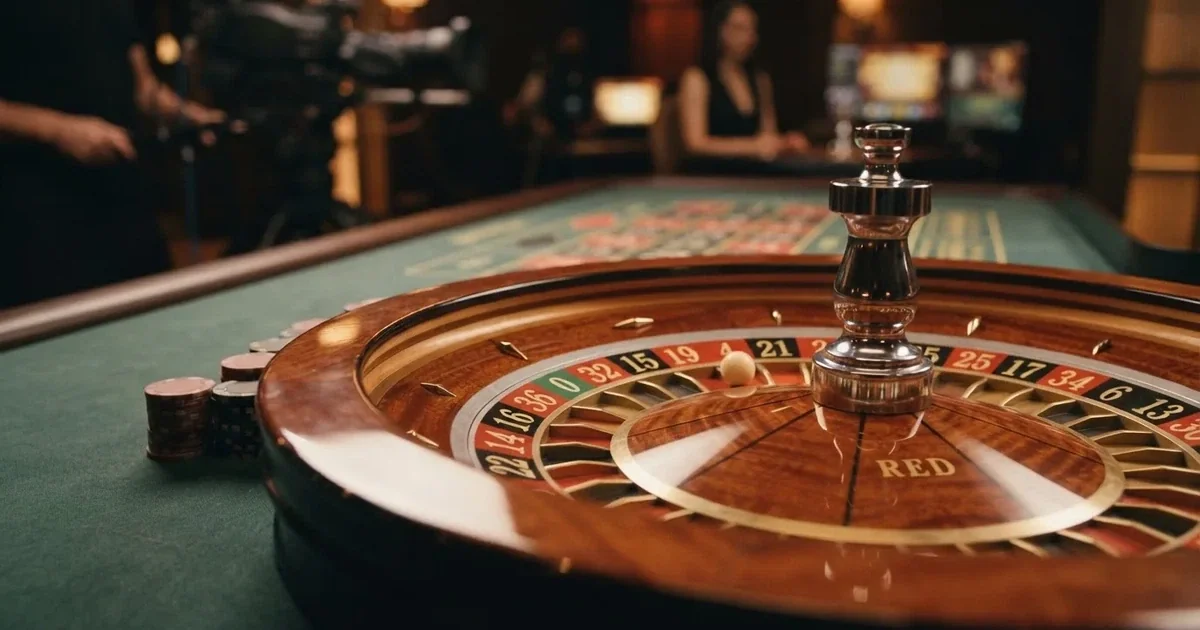
A live roulette table is a physical wheel in a studio somewhere, with a real person dealing, a camera pointing at the layout, and a betting grid on your screen. The wheel turns at the dealer’s pace, the ball drops where physics drops it, and your stake is settled against the result in front of you. Nothing on your side is animated; the spinning, the drop and the dealing all happen at the other end. The reason an Australian search tends to specify “live dealer” is that the alternative is a software-generated wheel whose outcomes are produced by a random number generator, and the visible difference is what the marketing sells.

The game played on those wheels has a longer history than the live stream. Roulette developed from the Italian game Biribi, with Pascal’s 17th-century experiments into perpetual motion often credited as a primitive precursor; the form most recognisable today was already being played in Paris from 1796. What arrived in Australian-licensed venues and then on offshore streams is that 18th-century French layout, sometimes modified by an extra zero or by special rules on even-money bets.
Paytables
The mathematical difference between live and software roulette is not the camera. It is the wheel under it. Two layouts cover most of what the marketing photographs:
Single-zero (European) roulette. Thirty-seven pockets: 0 and 1 to 36. A straight-up bet on a single number pays 35 to 1, and the slot the house keeps is the single zero. House edge is 2.70%. Some European tables soften this further with an en prison rule, or its cousin la partage: an even-money outside bet that lands on zero has its stake either held over for the next spin or returned at half its value, which pulls the effective edge on those particular bets below 2.70%. Whether a given table offers this rule is something the rules page, not the marketing, will say.
Double-zero (American) roulette. Thirty-eight pockets: 0, 00 and 1 to 36. The straight-up payout is still 35 to 1, so the extra zero is, mathematically, a second wedge for the house. House edge is 5.26%, almost exactly twice the European figure. Any stream that does not actively state single-zero is, in practice, two-zero.
A third layout now exists on some North American floors, which adds a third zero for thirty-nine pockets and a 7.69% house edge. It is rarely advertised and rarer still on a stream an Australian can actually reach.
The marketing photograph tends not to show you which of these wheels you are sitting at. The rules page for the specific table does. Read it before you bet.
Roulette House Edge Comparison
| Variant | Pockets | House Edge |
|---|---|---|
| European (Single-zero) | 37 | 2.70% |
| American (Double-zero) | 38 | 5.26% |
| Triple-zero | 39 | 7.69% |
The shape of a live-dealer lobby
Live-dealer lobbies are built around a small set of games. Roulette is one. The others most players meet are:
Baccarat. The casino banks the game and plays out both hands by fixed drawing rules, with the player merely choosing where to stake. House edge on the Banker bet is 1.06%, on the Player bet 1.24%, and on the Tie bet 14.36%, which is the worst regular bet on the floor. Punto banco, the variant most played today, was developed in Havana in the 1940s; chemin de fer, the older French two-player version, is rarer on streams. Cards 2 through 9 count at face value, tens and face cards at zero, and aces at one, with hand totals reduced modulo ten. In NSW, a casino operator must not permit such a game unless the regulator has approved both the game and its rules.
Blackjack. With the standard liberal rules strip — dealer stands on soft 17, double on any two, double after split, resplit aces, late surrender — the house edge against a player using basic strategy is about 0.28%. The Atlantic City variant is closer to 0.43%. The game’s predecessor is the English vingt-un, with veintiuno described in Cervantes around 1601-1602, and the name “blackjack” attributed to around 1899 during the Klondike Gold Rush. The Victorian Gambling and Casino Control Commission, which took over from the VCGLR on 1 July 2022, has to approve any rule change to a blackjack variant on the Melbourne floor, including a recent renaming of “Perfect Pairs” to “Crown Pairs” and a “Free Bet” option with a “Pot of Gold” side bet.
Craps. Rare on live-dealer streams aimed at an Australian player, partly because the betting surface is dense and partly because the house edge on the worst bets is steep. Pass/Come sits at 1.41%, Don’t Pass/Don’t Come at 1.36%, and Any Craps at 11.11%. Modern craps is an American simplification of the European dice game Hazard, and the simplified version reached New Orleans around 1805.
The point of running through these is not to give you a strategy for each. It is that the same legal frame covers every one of them: the Interactive Gambling Act 2001 draws no distinction between a roulette wheel, a baccarat shoe and a blackjack table. The casino end of the lobby is one product from the regulator’s view.
Where the law actually stands
The Interactive Gambling Act 2001, and what the 2026 amendment changed
The IGA, in its 2001 form, already prohibited the supply of certain interactive gambling services to Australians. The 2017 amendments tightened the scope and gave the Australian Communications and Media Authority the tools to act directly. What the IGA prohibits is a “prohibited interactive gambling service” — defined to include online casino games, online pokies, and in-play betting on races and sport. The text draws no distinction by game type, by dealer presence, or by the language the dealer happens to speak. A live roulette stream falls on the prohibited side of that line.
The Interactive Gambling Amendment (Gambling Reform) Bill 2026 passed both houses of Parliament on 19 August 2026. Its advertising and inducement measures commence on 1 January 2026+1, which means that as of the time of writing they are law with a future start date rather than provisions in force. The existing prohibition on supply is unaffected by the new commencement date and was already in force throughout the period covered on this page.
The corollary that matters to a player: minimum age is 18. The IGA targets the provider, not the punter. A person in Australia who opens an offshore account and places a bet is not personally prosecuted. What they cannot do is reach an Australian ombudsman when the withdrawal does not arrive, file a complaint to an Australian regulator that has jurisdiction, or recover a balance if the site is blocked mid-session.
BetStop, harm reduction, and what the offshore site is not connected to
BetStop, the National Self-Exclusion Register, has been live since August 2023. It binds every Australian-licensed online and telephone wagering operator, which means that excluding yourself through BetStop stops you reaching any of those brands for the period you nominate. An offshore casino is not bound by BetStop and is not technically connected to the register. Self-exclusion through an offshore site’s own account page is a different act, governed by that site’s terms, enforceable only by the offshore operator’s own staff.
The 24/7 National Gambling Helpline is 1800 858 858, with a chat line at Gambling Help Online. Both are free. Both are Australian-funded and Australian-run. The harm-reduction resources that exist under the National Consumer Protection Framework are designed to be reachable by a person regardless of the licensed status of the product they are using, because the help the helpline gives does not depend on whether the casino is licensed.
Watching a spinning wheel repeatedly, in particular, can produce a false sense of pattern. Each spin is independent of the last; the wheel has no memory of what came out the spin before. A fixed loss limit matters more on a live stream than reading the last few results.
What consumer protection looks like when the operator is offshore
A licensed Australian wagering account sits inside a complaints regime. There is an internal dispute process, an escalation to an external reviewer approved by the regulator, and a fund behind it if the operator becomes insolvent. A person using an offshore live-dealer site sits outside that. The site’s own terms govern. If the site refuses a withdrawal, the recourse is the site’s own dispute process; if that fails, the recourse is the regulator of whatever jurisdiction the site claims. None of those regulators will help an Australian resident enforce a complaint against a service they themselves hold to be unlawful.
There is also the blocking question. Australian internet service providers receive blocking requests from the ACMA, and the providers carry out the request under section 313 of the Telecommunications Act 1997. A blocked site does not pay out the balance that was on it when the block came down. The bookmaker’s terms usually cover this with a clause about “events beyond our control”, and the Australian side of the dispute is then closed.
The market behind the search: A$3.9 billion, falling share
The market that the offshore live-dealer stream is competing for is not small. H2 Gambling Capital’s 2026-1 report puts annual losses to illegal offshore gambling sites at roughly A$3.9 billion, and tracks the share of Australian gambling going through legal channels dropping from 74% in 2026-5 to 64% in 2026-1. Those figures are estimates rather than measurements, drawn from the same model that informs the regulator’s own assessment, and the direction matters more than the absolute number: more of the Australian dollar is leaving the licensed market.
The licensed bookmakers handling Australian online wagering are regulated at the territory level. The Northern Territory Racing and Wagering Commission oversees fifty-two of them — Sportsbet, Bet365 and Ladbrokes included — and runs with no full-time staff, meeting once a month in Darwin. The point the Commission makes in public about that arrangement is that the IGA allows it; the point critics make is that it is an arrangement that allows the same operator to take bets from an Australian resident, just without a casino game attached.
Crypto, PayID, and what the cashier is actually doing
What changes when the deposit is in bitcoin
Nothing about the wheel changes when the deposit rail does. A bitcoin-funded live roulette table spins the same physical wheel as a card-funded one; the dealer, the layout and the odds are identical. The only thing the deposit method changes is the path the money takes onto the table and off it. That path matters because of the Australian ban on credit and digital-currency deposits for online wagering, in force since 11 June 2026-2 — penalties for the licensed operator up to A$247,500 — and because it sits alongside a separate ban on credit-related products.
For an offshore site, the rules are different: the cashier is set up by the operator and runs under whatever regime the licence the operator shows on its footer claims. A bitcoin deposit bypassing an Australian bank is not, on its own, an offence for the punter; it is a signal that the site is not subject to the Australian ban, because the Australian ban does not reach it. The block on the Australian side is upstream of the deposit.
The legal status, in three sentences: a licensed Australian wagering operator cannot accept bitcoin as a deposit on or after 11 June 2026-2; an offshore live-dealer site is not subject to that rule; and a deposit the cashier accepts from an Australian resident is, under the IGA, a deposit into a prohibited service whichever way the funds arrived. The deposit method does not convert a prohibited service into a permitted one.
PayID and Osko as deposit rails on wagering accounts
The Australian-licensed deposit rails the regulator allows are debit card, bank transfer, PayID/Osko and BPAY. The NPP and PayID specifically are real-time payment rails operated under the Australian Payments Network; a debit through PayID typically clears in under a minute. A withdrawal from an Australian-licensed wagering account goes back through the same channel and is bounded only by the operator’s own internal review process. None of this applies to an offshore live-dealer site, where the deposit is normally taken by a payment processor or in cryptocurrency, and the withdrawal can take anywhere from a few hours to several business days depending on the operator and the rail.
Bonuses, deposits, and the offers that never quite say what they cost
Why the bonus headline is rarely the bonus figure
The market forces that drive Australian players toward offshore live-dealer sites are partly the marketing of those sites. A common offer headline reads as a large headline number attached to a deposit match, with terms running several paragraphs beneath it. In the experience of the warnings the ACMA has published over the last few years, every reviewed operator in this space is the subject of such a marketing push. No specific wagering multiple or bonus amount is given on this page, because every value in this market is variant to the operator and the promotion window; what stays constant is the shape.
The shape: a deposit match, an upper ceiling on the bonus, a wagering multiplier attached to the bonus balance, and a list of excluded games. A bonus balance is rarely paid out in cash; it is wagered through the specified multiplier, and any winnings remain bonus balance until cleared. A game that contributes 100% of stake to clearing the multiplier is doing so at a house edge of either 2.70% (single-zero roulette) or 5.26% (double-zero). The expected loss during the clearing period is the wagering requirement times the house edge, before any of it can be withdrawn.
A player who is offered “200% up to A$1,000, 40x bonus” is looking at A$400,000 of wagering at, say, 5.26% on an American roulette layout, for an expected loss before withdrawal of roughly A$21,000 against the bonus in question. That is the offer’s true price, and it is rarely the figure the banner prints. The maths here presumes only the bonus balance is being wagered, and that the game choice is fixed at the table advertised in the offer; in practice, players switch tables and the contribution percentages shift.
No-deposit offers, and what they usually require
The “no deposit bonus” headline in this market usually attaches to a small cash credit or a batch of free spins, with a withdrawal ceiling somewhere between 5x and 20x the credit and a wagering multiple of 30x to 60x. The combination is meant to convert the player into a depositing player; the conversion does not always produce the withdrawal the marketing photographs. No specific figure for any named offshore brand is given here because the figures shift by promotion window, but the structure is uniform enough across the warnings the ACMA has published that the direction of travel is consistent.
What the ACMA has actually done, and what it tells the player
The pile of blocks, as a rate
The ACMA’s enforcement against offshore gambling sits in two related registers: the formal warnings, which name a brand and the operator behind it, and the blocking requests, which ask Australian ISPs to make a domain unreachable from inside the country. As of the most recent published count in June 2026, 1,751 illegal gambling and affiliate marketing websites have been blocked since the first blocking request was issued in November 2026-7. That puts the running total at roughly 270 sites blocked per year since the regime started, or about 22-23 sites per month averaged across the full period. The rate is not flat — individual blocking rounds have batched a dozen or more sites at a time — and the cumulative line is what matters. The rate is also understating the picture: more than 230 unlicensed services have left the Australian market entirely since the ACMA’s enforcement powers were strengthened in 2026-9, so the live population of illegal offerings is the difference between what has been blocked and what has been wound down or moved.
The closing question is whether a site you are about to deposit into is on that line. The ACMA publishes its list after each round, and the list updates; the formal warnings name the operator behind the brand. If the brand is on either list, the IGA position has already been tested against it by the regulator that is supposed to test it.
Landscapes
The following table is the register published by the ACMA in the formal-warning series. Each row is a brand the ACMA has named, the operator behind it, and the date the formal warning was issued. The license shown in a site’s footer is not the same as a finding under Australian law, and the table is read across; a row’s “subject support” column carries none of the content a search for live roulette tables would suggest.
| Brand | ACMA action and date | Operator named by the ACMA | Subject support |
|---|---|---|---|
| RocketPlay | Formal warning, March 2026 | Pulsup Ltd | — |
| Level Up Casino | Formal warning, May 2026-4 | Dama N.V. | Software provider listings (Bgaming) |
| Woo Casino | Formal warning, March 2026-1 | Dama N.V. | — |
| Spirit Casino | Formal warning, May 2026-1 | Dama N.V. | — |
| National Casino | Formal warning, July 2026-1 | Consolutetish S.R.L. | Encyclopaedia entry (Wikipedia) |
| Bizzo Casino | Formal warning, July 2026-1; earlier 2022 | Consolutetish S.R.L.; earlier TechSolutions | — |
| Ignition Casino | Formal warning, July 2026-1 | Bamboo Media | — |
| Instant Casino | Formal warning, February 2026-1 | EOD Code SRL | — |
| Jackbit | Formal warning, April 2026 | Ryker B.V. | — |
| Casino Intense | Formal warning, April 2026-1 | Sterplay Holding Ltd | News and regulator listings (ABC, ACMA, Crown Melbourne) |
| Sky Crown | Formal warning, September 2026-4 | Hollycorn N.V. | — |
The warning date is the date the ACMA published, not the date the operator began serving Australian customers. The operator’s name is the legal entity the ACMA served the notice on; the brand is the trading name the customer reached. The fourth column reflects where the brand shows up outside the regulator’s own file; it is not a claim that the brand offers what an Australian resident is searching for.
What a formal warning actually changes
A formal warning under the Interactive Gambling Act 2001 is the first step in a graded enforcement process. It is a written statement that the named entity has been found to be providing a prohibited interactive gambling service to customers in Australia, and a request to stop. Failure to comply after a formal warning has been issued exposes the operator to civil penalty proceedings under the Act, with penalties assessed on a per-breach basis and escalations available up to the Federal Court. The blocking request is a separate, parallel action: ACMA directs Australian ISPs to make the domain unreachable, and the ISPs comply as a matter of routine under section 313 of the Telecommunications Act 1997.
The two actions are independent. A formal warning can be issued without a block being requested, and a block can be requested without an earlier warning. Most of the brands in the table above sit on both tracks at once.
The brands, one at a time
RocketPlay
RocketPlay was named by the ACMA in March 2026 for providing prohibited interactive gambling services to Australians. The named operator was Pulsup Ltd, with the domain recorded as Rocketplay. The same brand has been named earlier, in May 2026-4, when the operator behind it was a different legal entity in the Dama N.V. group — the same operator group that turns up across several rows of the table. The brand’s offer features a deposit-match promotion in the typical cash-plus-spins structure, with a wagering multiplier sitting at the high end of what this market tolerates. The IGA position remains unchanged: there is no Australian licence for an online casino product, and a brand-level licence from another jurisdiction does not affect that. The wagering requirement is high enough that expected loss on the bonus alone is significant before a withdrawal is in reach.
Level Up Casino
Level Up was named by the ACMA in May 2026-4, with the operator on the warning being Dama N.V. The brand’s own marketing pitches an Australian-friendly cashier and a tiered loyalty scheme. Outside Australia, Level Up’s games are sourced through providers whose names you will recognise from third-party directory listings. Inside Australia, the same product is the prohibited service the IGA names. Nothing about the cashier’s Australian-friendly configuration converts that.
Woo Casino
Woo was named by the ACMA in March 2026-1, again under the Dama N.V. operator group. This is the second action against the operator group within twelve months, the first being the May 2022 batch and the second the March 2025 one covered here. Woo’s deposit-match structure is similar in shape to the others on this list — large headline number, moderate ceiling, multiplier tied to the bonus balance — and the live-dealer lobby offers a single-zero wheel as well as a double-zero one, with the difference between them never highlighted in the marketing. The wagering requirement on the welcome package puts expected loss at a level that should give a player pause before signing in at all.
Spirit Casino
Spirit was named by the ACMA in May 2026-1, with Dama N.V. again as the named operator. The same operator group, the same month-class action, a brand with a separate trading identity. Spin’s product structure is close enough to Woo’s that the same expected-loss reasoning applies, and the operator-side enforcement record means the brand sits on a steadily shortening timeline.
National Casino
National was named by the ACMA in July 2026-1, with Consolutetish S.R.L. as the named operator. The brand runs a wide live-dealer lobby across roulette, blackjack and baccarat, with table limits ranging from a small-stake entry point to high-roller rooms; the wider the lobby, the harder it is for an Australian player to find a single-table offer that the regulator would consider compliant, because the regulator considers the whole product non-compliant. The brand is listed in third-party encyclopaedia entries.
Bizzo Casino
Bizzo was named by the ACMA in July 2026-1, with Consolutetish S.R.L. again as the named operator. The same brand had been the subject of an earlier formal warning in 2026-4, when the operator was recorded as TechSolutions (CY) Group Limited and TechSolutions Group N.V. Two warnings over the same brand, with the company behind the brand having changed between them, tells the player something the marketing does not. The product on offer is the same; the legal entity sitting behind it has been through at least one restructuring. The deposit-match headline looks generous; the expected loss, by the same multiplier reasoning as elsewhere on this page, is large.
Ignition Casino
Ignition was named by the ACMA in July 2026-1, with Bamboo Media as the named operator. The brand is among those most visible to Australian search traffic for live-dealer roulette, with marketing that emphasises a poker and casino mix rather than just a casino. The cashier offers a credit-card rail, a crypto rail, and an e-wallet rail, none of which converts the offer into an Australian-licensed one. The wagering requirement is at the higher end of the market.
Instant Casino
Instant was named by the ACMA in February 2026-1, with EOD Code SRL as the named operator. The “Instant” framing refers to the cashier, which is set up around instant crypto deposits and a small-batch of free-spin promotions. It is not a reference to the speed of any withdrawal; withdrawal review on this brand has been reported as taking the typical several-business-days from operator-side review to release. There is no path on the brand to a withdrawal that the regulator considers compliant, because the regulator considers the product prohibited throughout.
Jackbit
Jackbit was named by the ACMA in April 2026, with Ryker B.V. as the named operator. Jackbit’s market position is built around a crypto-only cashier and a sports-and-casino mix, with the casino side running roulette, blackjack, and a large slot catalogue. Crypto-only is not the same as crypto-anonymous: a blockchain deposit is reversible only by the operator crediting back the address, and the absence of a fiat rail narrows the dispute-resolution options further than at a fiat-and-crypto brand. The expected loss on a live roulette table here is the standard 2.70% or 5.26% per spin on the wheel actually under the camera, before the bonus terms apply.
Casino Intense
Casino Intense was named by the ACMA in April 2026-1, with Sterplay Holding Ltd as the named operator. The brand is one of the smaller entries in the formal-warning register; the audit trail on the brand’s other public references is thin, and coverage outside the regulator’s own file is limited. The product on offer is the standard live-dealer mix plus a slot catalogue. The IGA position is the same as the rest of this page.
Sky Crown
Sky Crown was named by the ACMA in a formal warning filed with Hollycorn N.V. as the named operator, the same group that operates Blue Leo. Sky Crown’s product is close enough to Hollycorn’s other brands that they sit together on the regulator’s file and likely share a customer database. The cashier is the multi-rail standard. The wagering requirement on the live-dealer welcome package is on the high end of the market, and the IGA position is unchanged.
What a player who wants roulette in Australia actually does
The licensed options, in their proper places
What the IGA does not prohibit is wagering on sports and racing placed before the event, lotteries, and keno. These are licensed by the Northern Territory Racing and Wagering Commission, which oversees the fifty-two online bookmakers handling Australian online wagering (Sportsbet, Bet365, Ladbrokes, and the rest) from a meeting room in Darwin that meets once a month. The licensed bookmaker product does not include a casino roulette table. A player who wants a roulette bet in Australia walks into Crown Melbourne — where the VGCCC has approved table-game variants on the floor — or into Crown Perth, or The Star Sydney; the streams inside those venues sit on the venue’s regulator and not under the IGA.
The cashier note that closes the loop
A licensed Australian wagering operator processes a deposit over a permitted rail — debit card, bank transfer, PayID/Osko, BPAY — with no credit, no credit-related product, and no digital currency on the licensed side since 11 June 2026-2. A request for a credit card or a bitcoin deposit on the live-dealer site is, in itself, evidence that the cashier is sitting outside the Australian rules. The cashier’s rail is the simplest test of where the operator sits, and it is a test that does not require reading the licence footer.
Choosing to look, and what to do with the result
The site’s own explanation is the first artefact
If a player has decided to look at a live-dealer roulette site — for research, for comparison, for curiosity — the first document to read is the site’s own rules. Which wheel does it run, single-zero or double-zero? What is the wagering contribution percentage of roulette to bonus clearing, and is the percentage even positive? Is there a maximum cashout on bonus winnings, and at what multiple of the bonus? Each of these terms is a hole to fall through. A 5x maximum cashout on a bonus credit is the difference between walking away with anything and walking away with the bonus envelope.
The stake-size consideration
A small live-dealer table is a 50-cent chip on a single-zero wheel, which means a single spin is a 50-cent exposure. At a 2.70% house edge, the expected loss per spin is 1.35 cents. The same table with a $500 chip and a 7.69% triple-zero layout puts the expected loss per spin at $38.45. Most offshore live-dealer lobbies let the player choose between the two, and the choice is rarely flagged at the time the player signs up.
A boundary that matters regardless of which side a player picks
A fixed loss limit, set in writing before the session begins, is the single decision a player makes that the casino cannot undo. BetStop binds the licensed bookmakers, not the offshore sites; an offshore site’s own self-exclusion is an account-by-account decision, with no central register behind it. The National Gambling Helpline is 1800 858 858, free and 24/7, with a chat line at Gambling Help Online for those who prefer not to use the phone. The walls around a player who has decided to stop are only as thick as the player builds them; the licensed market has more of them built-in, and the offshore market does not.
Frequently asked questions
Is it legal to play live roulette for real money at an online casino in Australia?
No. The Interactive Gambling Act 2001 prohibits the supply of online casino games — including live-dealer roulette — to a person in Australia. The provider is the target of the law, not the player, but no Australian-licensed operator offers the product. Search results pointing to offshore sites are pointing outside Australian jurisdiction, and consumer protection does not follow the click.
What is the practical difference between a single-zero and a double-zero roulette wheel?
A single-zero wheel has 37 pockets and a 2.70% house edge; a double-zero wheel has 38 pockets and a 5.26% house edge, almost exactly double. The straight-up payout is 35 to 1 on both, so the extra zero widens the house’s cut without changing the bet. Always confirm which wheel the live table uses; the marketing rarely specifies.
Why might a live roulette table specifically advertise English-speaking dealers?
Because the studio wants to widen the player pool it can address directly in the chat and on the audio channel, without translation. A dealer who speaks the player’s language removes one friction point and lets the marketing promise a “personal” experience. The dealer’s language has no bearing on the IGA position: the stream itself is what the Act addresses, and an English-speaking dealer does not convert a prohibited service into a permitted one.
Does a bitcoin-funded live roulette table use a different wheel to a card-funded one?
No. The wheel is the same physical object, the odds are the same, and the spin is the same. The only thing the deposit rail changes is how the stake reaches the cashier and how the winnings come off it. The Australian regulator prohibits bitcoin deposits on licensed wagering accounts since 11 June 2026-2, and an offshore live-dealer site is unaffected by that ban because the offshore site is not subject to it. The deposit method does not legalise the offer.
Can betting patterns based on previous spins improve the odds on a live roulette table?
No. The wheel has no memory of what came out the spin before, and each spin is independent. The pattern the eye reads onto a sequence of red-black-even-odd is a perception artefact, not a causal feature of the wheel. A fixed loss limit set before the session is the only thing that acts on a streak; the betting system does not.
How is a live roulette payout processed compared with a slot machine payout?
The settlement logic differs by the bet type, but the cashier review is the same. A roulette outside bet settles instantly on the spin; a roulette inside bet settles instantly too. Slots settle on each spin. The bottleneck is the operator’s withdrawal review, which is the same step regardless of which game produced the win. The bottleneck is not the game; it is the operator’s compliance and payment processes behind the win.