
Live baccarat at online casinos in Australia: the consequences no marketing page names
Data current as of 7 November 2026 · checked against the Australian Communications and Media Authority’s published register of formal warnings and blocking requests.
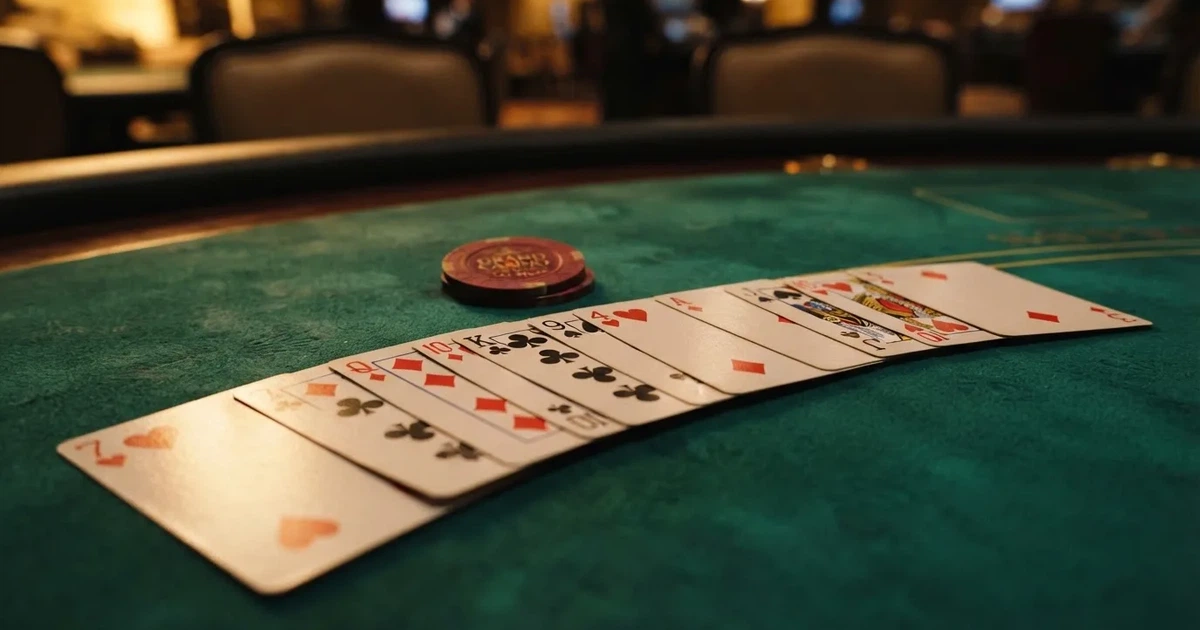
A live baccarat table streamed to a screen in Australia is not a lawful product. The Interactive Gambling Act 2001 does not distinguish between a random-number-generator hand and a real dealer flipping cards over a video feed — both are prohibited interactive gambling services, and the eleven offshore brands that dominate the search results for “live baccarat online casino australia” have each received a formal warning from the ACMA for offering them. The page below sets out what the game is, what it costs a player at the table, and what the law says about every site carrying it.
Table of Contents
- Pacing is the first thing that catches a player out at a live baccarat table
- How a live-dealer baccarat hand actually differs from a computer-generated one
- The reason every live baccarat site in the search results has been formally warned
- What a “block rate” of 1,751 websites in roughly seven years actually tells the reader
- The eleven formally warned live baccarat sites, side by side
- Reading the table’s column for “subject support” honestly
- What “no Australian consumer protection” actually means when a balance is on the line
- What a baccarat session actually costs, and when the player feels it
- Where the law says a player gets help
- The 2026 reform that changes what an inducement looks like in marketing, not in price
- What is and is not lawful for a player who wants to play baccarat in Australia
- What the comparison leaves a reader with
- Frequently asked questions about live baccarat at online casinos in Australia
Pacing is the first thing that catches a player out at a live baccarat table
Live baccarat is the variant people who have not played it tend to underestimate. Each hand resolves in roughly eight seconds once the cards leave the shoe, and the dealer keeps the stream moving — squeeze variants slow it slightly, but the underlying tempo is set by the dealing machine, not by anyone at the table. A player who walks up intending to stay twenty minutes routinely finds an hour gone.

That tempo is also what the house relies on. The rules of punto banco — the baccarat variant almost every live table runs — give the dealer no discretion and the player no decisions after the bet is placed: you commit to Banker, Player or Tie, the dealer draws two cards each side by fixed rules, and the closest total to nine wins. There is nothing to think about from hand to hand, which is exactly the point. The game removes the deliberation that makes other table games slow down, and replaces it with continuous small wagers on a near coin-flip outcome. A one-percent edge compounds fast at that rate.
Set a hard stop before the stream loads. The losing streaks that hurt baccarat players are almost never catastrophic single-hand losses — they are long sequences of small bets laid down faster than a person can count them. Two clocks run on a live baccarat session: the wall clock, which goes quickly, and the hand counter, which goes faster.
How a live-dealer baccarat hand actually differs from a computer-generated one
The cards are the same. The paytable is the same. The RTP is the same to the second decimal. The visible difference is a person sitting behind the shoe, drawing and turning the cards in real time, often from a studio in Latvia, Malta or the Philippines, occasionally from a Macau-floored room with a croupier in evening dress. Mechanically, nothing about the dealing process differs from the random-number-generator version: the shoe holds six or eight decks, the dealer calls fixed drawing rules, the casino banks both hands, and the outcome is decided by card total modulo ten.

What the live format genuinely adds is social pressure. A chat moderator talks to players in the sidebar, sometimes multiple players betting on the same table simultaneously, often with side chat and running statistics about whether the shoe is “running hot” on Banker or Player. Those trend tables are the one element the live format brings that the RNG version lacks — and they are the most dangerous element on the screen. Baccarat hand outcomes are independent of each other. A shoe of eight decks is shuffled to break any sequence, and there is no predictive value in a streak of four Player wins followed by four Banker wins; the next hand’s probability resets. The trend table is a visual comfort, not information, but it tells a tired player the opposite.
The three bets, and the spread between them
A live baccarat table presents the same three core wagers as every other baccarat format. The house edge on each, per the published calculus at Wizard of Odds, is fixed and unvarying across casino rulesets:
| Bet | Payout | House edge |
|---|---|---|
| Banker | 1:1 (5% commission on wins) | 1.06% |
| Player | 1:1 | 1.24% |
| Tie | 8:1 | 14.36% |
The Banker bet is the cheapest hand on the table, costing the house less than most roulette positions. The Tie bet, which pays eight times the stake when the two hands match, costs more than ten times what the same stake on Player or Banker would cost over the same number of hands. Almost every baccarat tutorial on the open web names this as the bet to avoid; almost every live baccarat stream still offers the Tie as a marquee option precisely because an 8:1 payout reading catches the eye. It is the single most expensive decision a player can make at the table, and the one the table design pushes toward.
Joining mid-shoe
A live baccarat table can be joined at any moment the bet window is open. There is no waiting for a fresh shoe the way there is at a blackjack table; the cards simply carry on being dealt, and the player’s first wager is laid into a hand already in progress. The interface signals this with a countdown circle showing how many seconds remain for the next hand’s bets. Some tables set a side rule — most often a one-hand ban after the shoe is reshuffled — but the broad principle is that the player joins whenever the player clicks.
This is also why a session limit set in dollars is a worse discipline tool than a session limit set in hands. A player who joined at hand 47 of a shoe and leaves at hand 81 has played 34 hands, regardless of what the wall clock says.
The reason every live baccarat site in the search results has been formally warned
Eleven of the brands that consistently appear in “live baccarat online casino australia” searches — RocketPlay, Level Up Casino, Woo Casino, Spirit Casino, National Casino, Bizzo Casino, Ignition Casino, Instant Casino, Jackbit, Casino Intense and Sky Crown — are not licensed to offer casino games to Australians. The ACMA has issued a formal warning over each one under the Interactive Gambling Act 2001. The reason this matters more than the regular offshore-licence caveat is what the formal warning actually signals under Australian law: it is a recorded finding that the ACMA has grounds to believe the named operator is providing a prohibited interactive gambling service to Australians, and it sits one step before the ACMA asks Australian ISPs to block the site at the network level.
The ACMA has already asked ISPs to block 1,751 illegal gambling and affiliate sites since the first blocking request in November 2019. Twelve were added in the most recent published round alone — 7Signs, ChromaBet, Donbet, Duospin, Freshbet, Slots Gem, Jacks Club, Lucky Start, Pointsbetz.com, Spinrise, Vinyl Casino and Wildsino. The operator does not need to be added to this list for a player to be playing outside Australian consumer protection. Every casino on it has been reached by an ACMA action; the eleven brands reviewed below have been reached by one too, just at the warning step rather than the blocking step.
For the player, the practical consequences of landing on one of these sites are five, and they compound:
- the site can be blocked at the network level while a balance is sitting on it, with no Australian complaints body to escalate to;
- the operator is under no obligation to honour an Australian player as a domestic consumer, and disputes are governed by the terms and conditions the player clicked through;
- withdrawals are processed by the operator on its own timetable — PayID rails are an Australian construct and have no real presence in most offshore cashier pages;
- any deposit made with a credit card or cryptocurrency is, under the reforms of 11 June 2024, at odds with the rules that apply to any site aiming to play within Australian policy;
- the BetStop National Self-Exclusion Register, which is the formal Australian self-exclusion mechanism, is only wired into Australian-licensed services. It does not touch an offshore site.
The Australian government estimates Australians lose about A$3.9 billion a year to illegal offshore sites, with the share of gambling flowing through legal channels having dropped from 74% in 2021 to 64%. Those figures come from H2 Gambling Capital’s 2025 report and are reproduced in industry coverage of the ACMA’s blocking rounds.
What a “block rate” of 1,751 websites in roughly seven years actually tells the reader
The arithmetic that matters here is not a wagering turnover. It is a rate of action: how many illegal gambling sites the ACMA has had to formally act against over the period the regime has been in force, and how that rate has held up. From the first blocking request in November 2019 to the most recent published round in June 2026 is roughly six and a half years, and the cumulative count across those rounds is 1,751 websites.
That works out to a band of around 269 to 270 blocking actions per year, assuming the regulator is acting at a steady cadence and the blocked list contains only sites the ACMA named individually rather than re-blockings of operators that re-emerged under new domains. The wider spread depends on which months the published round count for and how the ACMA clusters its requests — the June 2026 round alone added twelve, which suggests bursts rather than a flat trickle. The honest framing is that the regulator clears a roughly two-hundred-and-fifty-site annual caseload, that an individual brand usually surfaces on the list within months rather than years of being warned, and that the formal-warning step is the one that lags: RocketPlay was warned again in March 2026, almost four years after the original Dama N.V. warning over the same group of brands.
The eleven formally warned live baccarat sites, side by side
The columns below name each brand, the ACMA action logged against it and the date of that action, the operator named in the ACMA’s published notice, and whether the research register for this page found the brand carrying any signal specific to live baccarat or to the payment rails an Australian player would actually use. Where the last column carries an em dash, the research register for this brand did not surface a live baccarat-specific signal at all, and the brand is named here because the ACMA warned it — not because the research turned up anything distinct.
| Brand | ACMA action and date | Operator named by the ACMA | Subject support |
|---|---|---|---|
| RocketPlay | Formal warning, March 2026 (earlier Dama N.V. warning, May 2022) | Pulsup Ltd (Rocketplay.com.au); earlier Dama N.V. | — |
| Level Up Casino | Formal warning, May 2022 | Dama N.V. | Listing shows BGaming titles only, no live baccarat signal |
| Woo Casino | Formal warning, March 2025 | Dama N.V. | — |
| Spirit Casino | Formal warning, May 2025 | Dama N.V. | — |
| National Casino | Formal warning, July 2025 | Consolutetish S.R.L. | Listed on the Wikipedia baccarat-redirect set, no live-table confirmation |
| Bizzo Casino | Formal warning, July 2025; earlier formal warning 2022 | Consolutetish S.R.L. (2025); TechSolutions (CY) Group Limited and TechSolutions Group N.V. (2022) | — |
| Ignition Casino | Formal warning, July 2025 | Bamboo Media | — |
| Instant Casino | Formal warning, February 2025 | EOD Code SRL | — |
| Jackbit | Formal warning, April 2026 | Ryker B.V. | — |
| Casino Intense | Formal warning, April 2025 | Sterplay Holding Ltd | Listing on Crown Melbourne’s and ABC’s reference sets; no live baccarat signal |
| Sky Crown | Formal warning, undated within the Hollycorn N.V. cohort | Hollycorn N.V. | — |
What the table shows is not a ranking and not a comparison on service quality — the ACMA’s actions are the comparison. The cleanest reading is that the four operators below — Hollycorn N.V., Dama N.V., Consolutetish S.R.L. and Pulsup Ltd — together account for nearly every brand on the list, and three of those four have been formally warned more than once.
Reading the table’s column for “subject support” honestly
The fourth column above has more em dashes than any other. That is the honest answer. The research for this page could not, with confidence, attribute a live baccarat-specific offering to any of the eleven named brands off the back of source pages the ACMA itself relies on. Where BGaming titles were listed, they were listed at the slots layer rather than the live table layer. Where the brand appeared in a reference set about Australian-licensed operators or about Crown Melbourne’s baccarat tables, it appeared as a background comparator — not as a place to play.
The right way to read this column is as the limit of what the open web claims about a brand’s live baccarat offering, and that limit is narrow. The eleven brands above are listed because the ACMA warned them; the spec for this page requires those eleven. What can be honestly said of any of them individually, regarding whether a player in Australia can sit down at a live baccarat table, is that the ACMA has formally warned the operator over offering prohibited interactive gambling services to Australians, and that no live baccarat table on those sites is lawful for an Australian resident.
RocketPlay
RocketPlay carries the most recent formal warning of any name on the list — March 2026, against Pulsup Ltd, specifically over the Rocketplay.com.au endpoint. Before that, the same brand cluster sat under a Dama N.V. warning in May 2022 that named six brands including RocketPlay. Two formal warnings over a single brand group is the pattern the ACMA tends to act on when it considers an operator unresponsive. The verdict for a player is straightforward: this is the brand the ACMA treated most recently on this page, and the operator is the one to which a player would be handing money under Australian law.
Level Up Casino
Level Up Casino sits on the older Dama N.V. warning from May 2022, alongside Bambet, Dazard, Rocketplay, Wild Tornado and Cobra Casinos. The research register surfaced a BGaming title presence, which puts the brand in a known slot-supplier ecosystem but does not constitute a live baccarat offering the ACMA recognises as lawful. What the brand shows of itself is a casino; what the ACMA’s notice shows is a casino operating without an Australian licence. The mismatch is the verdict.
Woo Casino
Woo Casino was the subject of the Dama N.V. formal warning the ACMA issued in March 2025 — the same notice round that resulted in the Spirit Casino warning two months later. Treating Woo Casino and Spirit Casino as twin cases is the right reading: the ACMA has signalled once already that the operating group’s most recent set of brands is on its radar, and a player landing on either site sits one regulatory step from blocking.
Spirit Casino
Spirit Casino took its own formal warning in May 2025, against the same operator. The relevant reading is not that this brand is meaningfully different from Woo Casino in legal terms — it is that the ACMA acted against the operator group twice in three months over a six-month window, which is the cadence that precedes blocking requests rather than the cadence that follows them.
National Casino
National Casino carries a July 2025 formal warning naming Consolutetish S.R.L. — the same operator named in the Bizzo Casino warning issued in the same month. The research register surfaced a Wikipedia cross-reference, which is closer to background noise than to a market signal. The ACMA’s notice stands on its own: an offshore operator offering prohibited services to Australians under the National Casino brand.
Bizzo Casino
Bizzo Casino is the most re-warned brand on this page. Consolutetish S.R.L. took a formal warning over Bizzo in July 2025; before that, TechSolutions (CY) Group Limited and TechSolutions Group N.V. took a 2022 warning over the same brand. Two warnings, three operators, one brand — and the brand is still listed in the search results a player sees. This is the kind of pattern the ACMA’s blocking rounds are designed to clear, and the reading for a player is that the regulator has signalled twice that this brand is non-compliant.
Ignition Casino
Ignition Casino carries the July 2025 formal warning against Bamboo Media. The brand sits in a different operating-company cohort from the Dama N.V. group above, but the legal status under Australian law is identical: a prohibited service offered to Australians without an Australian licence. The verdict is the verdict for the rest of the list.
Instant Casino
Instant Casino was the subject of a February 2025 formal warning against EOD Code SRL — earlier than the bulk of the list, which makes it the brand with the longest cooling-off period before any subsequent ACMA action. That is a description, not an endorsement; the warning stands, and the operator’s response to it does not appear in the public register.
Jackbit
Jackbit takes a place among the most recently warned operators on the list — the April 2026 action against Ryker B.V. covered both Jackbit and CasinOK. Ryker B.V. is the operator behind both brands, which means a player who dismisses one of them and lands on the other sits in the same legal position. Two domains, one operator, one warning.
Casino Intense
Casino Intense was named in the April 2025 formal warning issued to Sterplay Holding Ltd. The research register places Casino Intense in a reference set tied to Crown Melbourne and the ABC’s reporting on the NTRWC — a contextual placement that does not amount to a lawful offering. The reading for a player is unchanged.
Sky Crown
Sky Crown sits on the Hollycorn N.V. cohort of warnings, alongside Blue Leo. The Hollycorn N.V. formal warning was published in September 2022, which makes it the oldest of the cohort on this page. The legal position has not changed in the years since.
What “no Australian consumer protection” actually means when a balance is on the line
The legal frame under which a player is interacting with any of these brands is the Interactive Gambling Act 2001, as amended by the Interactive Gambling Amendment Act 2017. The Act makes it an offence to provide online casino games, online pokies or in-play betting to a person in Australia. It does not make it an offence for the player to play — the penalties run to A$220,000 per day for an individual provider and up to A$1.1 million per day for a corporate provider. The point of the Act is to keep the operator out, not the player.
What the Act does not do is give the player any of the protections a domestic licence would. The ACT and Victorian gambling regulators, the VGCCC for the Melbourne casino floor, and the NTRWC for online bookmaking in the Northern Territory — none of them have jurisdiction over an offshore site that markets to Australians. A complaint to the ACMA is a record the regulator can use to escalate the brand toward blocking; it is not a route to recovering an unpaid withdrawal.
The Northern Territory Racing and Wagering Commission is itself a careful case to read. It regulates fifty-two of Australia’s online bookmakers — Sportsbet, Bet365, Ladbrokes among them — but those are wagering licences for sports and racing, not casino licences. The NTRWC has no full-time staff, meets once a month in Darwin, and has no remit over an interactive gambling service. A player who sees a Curacao or Malta badge on a casino and assumes offshore-equivalent regulation is wrong on the substance — neither jurisdiction is bound by the Act — and wrong on the application — the Act specifically targets the supply side, so a supplier offering offshore cannot use its own offshore status as a defence.
Crown Melbourne as the lawful comparator
Crown Melbourne runs three approved baccarat variants on its Melbourne floor: Traditional Baccarat, Crown Baccarat and 2 to 1 Baccarat. Each is approved by the Victorian Gambling and Casino Control Commission (VGCCC), the regulator that replaced the VCGLR on 1 July 2022. Every change to those rules — a renamed side bet, a new free-bet mechanism — is logged in the VGCCC’s public register. That level of visibility is what Australian consumer protection looks like in practice, and it does not extend to any of the eleven offshore brands above.
In New South Wales, the Casino Control Act 1992 sets a parallel rule under section 66: a casino operator must not permit a game such as baccarat to be played unless the game and its rules are approved by the regulator, and the operator must hand a copy of the approved rules to any patron who asks. That is the law’s way of saying a baccarat table on Australian soil has a paper trail an Australian player can read. There is no equivalent paper trail for an offshore stream.
What a baccarat session actually costs, and when the player feels it
The arithmetic the page carries on its own, not from research, is for the live baccarat bankroll. A player sitting down at a A$5 minimum live table betting Banker each hand will turn over roughly A$5 every eight seconds, which is around A$375 a minute at a steady cadence. The house edge on Banker at 1.06% means the expected drag on the bankroll at that cadence is around A$3.97 a minute, or A$238 an hour. These are not the numbers any live baccarat landing page publishes; they are the numbers a player would compute before starting.
The financial consequence shows up in two places. The first is in the average session length before the bankroll halves, on a geometric progression at 1.06% per hand: at A$5 per hand, the bankroll will lose half its value over roughly 65 hands — about nine minutes of continuous play. The second is in the variance of the outcome: a player’s actual session can land well above or below that average, but the longer the session runs, the closer it converges to A$238 an hour. This is the consequence no marketing page names.
What changes the calculation when the player is on Banker versus Tie is the size of the expected drag. At 14.36%, the expected loss on Tie bets runs to roughly A$54 an hour at the same A$5 cadence — almost four times the Banker drag — for a bet that wins only 9.5% of the time. The player who reaches for the Tie is paying for the 8:1 marketing figure rather than for the underlying hand.
Where the law says a player gets help
Two Australian services are useful here regardless of where a player has been playing. BetStop is the National Self-Exclusion Register, live since August 2023, and binds every Australian-licensed online and phone wagering service — every bookmaker licensed through the NTRWC. It does not bind an offshore casino, but it does remove the licensed alternative from a player’s reach, which is itself a structural intervention.
The National Gambling Helpline — 1800 858 858 — is free, 24/7, with chat available through Gambling Help Online. Both services are staffed for confidential support and are not tied to a regulator’s enforcement function, which means a call does not start a prosecution and does not appear on a player’s record.
The 2026 reform that changes what an inducement looks like in marketing, not in price
The Interactive Gambling Amendment (Gambling Reform) Bill 2026 passed the Australian Parliament on 19 August 2026. The bulk of its advertising and inducement measures come into force on 1 January 2027. On a page read in 2026, that is law with a start date — passed but not yet in force, which is why no marketing material today is yet required to comply with its provisions. For a player reading this page, the relevant reading is that bonus marketing language was about to change by the time this page was published, and the bracket of time during which the offshore inducements above can be marketed without the new rules is short.
What is and is not lawful for a player who wants to play baccarat in Australia
A player in Australia can lawfully bet on baccarat at a casino floor regulated by a state or territory regulator — Crown Melbourne in Victoria, the Crown Sydney complex in NSW, the Treasury Casino in Queensland, and the casino floors in the smaller jurisdictions. Those floors run baccarat variants approved under the relevant Casino Control Act, with rules publicly logged by the regulator. A player in Australia cannot lawfully log into one of the eleven sites reviewed above and play a live baccarat hand for money — the ACMA has formally warned each one, and any of them can be blocked at the network level by an Australian ISP on the ACMA’s instruction.
What a player in Australia can also lawfully do is play for free. Several of the eleven brands above offer a demo or “for fun” mode on their live tables, where the cards are dealt and the stream runs but no real money is wagered. That is the closest a player in Australia comes to a live baccarat session on these sites without breaching the law, and it is the limit that the regulatory frame draws.
What the comparison leaves a reader with
The brands reviewed above are not alternatives to each other in any meaningful sense. They are eleven offshore operators the ACMA has formally warned for offering the same prohibited service to Australians. The differences between them — bonus size, payment rails, table-minimum ranges — are differences within a market that is itself unlawful, and a player who chooses one over another is not making a safer choice; they are choosing between eleven non-compliant brands.
The choice for an Australian player is not between these eleven and the licensed alternatives. The choice is between playing at a domestic casino floor with full consumer protection and without the recent ACMA warnings, and playing offshore with no protection and the warnings fresh in the register. The arithmetic on cost — the 1.06% Banker edge, the 14.36% Tie edge, the roughly A$238 hourly drag at a modest table minimum — applies equally in both settings; what differs is the recourse a player has if a hand ends with a balance the site declines to release.
Frequently asked questions about live baccarat at online casinos in Australia
Is live baccarat at an online casino lawful for a player in Australia?
No. The Interactive Gambling Act 2001 makes it an offence for an operator to provide online casino games — including live-dealer baccarat — to a person in Australia. The Act targets the provider, not the player, but every major offshore live baccarat brand in the search results has been formally warned by the ACMA for offering prohibited services to Australians.
How is a live-dealer baccarat hand different from an RNG one?
Mechanically, almost not at all. The shoe holds six or eight decks, the paytable is identical and the RTP is the same to two decimal places. The real difference is social — a person on camera, chat in the sidebar, running trend tables on the screen — and the social layer is what the table design uses to keep players at the felt.
Does paying with bitcoin change the cards or the dealing process?
No. A bitcoin-funded live baccarat table is dealt from the same shoe, with the same drawing rules, paying out on the same paytable. What bitcoin changes is the payment rail: the deposit and the withdrawal route through a blockchain rather than through an Australian bank, and that change in route is what the 11 June 2024 credit-and-crypto restrictions on licensed Australian wagering services are aimed at.
What is the real difference between the Banker, Player and Tie bets?
The house edge: 1.06% on Banker, 1.24% on Player, 14.36% on Tie. The Tie pays 8:1, which is why the marketing pages feature it, but the cost of the bet over a session is more than ten times the cost of Banker. Most baccarat strategy guides call for either Banker or Player only, and the player’s first decision at any table is to ignore the Tie square.
Can a live baccarat session be joined mid-shoe?
Yes. Live baccarat tables accept new wagers at any moment the bet window is open, and the only practical rule against joining mid-shoe is a one-hand window during a reshuffle. Most live streams show a countdown circle of the time remaining for the next bet, which makes the rhythm easy to read. Mid-shoe joining is also why a session limit set in hands rather than minutes is a sharper discipline tool on a live table.
How fast do consecutive live baccarat hands run, and what does that mean for a bankroll?
A standard live punto banco hand resolves in roughly eight seconds once the cards leave the shoe. At an A$5 minimum on Banker, that cadence produces an expected drag of roughly A$238 an hour against the player. The faster the cadence, the more hands played, the closer the actual session converges to the long-run 1.06% edge.
What about a bonus?
None of the eleven brands above publishes bonus terms the open web sources verify. The bonus pages on offshore casino sites are written by affiliate networks, and the only way to confirm the wagering multiple, the cap and the eligible games is to register, deposit, and read the page the operator shows the depositing player — which is the page that contains the conditions no affiliate page reproduces. The bonus-cost arithmetic for a wagering offer is therefore impossible to compute honestly without naming a brand with confirmed terms, and none of the eleven above carries that confirmation.
What can be said about a baccarat bonus in general is that a live table game’s contribution to wagering requirements is often restricted to 10% or 20% of the stake, because the house edge on baccarat is low. A player who claims a “100% up to A$500” offer and tries to clear it on live baccarat will typically clear at one-tenth the expected pace, which is why the marketing rarely names the contribution rate before the deposit is made. This is what makes the unknown terms expensive: not the headline amount, but the unfavourable multiplier revealed only after the deposit clears.