
What “newest” actually changes for an Australian looking at a no-deposit bonus
A new website is a marketing fact, not a legal one. The block on providing online casino games to people in Australia was set by the Interactive Gambling Act 2001, tightened in 2017, and the same prohibition has applied to every offshore site launched since. What changes when a casino site is brand new is its bonus terms and the splash it puts out; what does not change is that, for an Australian, the site sits outside Australian law and outside Australian consumer protection no matter how recently it went live. This page is a record of that gap — of what the newest offshore casinos have been advertising, what the Australian Communications and Media Authority has done about them, and what an Australian player should know before any PayID or bank transfer goes out.

A note on what this page covers. Everything here is built from publicly available sources: ACMA formal warnings as published on its own site, regulator pages, the Reserve Bank of Australia’s payment-cost review, and reporting on ACMA blocking rounds. The article is current as of 29 October 2026 and the licence claims and formal warnings it discusses were checked against the ACMA register itself.
Table of Contents
- The shape of the “newest” market, and why it keeps growing
- The legal position, plainly stated
- Responsible play, and the boundaries of Australian protection
- The payment routes these sites list — and what sits behind them
- What changes first when a casino site is brand new
- A record of ACMA formal warnings, brand by brand
- The numbers behind the blocks
- Reading a “newest” offer once you have read this far
- FAQ
The shape of the “newest” market, and why it keeps growing
The phrase “newest online casino no deposit bonus” does a lot of work in Australian search. It bundles three different promises: that a site has just launched, that it is offering some sort of bonus without a deposit, and that the offer is worth chasing. None of these is a regulated category in Australia. There is no register of “newest” casinos the way there is a register of licensed wagering providers, no published definition of a “no-deposit bonus” the regulator recognises, and no complaint body an Australian could use against an offshore site that refuses to pay out. What the phrase describes is the marketing of an industry that targets Australians from outside the country.

That market is large and concentrated in a small number of operators. The same handful of corporate groups — Dama N.V., Hollycorn N.V., TechSolutions Group, Consolutetish S.R.L. — rebrand the same platform under a new name every few months and run the new name through the same affiliate network. Each rebrand gets its own launch press, its own “newest no-deposit bonus” landing pages, and often its own ACMA action once it reaches Australian search traffic. The “newest” claim is rarely about a brand new platform. It is about the newest skin on an old operation.
The official picture lines up with that. H2 Gambling Capital’s 2025 estimate puts Australians’ annual losses to illegal gambling sites at roughly A$3.9 billion, and the share of gambling going through legal channels dropped from 74 per cent in 2021 to 64 per cent by 2025. Legal spend has fallen, illegal spend has not. A “newest” casino page is one of the routes the illegal share takes.
See also No deposit bonus casino offers aimed at Australians in 2026.
The legal position, plainly stated
The Interactive Gambling Act 2001 (IGA), strengthened by the Interactive Gambling Amendment Act 2017, makes it an offence to provide online casino games, online pokies or in-play betting to a person physically in Australia. No state or territory issues licences for these products. The Northern Territory Racing and Wagering Commission — the body that regulates the licensed online bookmakers Australians can use, including Sportsbet, Bet365 and Ladbrokes — does so for wagering only. The NTRWC has no full-time staff and meets once a month in Darwin. There is no equivalent body for casino games because the activity is prohibited, not because it has not been set up yet.
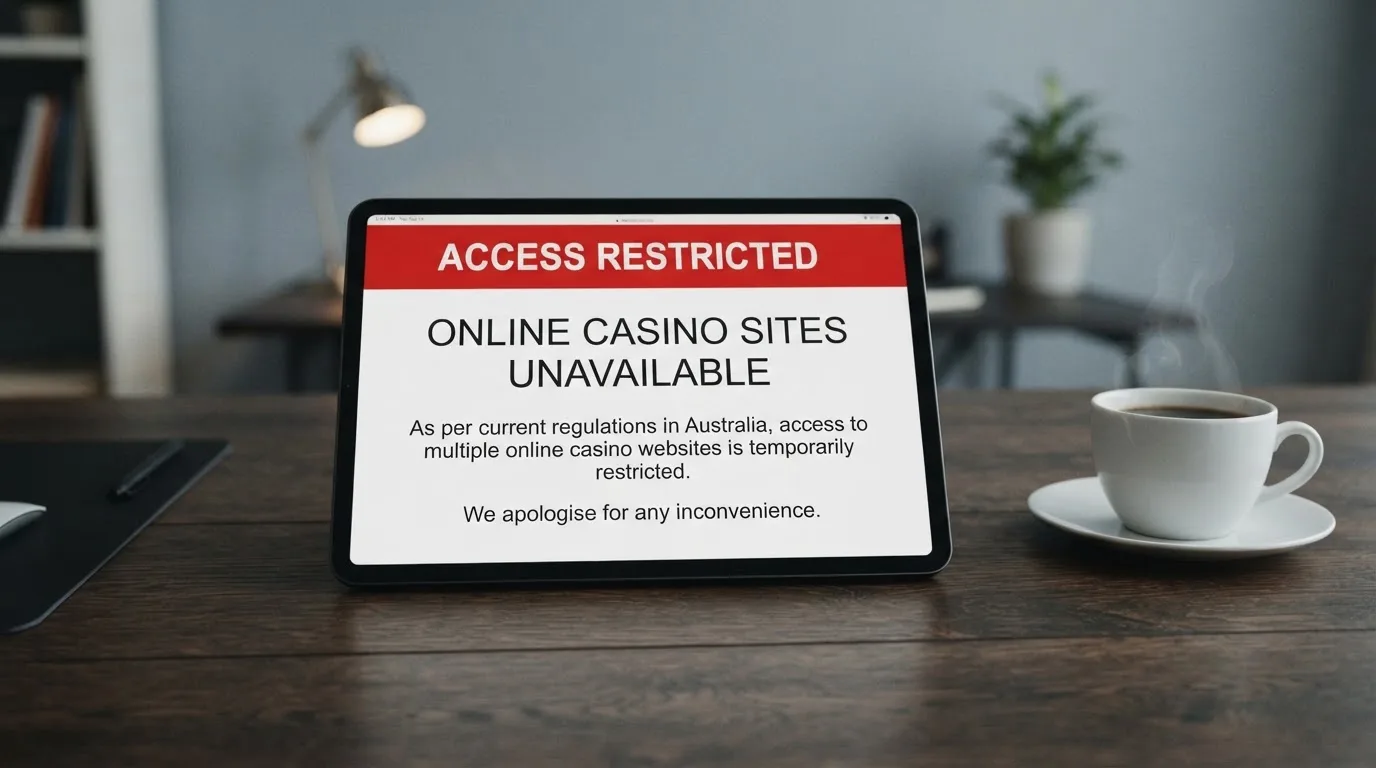
Enforcement falls to the ACMA. The regulator investigates complaints, issues formal warnings to operators, and can direct Australian internet service providers to block illegal sites. As of June 2026 the ACMA had asked ISPs to block 1,751 illegal gambling and affiliate marketing websites since the first blocking request in November 2019, and more than 230 unlicensed services had left the Australian market since 2017. That number has kept climbing because offshore operators re-enter under new names faster than the regulator can chase them down. In a single round reported on 26 June 2026, twelve more sites went onto the blocking list: 7Signs, ChromaBet, Donbet, Duospin, Freshbet, Slots Gem, Jacks Club, Lucky Start, Pointsbetz, Spinrise, Vinyl Casino and Wildsino.
What the IGA does not do is prosecute the Australian player. The offence sits with the provider. But “the player is not the target” is not the same as “the player is protected”. An offshore site gives no Australian consumer protection: no complaints body, no local dispute resolution, no recourse if a withdrawal is refused or a balance disappears after a blocking order. The site can be blocked with the player’s money still sitting on it.
There is one more recent shift worth noting. The Interactive Gambling Amendment (Gambling Reform) Bill 2026 passed Parliament on 19 August 2026, and its advertising and inducement measures commence on 1 January 2027. The bill is law, not yet in force. The newest-casino marketing Australians see in the remainder of 2026 is running under the rules that applied before this reform.
Responsible play, and the boundaries of Australian protection
Help is available, and it is worth naming what it covers and what it does not. The National Gambling Helpline (1800 858 858) is free and operates 24/7, with chat support through Gambling Help Online. BetStop, the National Self-Exclusion Register, has been live since August 2023 and lets a person exclude themselves from every Australian-licensed online and phone wagering service at once. BetStop only binds Australian-licensed operators. An offshore casino is not connected to it, and a BetStop registration does not by itself stop a person being able to deposit at an offshore site.
This is the part where responsible-play material and the rest of this page meet. A player using BetStop is making a serious decision to stop. The same player can still find a “newest online casino no-deposit bonus” landing page in their search results on the same day, deposit by PayID or by Visa debit, and lose money at a site the ACMA is in the process of blocking. The tools exist; the offshore market is not plugged into them.
That asymmetry is what this page exists to make plain. The newest-casino marketing targets Australians specifically because Australians are a large English-language market sitting next to legal wagering on races and sport. The prohibition is a real one, and the offshore operators are not offering a parallel legal service. They are offering a parallel illegal one.
The payment routes these sites list — and what sits behind them
Newest-casino marketing pages tend to show a long list of payment methods as evidence that the site is “modern” and “local-friendly”. The list is partly true and partly a distraction. Each of the methods Australians see on those pages has a specific Australian angle that is worth knowing.
PayID and Osko. PayID is the address book on the New Payments Platform — a phone number, email or ABN that maps to a bank account. Osko is the instant-transfer layer on top of it. With Osko, a bank transfer between participating Australian banks arrives in under a minute, 24/7, weekends included, whether it is addressed to a BSB and account number or to a PayID. Over 100 Australian financial institutions offer PayID-based instant transfers, and more than 25 million PayIDs had been registered on the platform as of April 2025. Paying to a PayID shows the name of the account holder before the transfer goes out, and Australian Payments Plus warns that being asked to transfer to a PayID on an illegal gambling site almost certainly means a scam site. The technology is genuinely fast. Whether the recipient is a legitimate business is a separate question.
BPAY. BPAY has been in Australian online banking since 1997, is offered through more than 140 banks and financial institutions, and is used by over 95,000 billers. It is a bill-payment service: the payer enters the Biller Code and Customer Reference Number printed on the bill, and the funds move through the bank-to-bank system rather than through card networks. BPAY is now run by Australian Payments Plus, the same operator that runs PayID and Osko. BPAY is not a deposit method a casino can offer in real time; it is built for scheduled bill payment.
Debit cards. Visa debit and Mastercard debit are the routes most newest-casino pages list first. They are also the routes that licensed Australian wagering operators use, and the IGA credit-card ban that came into force on 11 June 2024 (penalties of up to A$247,500 for operators) does not extend to debit cards. What does extend to debit is the gambling block the banks themselves have rolled out. Westpac’s gambling block works at the card level and refuses authorisation of transactions registered under the merchant category code “Betting/Casino Gambling” on eligible personal credit and debit cards. Commonwealth Bank offers a similar gambling lock through its app. ANZ’s gambling transaction block, once turned on in the ANZ app, also blocks gambling transactions made through a digital wallet like Apple Pay on the eligible card; turning the block off again requires a 48-hour waiting period, and the bank warns that not all gambling transactions will be blocked and some non-gambling transactions might be blocked in error. The block is a control the bank applies; it does not depend on the casino being legal.
Apple Pay and the other wallets. Apple Pay does not charge consumers a fee to use in stores, online or in apps — any surcharge is the merchant’s own card-processing fee, not Apple’s. Apple Pay transaction limits and PIN requirements are set by the card issuer or the merchant, not by Apple itself. By the end of 2025, Apple Pay, Google Pay and Samsung Pay transactions collectively made up about 45 per cent of all card payments in Australia by number. The credit-card ban on licensed wagering, and ANZ’s card-level gambling block, both extend to a digital wallet on an eligible card; the wallet is a way of presenting the card, not a way of bypassing the rule on it.
American Express. Amex has been a card issuer since launching its first charge card on 1 October 1958 and, unlike Visa or Mastercard’s four-party network, traditionally issues cards and processes transactions itself as a three-party scheme. The Reserve Bank’s July 2025 review of merchant card payment costs proposed removing surcharges only on eftpos, Mastercard and Visa transactions, and explicitly left American Express outside the scope of the proposed surcharge ban. Amex is therefore the one card network most likely to keep charging a merchant surcharge, and an Australian depositing with an Amex card on any site — licensed or offshore — pays whatever the merchant’s Amex rate is on top.
AUSTRAC thresholds. AUSTRAC’s threshold-transaction-report rule, which requires reporting of transfers of A$10,000 or more, applies to physical cash only. Ordinary electronic bank transfers are not subject to that per-transaction reporting rule, regardless of the amount. Bank transfers and PayID transfers to an offshore casino do not trip the threshold report on their own.
The credit-card and crypto line. Since 11 June 2024, licensed Australian wagering operators cannot accept credit cards, credit-related products or digital currency as payment. The credit-card ban is on licensed wagering, not on offshore casinos. A newest-casino site asking for an Australian credit card or a crypto deposit is not breaking the Australian credit-card rule (the rule does not apply to it). It is, instead, evidence the site is not the licensed-wagering product the rule was written for.
What changes first when a casino site is brand new
A genuinely new offshore casino tends to lead with two things, in this order: bonus terms and a game library. The bonus terms come first because that is what the affiliate pages and the launch press are built around. A “no-deposit bonus” — the term in another shape — is usually a small cash credit or a fixed number of free spins granted on signup, sometimes after an email or phone verification, sometimes not. The wagering requirement, the maximum cashout, the games it applies to, and the country restrictions sit in the terms page rather than the landing page, and they are usually heavier than the landing page implies. A no-deposit bonus is rarely a free gift; it is a free trial, with the trial conditions set by the house.
The game library tends to follow a week or two after launch. The same providers (Realtime Gaming, or RTG, on the pages that describe themselves as “newest RTG casinos”; Pragmatic Play, Betsoft, and a handful of live-dealer studios on the others) plug into the platform via standard aggregator integrations, and the brand can stand up a several-hundred-title lobby within days of going live. The titles themselves — “newest online pokies australia”, “newest online slots”, “newest slot games” — are usually a mix of provider releases from the past year and rebrands of older games that the new operator has acquired the rights to. A “newest” pokie and an older one with a new wrapper is a common pattern.
The player-protection features do not come first. Self-exclusion, deposit limits and session-time reminders are usually switched on once the operator is ready for a regulated market; in the first weeks of an offshore launch aimed at Australia, they are often missing or set to defaults the operator can change later. A player who values those controls is better served by an Australian-licensed wagering operator than by a brand-new offshore site, regardless of the welcome offer.
A record of ACMA formal warnings, brand by brand
The ACMA publishes formal warnings when it has reasonable grounds to believe an offshore operator has been providing prohibited interactive gambling services to Australians. Each of the brands below has been the subject of at least one such warning, with the operator name and the date as the ACMA itself recorded it. The table is a record, not a recommendation.
| Brand | ACMA action and date | Operator named by the ACMA |
|---|---|---|
| RocketPlay | Formal warning, March 2026; earlier formal warning to Dama N.V. covering Rocketplay among others, May 2022 | Pulsup Ltd (March 2026); Dama N.V. (May 2022) |
| Level Up Casino | Formal warning, May 2022 | Dama N.V. |
| Woo Casino | Formal warning, March 2025 | Dama N.V. |
| Spirit Casino | Formal warning, May 2025 | Dama N.V. |
| National Casino | Formal warning, July 2025 | Consolutetish S.R.L. |
| Bizzo Casino | Formal warning, July 2025; earlier formal warning to TechSolutions, 2022 | Consolutetish S.R.L. (July 2025); TechSolutions (CY) Group Limited and TechSolutions Group N.V. (2022) |
| Ignition Casino | Formal warning, July 2025 | Bamboo Media |
| Instant Casino | Formal warning, February 2025 | EOD Code SRL |
| Jackbit | Formal warning, April 2026 | Ryker B.V. |
| Casino Intense | Formal warning, April 2025 | Sterplay Holding Ltd |
| Sky Crown | Formal warning, September 2022 | Hollycorn N.V. |
Several of the brands share an operator. Dama N.V. has been named by the ACMA across at least four formal warnings between May 2022 and May 2025 — Level Up Casino, Woo Casino and Spirit Casino among them, plus Rocketplay in its earlier Dama N.V. incarnation. Hollycorn N.V. was named in the Sky Crown and Blue Leo warning. Consolutetish S.R.L. received a single July 2025 warning covering both National Casino and Bizzo Casino; Bizzo Casino had already been the subject of a 2022 formal warning to TechSolutions. The pattern is what “newest” usually means in this market: a corporate group runs several brands at once, the ACMA warns against one or two, and the others keep advertising to Australians until they are warned against as well.
RocketPlay
Rocketplay was the subject of a fresh ACMA formal warning in March 2026, naming Pulsup Ltd as the operator behind Rocketplay. That is the second warning the brand has attracted: Dama N.V. was named over Rocketplay in May 2022, when the ACMA warned against six Dama N.V. brands in a single round (Bambet, Dazard, Level Up, Rocketplay, Wild Tornado and Cobra Casinos). The change of operator on paper, from Dama N.V. to Pulsup Ltd, did not change the legal position for Australians — the IGA applies to whoever is providing the service, regardless of which corporate entity the latest terms page names. The site’s affiliate listings describe a no-deposit free-spins offer and a multi-tier deposit welcome package; the terms behind those offers are the usual offshore combination of a wagering multiple on the bonus, a maximum cashout cap on free-spin winnings, and country restrictions that exclude Australian-licensed jurisdictions. The page leaves the brand to that record: a warned-against operator on two separate occasions, with a fresh warning issued four years after the first.
Level Up Casino
Level Up Casino sits inside the May 2022 Dama N.V. round — one of six brands named together. It has not been the subject of a separate, more recent ACMA action in the public record the ACMA publishes, which is not the same as the brand having left the Australian market. Affiliate listings continue to appear for the brand in searches aimed at Australian players. For an Australian player reading this back, the relevant fact is the 2022 warning, the prohibition on the activity, and the IGA’s silence on the player’s liability but indifference to the player’s protection.
Woo Casino
The ACMA issued a formal warning to Woo Casino in March 2025, again over Dama N.V. The March 2025 warning came nearly three years after the May 2022 round that named Rocketplay and Level Up; it is one of two Dama N.V. brands the ACMA named in 2025, alongside Spirit Casino. The gap between the original Dama N.V. warning and the Woo Casino follow-up is the kind of timeline that an Australian player would do well to keep in mind: a brand can keep marketing to Australians for years after the first warning, and a second warning often arrives only when a regulator runs a fresh sweep.
Spirit Casino
Spirit Casino received an ACMA formal warning in May 2025, again over Dama N.V., three years after the original May 2022 round. The brand sits inside the same operator footprint as Rocketplay, Level Up and Woo Casino. The fact that Dama N.V. has now been named across four separate brands over a three-year span is a more useful piece of information for an Australian reader than the order of the warnings themselves — it tells the reader that “newest” in this market means a different label on the same operation.
National Casino
In July 2025, the ACMA published a formal warning naming National Casino and identifying Consolutetish S.R.L. as the operator. National Casino and Bizzo Casino were named in the same July 2025 warning round. The brand is one of the longer-running “newest casino” properties in the offshore market — National Casino has been advertised to Australian players for years, with regular affiliate-driven no-deposit bonus pushes and a fresh-spin “exclusive” claim that rotates every few weeks. The 2025 warning is what the regulator published; it does not displace the IGA prohibition that applied to the brand from launch.
Bizzo Casino
Bizzo Casino received an ACMA formal warning in July 2025 related to Consolutetish S.R.L., following an earlier formal warning to TechSolutions (CY) Group Limited and TechSolutions Group N.V. in 2022. The two warnings, three years apart, across two different named operators, are a textbook case of a brand surviving a warning under a new operating company. The legal effect for an Australian player is unchanged: the activity remains prohibited, the consumer protection remains absent, and the offshore operator remains outside the ACMA’s reach beyond blocking.
Ignition Casino
Ignition Casino was the subject of an ACMA formal warning in July 2025, naming Bamboo Media as the operator. Ignition has long been one of the more heavily advertised offshore brands in Australian search, particularly through affiliate networks that target “newest RTG casinos” traffic. The July 2025 warning is the first ACMA action the public record carries for the brand.
Instant Casino
Instant Casino received an ACMA formal warning in February 2025 over EOD Code SRL. The brand’s affiliate pages list the usual offshore payment stack — Visa and Mastercard, e-wallets including ecoPayz, plus PayID and bank transfer as the “Australian-friendly” methods. PayID transfers to a recipient on an illegal gambling site are the case Australian Payments Plus specifically warns about: the transfer itself works, but the recipient is almost certainly a scam site.
Jackbit
Jackbit was the subject of an ACMA formal warning in April 2026, naming Ryker B.V. as the operator. The same April 2026 warning also named CasinOK, another Ryker B.V. property — the same two-brands-in-one-warning pattern the ACMA used in July 2025 against National Casino and Bizzo Casino. Jackbit’s marketing leans heavily on cryptocurrency deposits and on the speed of crypto withdrawals; for an Australian reader, the credit-card and crypto bans on licensed wagering that came into force on 11 June 2024 do not apply to Jackbit, because Jackbit is not a licensed wagering operator.
Casino Intense
Casino Intense was the subject of an ACMA formal warning in April 2025, naming Sterplay Holding Ltd as the operator. The brand is among the older offshore properties in this list; the April 2025 warning was the first ACMA action the public record carries for the brand. Casino Intense’s Australian-facing affiliate pages have pushed no-deposit bonus offers for several years; the legal status of those offers under the IGA is unchanged.
Sky Crown
Sky Crown was named in the ACMA’s formal warning to Hollycorn N.V., which the regulator published in September 2022 covering Sky Crown and Blue Leo. Hollycorn N.V. is one of the larger operator groups in the offshore market; the same corporate group ran a portfolio of sister brands aimed at Australian players over the period that followed. The Sky Crown warning is the oldest in this list, and the legal position for an Australian reader has not changed since.
What “newest” actually changes for an Australian looking at a… — More on this topic at casino deposit.
The numbers behind the blocks
The “blocking-rate” calculation asks how fast the ACMA is actually removing access to these sites. The arithmetic on this page uses the ACMA’s own figures: 1,751 illegal gambling and affiliate marketing websites blocked since the first blocking request in November 2019, with 12 of those added in a single round reported on 26 June 2026.
Run as a band. The first blocking request was in November 2019. The total of 1,751 blocked sites as of June 2026 is roughly 80 months of blocking activity. That works out to an average of around 22 blocked sites per month across the whole enforcement period — a long-run average that flatters the early years (when blocks were slow and the operator set was small) and understates the recent rounds (when the ACMA has been issuing multi-site orders more often). In the single round reported on 26 June 2026 alone, the ACMA asked ISPs to block 12 sites in one batch.
Read as a band, the answer is roughly 15 to 30 sites per month over the lifetime of the blocking regime, with the upper end of that range reflecting the recent pace rather than the average. The reader-facing point is that the blocking regime is doing real work, and the ACMA is the source to trust on what it has done — not the “newest casino” pages that frame the same enforcement activity as something happening to a competitor rather than to them.
Reading a “newest” offer once you have read this far
A “newest online casino no deposit bonus” landing page is built to convert, and the conversion is the deposit. The no-deposit part of the offer is the hook: a few free spins or a small cash credit, with the wagering requirement and the maximum cashout written into the terms rather than the headline. Once the wagering requirement is met, the next step is a real-money deposit, with a welcome package and a reload schedule attached. The whole funnel assumes the player does not stop to ask what the operator’s legal position is, or whether the offer is enforceable against an Australian player when the offshore operator decides to keep the winnings.
Two practical points close this section out. First, the ACMA’s blocking regime is a moving target for the player as well as for the operator. A site that is reachable today can be on a block list next month, and any balance on it at that point is, for practical purposes, gone. Second, the operator’s “Australian-friendly” payment list — PayID, Visa debit, Osko — is built to make the deposit feel routine. The deposit is routine; the destination is not.
The Australian-licensed alternative is wagering on races and sport, lotteries and keno, all of which can be accessed through providers the Northern Territory Racing and Wagering Commission regulates and which fall inside BetStop, the gambling blocks the banks now offer, and the Australian consumer protection framework. A punter who wants none of that framework has chosen to give it up; a punter who wants it has chosen not to be on this page.
FAQ
What usually changes first when a casino site is brand new — its bonus terms or its game library?
The bonus terms come first. The no-deposit offer and the welcome package are what the launch press and the affiliate pages are built around; the game library plugs in over the following days via standard aggregator integrations with the same providers every other new site uses.
Do the newest online pokies and slot titles advertised on these sites actually differ from older ones?
Often the titles are provider releases from the past year, but a meaningful share are older games relabelled or rewrapped for the new operator’s lobby. A “newest” pokie and an older pokie in a new wrapper is a common pattern, and the only way to tell them apart is to check the provider and the release date on the studio’s own site rather than the casino’s.
Is a newest-online-casino no-deposit bonus claim from an offshore site enforceable for an Australian player?
No. The Interactive Gambling Act 2001 makes it an offence to provide the service in the first place; the contract sits outside Australian law, and there is no Australian complaints body the player can take an offshore operator to. If the operator refuses a withdrawal, the player has no recourse.
How can someone tell a genuinely new casino site from a reskin of an older, already-warned one?
The honest signal is the operator name on the ACMA register, not the brand on the landing page. Several of the brands named in the formal warnings table above share an operator across multiple “newest” labels — Dama N.V. across four, Consolutetish S.R.L. across two, Ryker B.V. across two. A new brand from a corporate group that has already been warned against is the most common shape the “newest” market takes.
Why do newest RTG casino pages and newest online slot pages so often overlap on the same domains?
Because these pages are run by third-party marketing groups, not by the operators, and the groups list every brand in their portfolio across every search term that pulls traffic. Realtime Gaming, Betsoft and Pragmatic Play supply most of the games on the offshore platforms that target Australians, and a single affiliate domain can list dozens of brands under the “newest RTG casinos”, “newest online slots” and “newest online pokies australia” headings at once.
What should change in how cautious someone is, simply because a casino site is new rather than established?
More, not less. A new site has had less time to be warned against, and the responsible-play controls are usually switched on only after launch. The ACMA’s blocking regime is a moving target: a site reachable this month can be on a block list next month, with any balance on it effectively lost. The risk of a refusal to pay out, and the absence of any Australian complaints body to escalate that refusal to, is the same on a new site as on an established one.